A black body is heated from ${27^o}C$ to ${127^o}C$. The ratio of their energies of radiations emitted will be
AIIMS 2001, Medium
Download our app for free and get started
(d) $\frac{{{Q_1}}}{{{Q_2}}} = \frac{{T_1^4}}{{T_2^4}} = {\left( {\frac{{273 + 27}}{{273 + 127}}} \right)^4} = {\left( {\frac{{300}}{{400}}} \right)^4} = \frac{{81}}{{256}}$

Download our appand get started for free
Experience the future of education. Simply download our apps or reach out to us for more information. Let's shape the future of learning together!No signup needed.*
Similar Questions
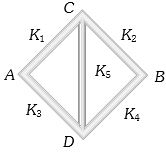
- 1Five rods of same dimensions are arranged as shown in the figure. They have thermal conductivities $K1, K2, K3, K4$ and $K5$ . When points $A$ and $B$ are maintained at different temperatures, no heat flows through the central rod ifView Solution
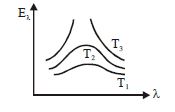
- 2View SolutionVariation of radiant energy emitted by sun, filament of tungsten lamp and welding arc as a function of its wavelength is shown in figure. Which of the following option is the correct match?
- 3A body cools from $60\,^oC$ to $50\,^oC$ in $10\,minutes$ . If the room temperature is $25\,^oC$ and assuming Newton's law of cooling to hold good, the temperature of the body at the end of the next $10\,minutes$ will be ......... $^oC$View Solution
- 4View SolutionSnow is more heat insulating than ice, because
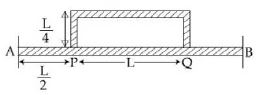
- 5Temperature difference of $120\,^oC$ is maintained between two ends of a uniform rod $AB$ of length $2L$. Another bent rod $PQ$, of same cross-section as $AB$ and length $\frac{{3L}}{2}$, is connected across $AB$ (See figure). In steady state, temperature difference between $P$ and $Q$ will be close to .......... $^oC$View Solution
- 6The ends $\mathrm{Q}$ and $\mathrm{R}$ of two thin wires, $\mathrm{PQ}$ and $RS$, are soldered (joined) togetker. Initially each of the wires has a length of $1 \mathrm{~m}$ at $10^{\circ} \mathrm{C}$. Now the end $\mathrm{P}$ is maintained at $10^{\circ} \mathrm{C}$, while the end $\mathrm{S}$ is heated and maintained at $400^{\circ} \mathrm{C}$. The system is thermally insulated from its surroundings. If the thermal conductivity of wire $\mathrm{PQ}$ is twice that of the wire $RS$ and the coefficient of linear thermal expansion of $P Q$ is $1.2 \times 10^{-5} \mathrm{~K}^{-1}$, the change in length of the wire $\mathrm{PQ}$ isView Solution
- 7An object is cooled from $75°C$ to $65°C$ in $2$ minutes in a room at $30°C$ . The time taken to cool another object from $55°C$ to $45°C$ in the same room in minutes isView Solution
- 8A constant potential difference is applied to the ends of a graphite rod, whose resistance decreases with a rise of temperature. The rod can be $(1)$ covered with asbestos or $(2)$ left open to atmosphere. Answer for steady state.View Solution
- 9An incandescent bulb has a thin filament of tungsten that is heated to high temperature by passing an electric current. The hot filament emits black-body radiation. The filament is observed to break up at random locations after a sufficiently long time of operation due to non-uniform evaporation of tungsten from the filament. If the bulb is powered at constant voltage, which of the following statement($s$) is(are) true?View Solution
($A$) The temperature distribution over the filament is uniform
($B$) The resistance over small sections of the filament decreases with time
($C$) The filament emits more light at higher band of frequencies before it breaks up
($D$) The filament consumes less electrical power towards the end of the life of the bulb
- 10The 'Kangri' is an earthen pot used to stay warm in Kashmir during the winter months. Assume that the 'Kangri' is spherical and of surface area $7 \times 10^{-2} \,m ^{2}$. It contains $300 g$ of a mixture of coal, wood and leaves with calorific value of $30 \,kJ / g$ (and provides heat with $10 \%$ efficiency). The surface temperature of the 'Kangri' is $60^{\circ} C$ and the room temperature is $0^{\circ} C$. Then, a reasonable estimate for the duration $t$ (in h) that the 'Kangri' heat will last is (take the 'Kangri' to be a black body)View Solution