Question
A hydraulic automobile lift is designed to lift cars with a maximum mass of $3000kg$. The area of cross-section of the piston carrying the load is $425cm^2$. What maximum pressure would the smaller piston have to bear?

Answer

The maximum mass of a car that can be lifted, $m=3000 \mathrm{~kg}$. Area of cross-section of the load-carrying piston, $\mathrm{A}=$ $425 \mathrm{~cm}^2=425 \times 10^4 \mathrm{~m}^2$ The maximum force exerted by the load, $\mathrm{F}=\mathrm{mg}=3000 \times 9.8=29400 \mathrm{~N}$ The maximum pressure exerted on the load-carrying piston, $\mathrm{P}=\mathrm{F} / \mathrm{A} \frac{29400}{(425 \times 10-4)}=6.917 \times 10^5 \mathrm{~Pa}$ Pressure is transmitted equally in all directions in a liquid. Therefore, the maximum pressure that the smaller piston would have to bear is $6.917 \times$ $10^5 \mathrm{~Pa}$.

Need a full question paper?

Generate a complete, print-ready paper with questions like this in minutes — across 16+ boards, with answer keys.
Start Generating Free

Similar questions

A sphere of mass $20kg$ is suspended by a metal wire of unstretched length $4m$ and diameter $1mm$. When in equilibrium, there is a clear gap of $2mm$ between the sphere and the floor. The sphere is gently pushed aside so that the wire makes an angle $\theta$ with the vertical and is released. Find the maximum value of $\theta$ so that the sphere does not rub the floor. Young's modulus of the metal of the wire is $2.0 \times 10^{11}N/m^2$. Make appropriate approximations.
A metallic sphere of radius $1.0 \times 10^{-3} m$ and density $1.0 \times 10^4 kg m ^{-3}$ enters a tank of water, after a free fall through a distance of $h$ in the earth's gravitational field. If its velocity remains unchanged after entering water, determine the value of $h$. Given coefficient of viscosity of water $=1.0 \times 10^{-3} Nsm ^{-2}, g=10 ms^{-2}$ and density of water $=1.0 \times 10^3 kgm ^{-3}$.
Two ideal monoatomic gases A and B at 27°C and 37°C are mixed. The number of moles in gas A are 2 and number of moles in gas B are 3. What will be the temperature of the mixture?
A vessel containing one mole of a monatomic ideal gas (molecular weight $=20 \mathrm{gmol}^{-1}$ ) is moving on a floor at a speed of $50 \mathrm{~ms}^{-1}$. The vessel is stopped suddenly. Assuming that the mechanical energy lost has gone into the internal energy of the gas, find the rise in its temperature.
The electric field associated with a monochromatic beam becomes zero $1.2 \times 10^{15}$ times per second. Find the maximum kinetic energy of the photoelectrons when this light falls on a metal surface whose work function is 2.0eV.
The length of a rod is exactly $1m$ when measured at rest. What will be its length when it moves at a speed of:
a. $3 \times 10^5 \mathrm{~m} / \mathrm{s}$.
b. $3 \times 10^6 \mathrm{~m} / \mathrm{s}$.
c. $3 \times 10^7 \mathrm{~m} / \mathrm{s}$.
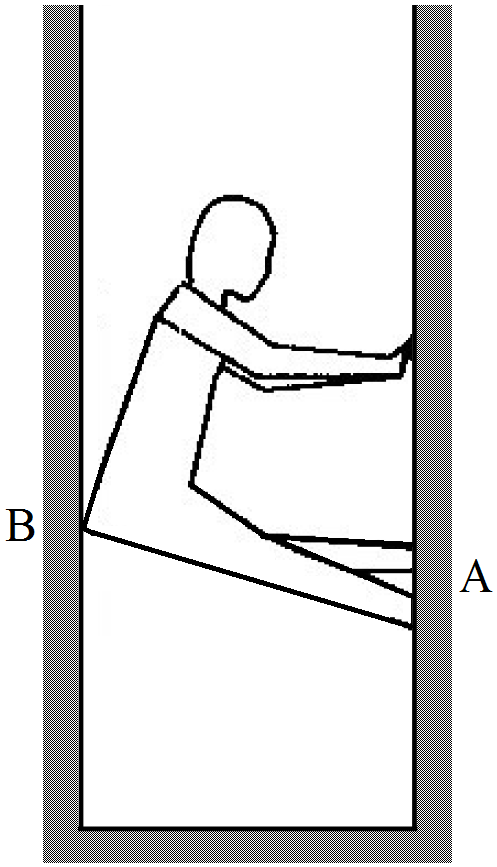
A person $(40\ kg)$ is managing to be at rest between two vertical walls by pressing one wall $A$ by his hands and feet and the other wall $B$ by his back. Assume that the friction coefficient between his body and the walls is $0.8$ and that limiting friction acts at all the contacts.
  1. Show that the person pushes the two walls with equal force.
  2. Find the normal force exerted by either wall on the person. Take $g = 10m/s^2$.
Draw energy distribution curves for a black body at two different temperatures $T_1$ and $T_2$ where $(T_1 > T_2)$. Write any two conclusions that can be drawn from these curves.
The diameter of the sun is $1.4 \times 10^9m$ and its distance from the earth is $1.5 \times 10^{11}m$. Find the radius of the image of the sun formed by a lens of focal length $20cm$.
Given a + b + c + d = 0, which of the following statements are correct: a, b, c, and d must each be a null vector.