Question
A hydrogen atom contains one proton and one electron. It may be assumed that the electron revolves in a circle of radius $0.53$ angstrom (1 angstrom = $10^{-10}m$ and is abbreviated as A) with the proton at the centre. The hydrogen atom is said to be in the ground state in this case. Find the magnitude of the electric force between the proton and the electron of a hydrogen atom in its ground state.
Answer

$\text{R}=0.53\text{A}^\circ=0.53\times10^{-10}\text{m}$$\text{F}=\frac{\text{Kq}_1\text{q}_2}{\text{r}^2}$
$=\frac{9\times10^9\times1.6\times1.6\times10^{-38}}{0.53\times0.53\times10^{-10}\times10^{-10}}$
$=82.02\times10^{-9}\text{N}$

Need a full question paper?

Generate a complete, print-ready paper with questions like this in minutes — across 16+ boards, with answer keys.

Start Generating Free

Similar questions

The maximum stress that can be applied to the material of a wire used to suspend on elevator is $1.3 \times 10^8Nm^{-2}$. If the mass of the elevator is $900kg$ and it moves up with an acceleration of $2.2ms^{-2}$, then what is the minimum diameter of the wire?
Explain why Surface tension of a liquid is independent of the area of the surface.
In a Callender's compensated constant pressure air thermometer, the volume of the bulb is 1800 cc. When the bulb is kept immersed in a vessel, 200 cc of mercury has to be poured out. Calculate the temperature of the vessel.
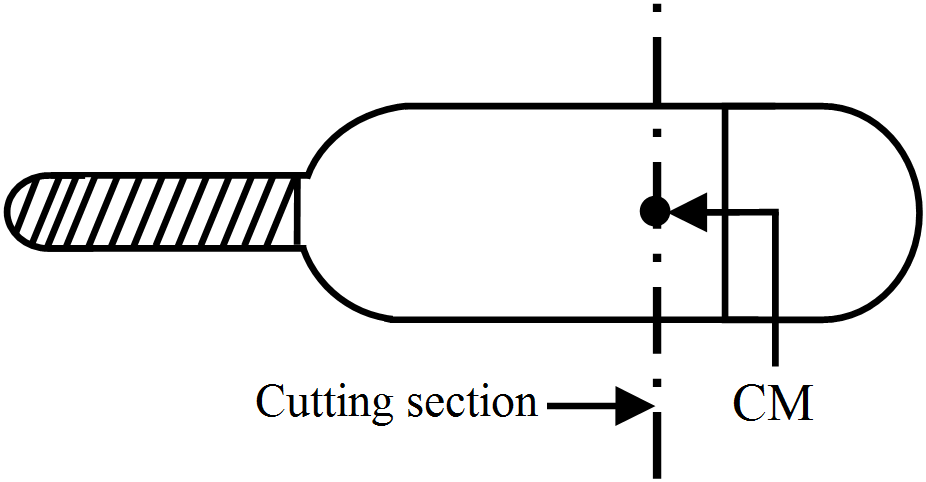
A cricket bat is cut through its centre of mass into two parts as shown Then, state whether both parts are of same mass or not. Also, give reason.
A small disc is set rolling with a speed v on the horizontal part of the track of the previous problem from right to left. To what height will it climb up the curved part?
A high jumper successfully clears the bar. Is it possible that his centre of mass crossed the bar from below it? Try it with appropriate figures.
Which of the following processes is reversible and which is irreversible?
(i) Isothermal expansion of gas
(ii) Isothermal compression of gas
(iii) Heat flow due to friction
(iv) Heating of resistance by electric current
(v) Flow of heat from hot to cold object
(vi) Carnot engine
(vii)Burst of bicycle tube
(viii) Diffusion of gas
(ix) Slowly strectching or compressing the spring
(x) Exchange of heat between two objects at the same temperature
When a ball is thrown upward, its momentum first decreases and then increases. Does this violate the principle of conservation of momentum?
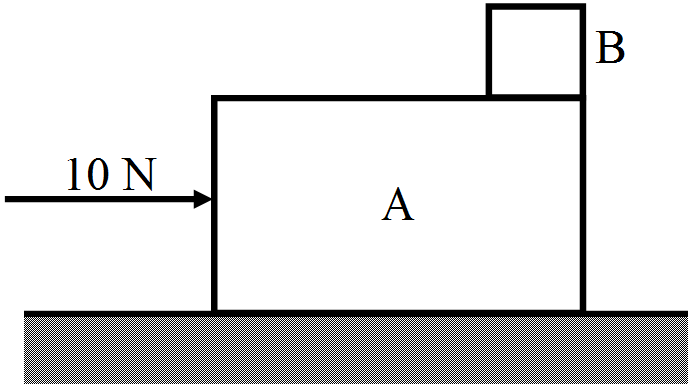
A small block B is placed on another block A of mass 5kg and length 20cm. Initially the block B is near the right end of block A. A constant horizontal force of 10N is applied to the block A. All the surfaces are assumed frictionless. Find the time elapsed before the block B separates from A.
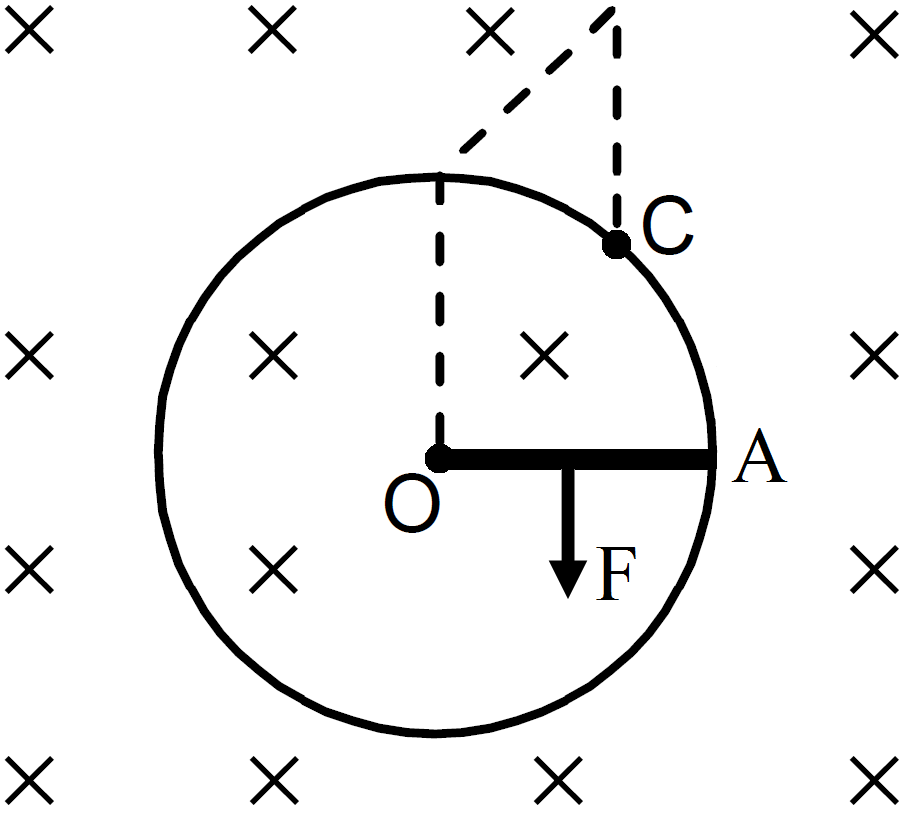
Figure shows a conducting circular loop of radius a placed in a uniform, perpendicular magnetic field B. A thick metal rod OA is pivoted at the centre O. The other end of the rod touches the loop at A. The centre O and a fixed point C on the loop are connected by a wire OC of resistance R. A force is applied at the middle point of the rod OA perpendicularly, so that the rod rotates clockwise at a uniform angular velocity $\omega.$ Find the force.