Question
When a ball is thrown upward, its momentum first decreases and then increases. Does this violate the principle of conservation of momentum?

Answer

No, because the momentum of the system (ball and air molecules) always remains constant. When the momentum of the ball decreases, the momentum of air particles increases, and when the momentum of the ball increases, the momentum of the air particles decreases.

Need a full question paper?

Generate a complete, print-ready paper with questions like this in minutes — across 16+ boards, with answer keys.
Start Generating Free

Similar questions

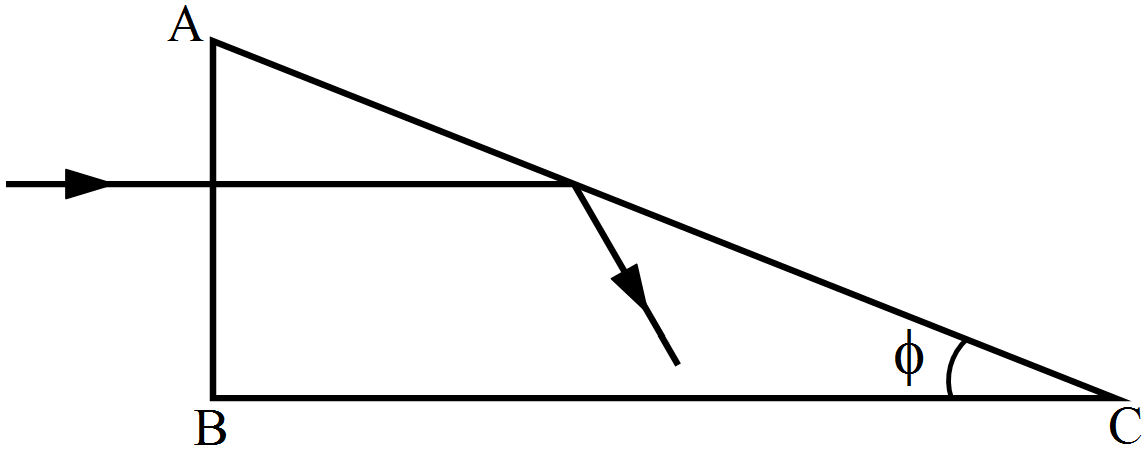
A light ray is incident normally on the face AB of a right-angled prism ABC $(\mu=1.50)$ as shown in figure. What is the largest angle $\phi$ for which the light ray is totally reflected at the surface AC?
A boy is standing on a platform which is free to rotate about its axis. The boy holds an open umbrella in his hand. The axis of the umbrella coincides with that of the platform. The moment of inertia of ''the platform plus the boy system'' is $3.0 \times 10^{-3}kg-m^2$ and that of the umbrella is $2.0 \times 10^3kg-m^2$. The boy starts spinning the umbrella about the axis at an angular speed of 2.0rev/s with respect to himself. Find the angular velocity imparted to the platform.
A positive charge q is placed in front of a conducting solid cube at a distance d from its centre. Find the electric field at the centre of the cube due to the charges appearing on its surface.
Explain why: Heating systems based on circulation of steam are more efficient in warming a building than those based on circulation of hot water.
In a car lift compressed air exerts a force $F$ on a small piston having a radius of $5.0 \ cm$. This pressure is transmitted to a second piston of radius $15 \ cm ($Fig $9.7).$ If the mass of the car to be lifted is $1350 \ kg$, calculate $F_1$. What is the pressure necessary to accomplish this task? $\left(g=9.8\ ms ^2\right)$
With the help of examples differentiate between free oscillations and forced oscillations.
The charge on a proton is $+1.6 \times 10^{-19} \mathrm{C}$ and that on an electron is $-1.6 \times 10^{-19} \mathrm{C}$. Does it mean that the electron has a charge $3.2 \times 10^{-19} \mathrm{C}$ less than the charge of a proton?
State Bernoulli's Theorem.
A body has a sense of weightlessness in a satellite revolving around the earth, why?
The electric current in a discharging $R-C$ circuit is given by $\text{i}=\text{i}_0\text{e}^{-\frac{\text{t}}{\text{RC}}}$ where $i_0, R$ and $C$ are constant parameters and $t$ is time. Let $\text{i}_0=2.00\text{A},\text{R}=600\times10^5\Omega$ and $\text{C}=0.500\mu\text{F}.$
  1. Find the current at $t = 0.3s.$
  2. Find the rate of change of current at $t = 0.3s.$
  3. Find approximately the current at $t = 0.31s.$