Question
A hydrogen atom moving at speed $υ$ collides with another hydrogen atom kept at rest. Find the minimum value of $υ$ for which one of the atoms may get ionized. The mass of a hydrogen atom $= 1.67 \times 10^{-27}kg.$

Answer

The hydrogen atoms after collision move with speeds $v_1$ and $v_2$​​​​​​​
$\text{mv}=\text{mv}_1+\text{mv}_2\ ....(\text{i})$
$\frac{1}{2}\text{mv}^2=\frac{1}{2}\text{mv}^2_1+\frac{1}{2}\text{mv}^2_2+\Delta\text{E}\ ....(\text{ii})$
From $(i), \text{v}^2=(\text{v}_1+\text{v}_2)^2=\text{v}^2_1+\text{v}^2_2+2\text{v}_1\text{v}_2$
From $ (ii), \text{v}^2=\text{v}^2_1+\text{v}^2_2+\frac{2\Delta\text{E}}{\text{m}}$
$=2\text{v}_1\text{v}_2=\frac{2\Delta\text{E}}{\text{m}}\ ...(\text{iii})$
$(\text{v}_1-\text{v}_2)^2=\big(\text{v}_1+\text{v}_2\big)^2-4\text{v}_1\text{v}_2$
$(\text{v}_1-\text{v}_2)=\text{v}^2-\frac{4\Delta\text{E}}{\text{m}}$
For minimum value of $‘v\ ’$
$\text{v}_1=\text{v}_2$
$\text{v}^2-\Big(\frac{4\Delta\text{E}}{\text{m}}\Big)=0$
$\text{v}^2=\frac{4\Delta\text{E}}{\text{m}}=\frac{4\times13.6\times1.6\times10^{-19}}{1.67\times10^{-27}}$
$\text{v}=\sqrt{\frac{4\times13.6\times1.6\times10^{-19}}{1.67\times10^{-27}}}=7.2\times10^4\text{m/s}$

Need a full question paper?

Generate a complete, print-ready paper with questions like this in minutes — across 16+ boards, with answer keys.
Start Generating Free

Similar questions

  1. State Huygen’s principle. Using this principle draw a diagram to show how a plane wave front incident at the interface of the two media gets refracted when it propagates from a rarer to a denser medium. Hence verifiy Snell’s law of refraction.
  2. When monochromatic light travels from a rarer to a denser medium, explain the following, giving reasons:
    1. Is the frequency of reflected and refracted light same as the frequency of incident light?
    2. Does the decrease in speed imply a reduction in the energy carried by light wave?
What is the difference between cathode rays and beta rays? When the two are travelling in space, can you make out which is the cathode ray and which is the beta ray?
A rectangular loop of sides $25\ cm$ and $10\ cm$ carrying a current of $15A$ is placed with its longer side parallel to a long straight conductor $2.0\ cm$ apart carrying a current of $25A ($fig$)$. What is the net force on the loop?
A long solenoid $'S \ '$ has $'n\ '$ turns per meter, with diameter $'a\ '$. At the centre of this coil we place a smaller coil of $'N\ '$ turns and diameter $'b\ ' ($where $b < a)$. If the current in the solenoid increases linearly, with time, what is the induced emf appearing in the smaller coil. Plot graph showing nature of variation in emf, if current varies as a function of $mt^2 +C$.
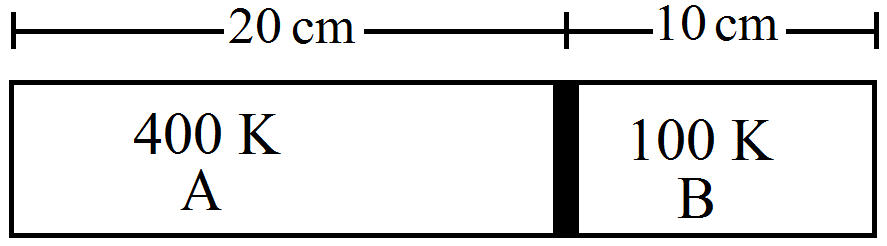
Figure. shows a cylindrical tube of length 30cm which is partitioned by a tight-fitting separator. The separator is very weakly conducting and can freely slide along the tube. Ideal gases are filled in the two parts of the vessel. In the beginning, the temperatures in the parts A and B are 400K and 100K respectively. The separator slides to a momentary equilibrium position shown in the figure. Find the final equilibrium position of the separator, reached after a long time.
A compound microscope consists of an objective lens of focal length $2.0 \ cm$ and an eyepiece of focal length $6.25 \ cm$ separated by a distance of $15 \ cm$. How far from the objective should an object be placed in order to obtain the final image at
(a) the least distance of distinct vision $(25 \ cm),$ and
(b) at infinity? What is the magnifying power of the microscope in each case?
The left end of a copper rod $($length $= 20\ cm$ area of cross section $= 0.20\ cm)$ is maintained at $20^\circ C$ and the right end is maintained at $80^\circ C.$ Neglecting any loss of heat through radiation, find,
  1. The temperature at a point $11\ cm$ from the left end
  2. The heat current through the rod. Thermal conductivity of copper $=385\text{Wm}^{-1}{^{\circ}}\text{C}^{-1}.$
Two conductors are made of the same material and have the same length. Conductor $A$ is a solid wire of diameter $1\ mm.$ Conductor $B$ is a hollow tube of outer diameter $2\ mm$ and inner diameter $1\ mm.$ Find the ratio of resistance $R_A$ to $R_B.$
Two identical balls, each having a charge of $2.00 \times 10^{-7}C$ and a mass of $100g$, are suspended from a common point by two insulating strings each $50\ cm$ long. The balls are held at a separation $5.0\ cm$ apart and then released. Find,
  1. The electric force on one of the charged balls.
  2. The components of the resultant force on it along and perpendicular to the string.
  3. The tension in the string.
  4. The acceleration of one of the balls. Answers are to be obtained only for the instant just after the release.
  1. An electron moves along a circle of radius 1m in a perpendicular magnetic field of strength 0.50T. What would be its speed? Is it reasonable?
  2. If a proton moves along a circle of the same radius in the same magnetic field, what would be its speed?