Question
What is the difference between cathode rays and beta rays? When the two are travelling in space, can you make out which is the cathode ray and which is the beta ray?

Answer

Cathode rays consist of electrons that are accelerated using electrodes. They do not carry high energy and do not harm human body. On the other hand, beta rays consist of highly energetic electrons that can even penetrate and damage human cells. Beta rays are produced by the decay of radioactive nuclei. If the two are travelling in space, they can be distinguished by the phenomenon named production of Bremsstrahlung radiation, which is produced by the deceleration of a high energy particle when deflected by another charged particle, leading to the emission of blue light. Only beta rays are capable of producing it.
Need a full question paper?

Generate a complete, print-ready paper with questions like this in minutes — across 16+ boards, with answer keys.

Start Generating Free

Similar questions

An electron is projected horizontally with a kinetic energy of $10keV.$ A magnetic field of strength $1.0 \times 10^{-7}T$ exists in the vertically upward direction.
  1. Will the electron deflect towards the right or left of its motion?
  2. Calculate the sideways deflection of the electron while travelling through $1m$. Make appropriate approximations.
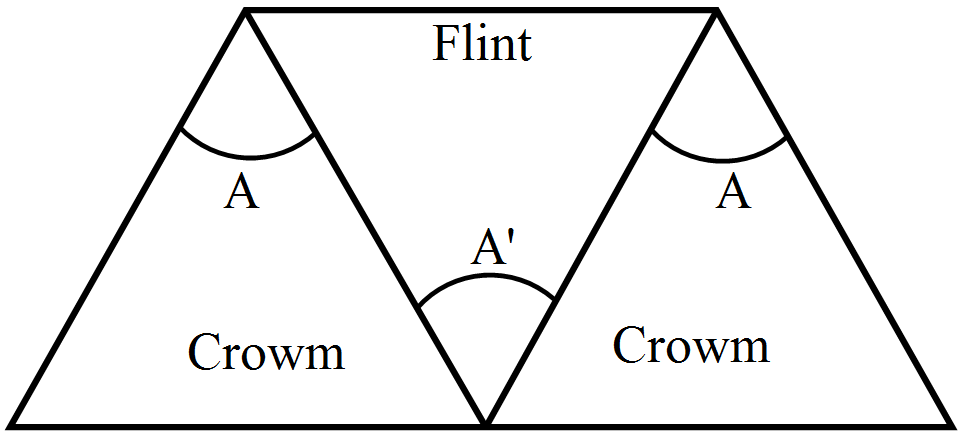
Three thin prisms are combined as shown in figure. The refractive indices of the crown glass for red, yellow and violet rays are $\mu_\text{r},\mu_\text{y}$ and $\mu_\text{v}$ respectively and those for the flint glass are $\mu'_\text{r},\mu'_\text{y}$ and $\mu'_\text{v}$ respectively. Find the ratio $\frac{\text{A}'}{\text{A}}$ for which.
  1. There is no net angular dispersion.
  2. There is no net deviation in the yellow ray.
Find the magnetic field B at the centre of a rectangular loop of length l and width b, carrying a current i.
An object 1.5 cm in size is placed on the side of the convex lens in the arrangement (a) above. The distance between the object and the convex lens is 40 cm. Determine the magnification produced by the two-lens system, and the size of the image.
In an imaginary atmosphere, the air exerts a small force $F$ on any particle in the direction of the particle's motion. A particle of mass $m$ projected upward takes a time $t_1$ in reaching the maximum height and $t_2$ in the return journey to the original point. Then:
$a.$ Derive the expression for the current flowing in an ideal capacitor and its reactance when connected to an ac source of voltage $V = V _{ o } \sin \omega t$.
$b.$ Draw its phasor diagram.
$c.$ If resistance is added in series to capacitor what changes will occur in the current flowing in the circuit and phase angle between voltage and current.
The electric field at a point associated with a light wave is $\text{E}=\big(100\frac{\text{v}}{\text{m}}\big)\sin[(3.0\times10^{15}\text{s}^{-1})\text{t]sin[(6.0}\times10^{15}\text{s}^{-1})\text{t}].$ If this light falls on a metal surface having a work function of $2.0eV,$ what will be the maximum kinetic energy of the photoelectrons?
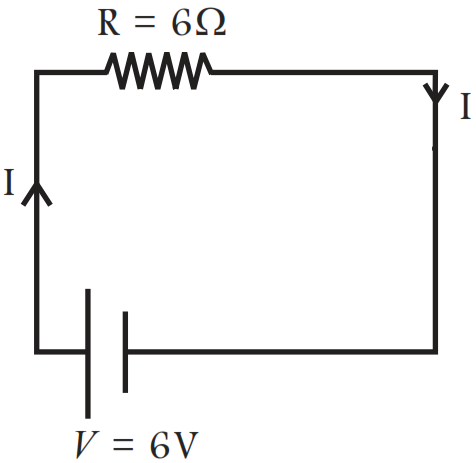
Consider circuit in Fig. How much energy is absorbed by electrons from the initial state of no current $($ignore thermal motion$)$ to the state of drift velocity?
Two convex lenses, each of focal length $10\ cm$, are placed at a separation of $15\ cm$ with their principal axes coinciding,
  1. Show that a light beam coming parallel to the principal axis diverges as it comes out of the lens system.
  2. Find the location of the virtual image formed by the lens system of an object placed far away.
  3. Find the focal length of the equivalent lens.
$($Note that the sign of the focal length is positive although the lens system actually diverges a parallel beam incident on it$).$