Question
A hydrogen atom moving at speed υ collides with another hydrogen atom kept at rest. Find the minimum value of υ for which one of the atoms may get ionized. The mass of a hydrogen atom $= 1.67 \times 10^{-27}kg.$

Answer

The hydrogen atoms after collision move with speeds $v_1$ and $v_2$
$\text{mv}=\text{mv}_1+\text{mv}_2\ ....(\text{i})$
$\frac{1}{2}\text{mv}^2=\frac{1}{2}\text{mv}^2_1+\frac{1}{2}\text{mv}^2_2+\Delta\text{E}\ ....(\text{ii})$
From (i), $\text{v}^2=(\text{v}_1+\text{v}_2)^2=\text{v}^2_1+\text{v}^2_2+2\text{v}_1\text{v}_2$
From (ii), $\text{v}^2=\text{v}^2_1+\text{v}^2_2+\frac{2\Delta\text{E}}{\text{m}}$
$=2\text{v}_1\text{v}_2=\frac{2\Delta\text{E}}{\text{m}}\ ...(\text{iii})$
$(\text{v}_1-\text{v}_2)^2=\big(\text{v}_1+\text{v}_2\big)^2-4\text{v}_1\text{v}_2$
$(\text{v}_1-\text{v}_2)=\text{v}^2-\frac{4\Delta\text{E}}{\text{m}}$
For minimum value of ‘v’
$\text{v}_1=\text{v}_2$
$\text{v}^2-\Big(\frac{4\Delta\text{E}}{\text{m}}\Big)=0$
$\text{v}^2=\frac{4\Delta\text{E}}{\text{m}}=\frac{4\times13.6\times1.6\times10^{-19}}{1.67\times10^{-27}}$
$\text{v}=\sqrt{\frac{4\times13.6\times1.6\times10^{-19}}{1.67\times10^{-27}}}=7.2\times10^4\text{m/s}$

Need a full question paper?

Generate a complete, print-ready paper with questions like this in minutes — across 16+ boards, with answer keys.
Start Generating Free

Similar questions

On the basis of band theory, differentiate between conductors, insulators and conductors.
If the tension in the cable supporting an elevator is equal to the weight of the elevator, the elevator may be:
  1. Going up with increasing speed.
  2. Going down with increasing speed.
  3. Going up with uniform speed.
  4. Going down with uniform speed.
A long straight horizontal cable carries a current of 2.5 A in the direction 10° south of west to 10° north of east. The magnetic meridian of the place happens to be 10° west of the geographic meridian. The earth’s magnetic field at the location is 0.33 G, and the angle of dip is zero. Locate the line of neutral points (ignore the thickness of the cable). (At neutral points, magnetic field due to a current-carrying cable is equal and opposite to the horizontal component of earth’s magnetic field.)
$^{238}U$ decays to $^{206}Pb$ with a half-life of $4.47 \times 10^9y$. This happens in a number of steps. Can you justify a single half for this chain of processes? A sample of rock is found to contain 2.00mg of $^{238}U$ and 0.600mg of $^{206}Pb$. Assuming that all the lead has come from uranium, find the life of the rock.
Two identical balls, each having a charge of $2.00 \times 10^{-7}C$ and a mass of 100g, are suspended from a common point by two insulating strings each 50cm long. The balls are held at a separation 5.0cm apart and then released. Find,
  1. The electric force on one of the charged balls.
  2. The components of the resultant force on it along and perpendicular to the string.
  3. The tension in the string.
  4. The acceleration of one of the balls. Answers are to be obtained only for the instant just after the release.
Consider the situation of the previous problem. A charges of $-2.0 \times 10^{-4}C$ is moved from the point A to the point B. Find the change in electrical potential energy $U_B - U_A$ for the cases (a), (b) and (c).
  1. With the help of a labelled diagram, explain the working of a step-up transformer. Give reasons to explain the following:
  1. The core of the transformer is laminated.
  2. Thick copper wire is used in windings.
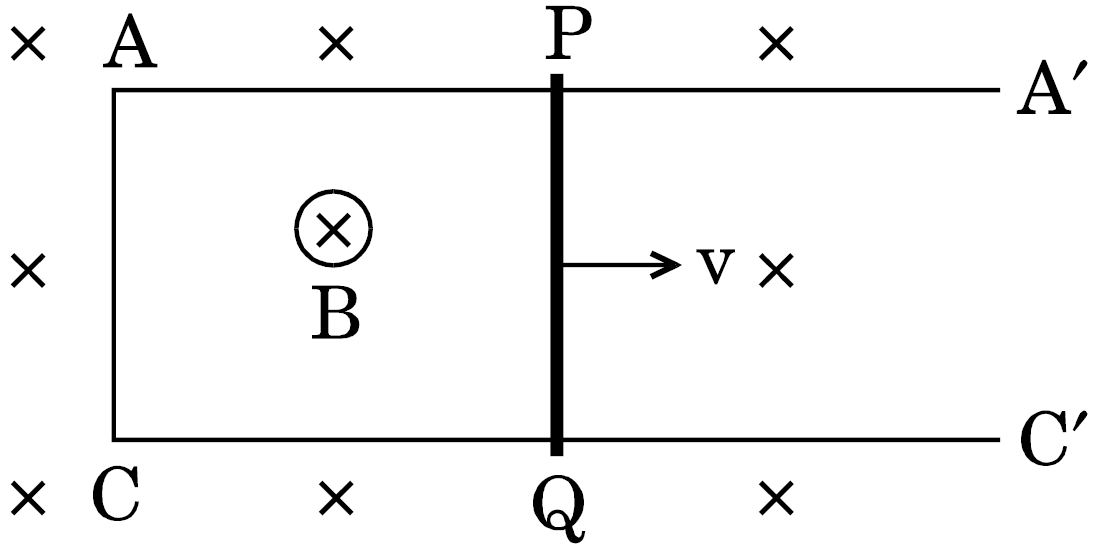
  1. A conducting rod PQ of length 20cm and resistance $0.1\Omega$ rests on two smooth parallel rails of negligible resistance AA' and CC'. It can slide on the rails and the arrangement is positioned between the poles of a permanent magnet producing uniform magnetic field B = 0.4T. The rails, the rod and the magnetic field are in three mutually perpendicular directions as shown in the figure. If the ends A and C of the rails are short circuited,
Find:
  1. External force required to move the rod with uniform velocity v = 10cm/ s,
  2. Power required to do so.
The wavelengths of $\text{K}_\alpha$ and $\text{L}_\alpha$ X-rays of a material are 21.3pm and 141pm respectively. Find the wavelength of $\text{K}_\beta$ X-ray of the material.
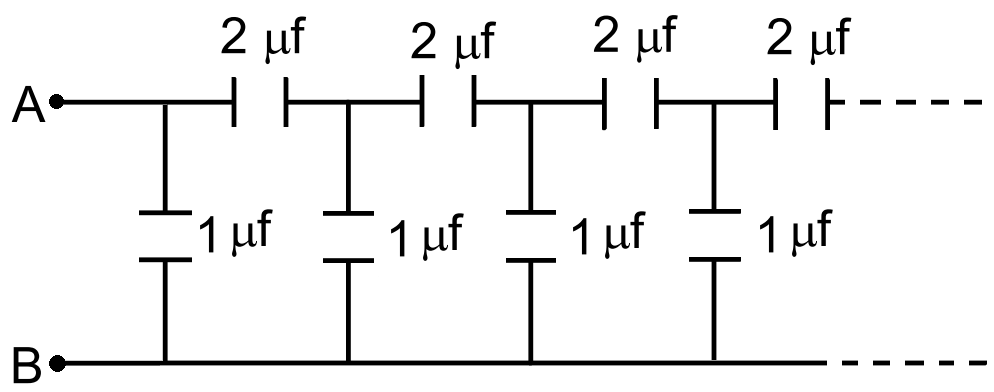
Find the equivalent capacitance of the infinite ladder shown in figure between the points A and B.
A 5mm high pin is placed at a distance of 15cm from a convex lens of focal length 10cm. A second lens of focal length 5cm is placed 40cm from the first lens and 55cm from the pin. Find
  1. The position of the final image.
  2. Its nature.
  3. Its size.