A 5mm high pin is placed at a distance of 15cm from a convex lens of focal length 10cm. A second lens of focal length 5cm is placed 40cm from the first lens and 55cm from the pin. Find
- The position of the final image.
- Its nature.
- Its size.
Download our app for free and get started
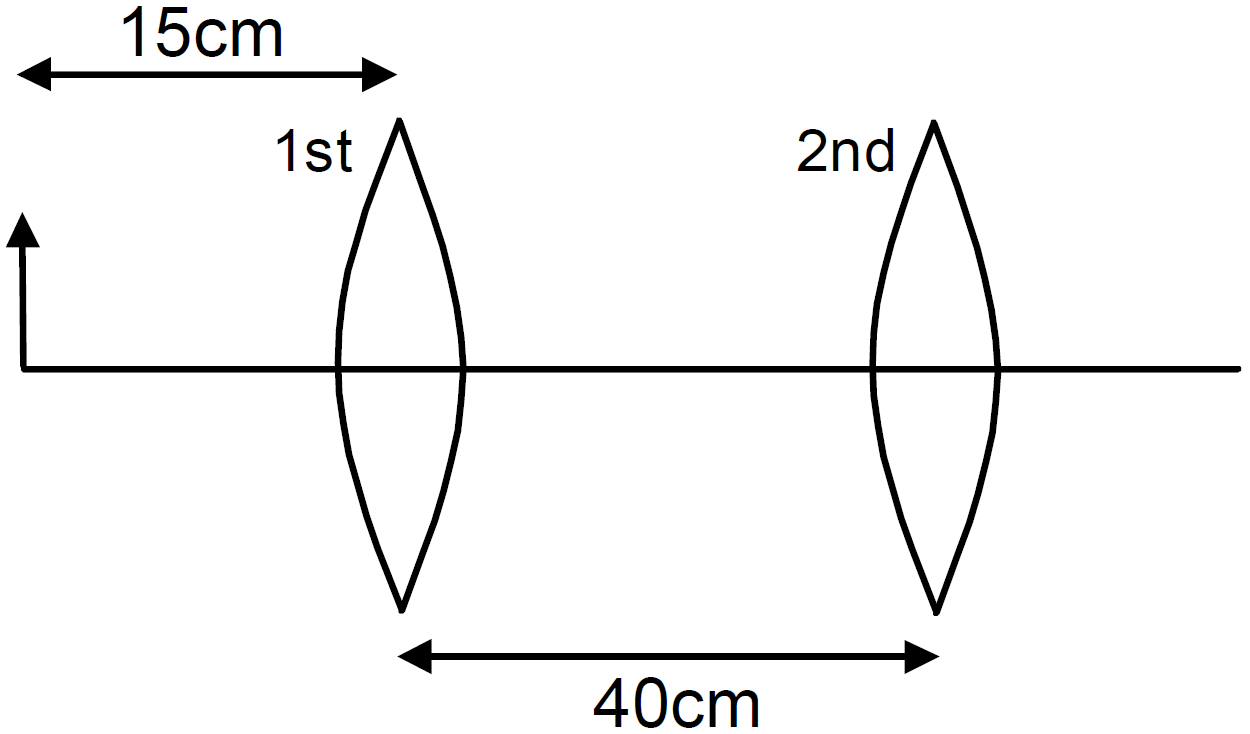
- First lens:
$\frac{1}{\text{v}}-\frac{1}{\text{u}}=\frac{1}{\text{f}}\Rightarrow\frac{1}{\text{v}}-\Big(-\frac{1}{15}\Big)=-\frac{1}{10}$
$\Rightarrow\text{v}=30\text{cm}$
So, the final image is formed 10cm right of second lens.
- m for $1^{st}$ lens:
$\Rightarrow\text{h}_{\text{image}}=-10\text{mm}$ (inverted)
Second lens:
$u = -(40 - 30) = -10cm; f = 5cm$
[since, the image of $1^{st}$ lens becomes the object for the second lens]
$\frac{1}{\text{v}}-\frac{1}{\text{u}}=\frac{1}{\text{f}}\Rightarrow\frac{1}{\text{v}}-\Big(-\frac{1}{10}\Big)=\frac{1}{5}$
$\Rightarrow\text{v}=10\text{cm}$
m for $2^{nd}$ lens:
$\frac{\text{v}}{\text{u}}=\frac{\text{h}_{\text{image}}}{\text{h}_{\text{object}}}\Rightarrow\Big(\frac{10}{10}\Big)=\frac{\text{h}_{\text{image}}}{{-10}}$
$\Rightarrow\text{h}_{\text{image}}=10\text{mm}$ (erect, real).
- So, size of final image = 10mm

Download our appand get started for free
Experience the future of education. Simply download our apps or reach out to us for more information. Let's shape the future of learning together!No signup needed.*
Similar Questions
- 1A thin lens made of a material of refractive index $\mu_2$ has a medium of refractive index $\mu_1$ on one side and a medium of refractive index $\mu_3$ on the other side. The lens is biconvex and the two radii of curvature have equal magnitude R. A beam of light travelling parallel to the principal axis is incident on the lens. Where will the image be formed if the beam is incident from:View Solution
- The medium $\mu_1$
- From the medium $\mu_3?$
- 2Two concave mirrors of equal radii of curvature R are fixed on a stand facing opposite directions. The whole system has a mass m and is kept on a frictionless horizontal table.View Solution
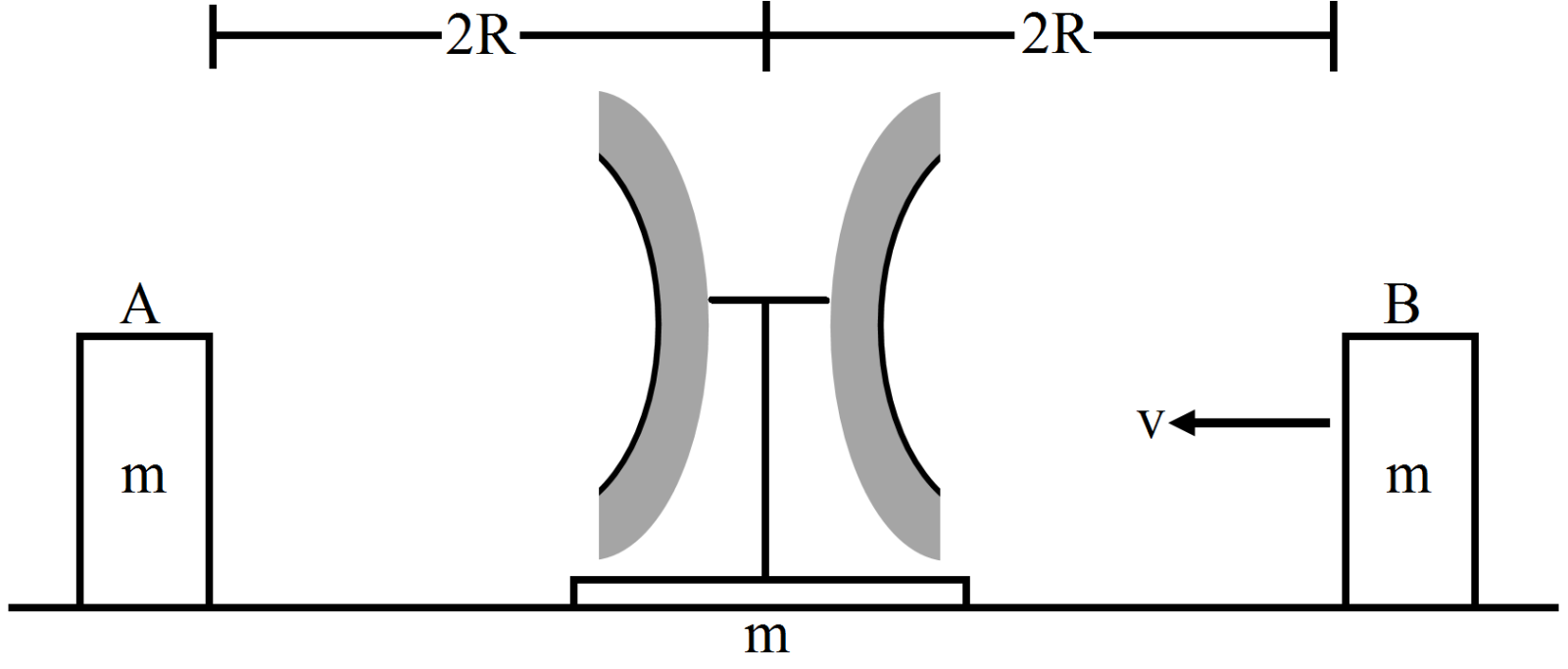
Two blocks A and B, each of mass m, are placed on the two sides of the stand. At t = 0, the separation between A and the mirrors is 2 R and also the separation between B and the mirrors is 2 R. The block B moves towards the mirror at a speed v. All collisions which take place are elastic. Taking the original position of the mirrors-stand system to be x = 0 and X-axis along AB, find the position of the images of A and B at t =- $\frac{\text{R}}{\text{v}}$
- $\frac{3\text{R}}{\text{v}}$
- $\frac{5\text{R}}{\text{v}}$
- 3View Solution
- Derive the mathematical relation between refractive indices $n_1$ and $n_2 $ of two radii and radius of curvature R for refraction at a convex spherical surface. Consider the object to be a point since lying on the principle axis in rarer medium of refractive index $n_1$ and a real image formed in the denser medium of refractive index $n_{2}$.Hence, derive lens maker's formula.
- Light from a point source in air falls on a convex spherical glass surface of refractive index 1.5 and radius of curvature 20 cm. The distance of light source from the glass surface is 100 cm. At what position is the image formed?
- 4View Solution
- Draw a labelled ray diagram showing the formation of image by a compound microscope in normal adjustment. Derive the expression for its magnifying power.
- How does the resolving power of a microscope change when.
- The diameter of the objective lens is decreased,
- The wavelength of the incident light is increased.
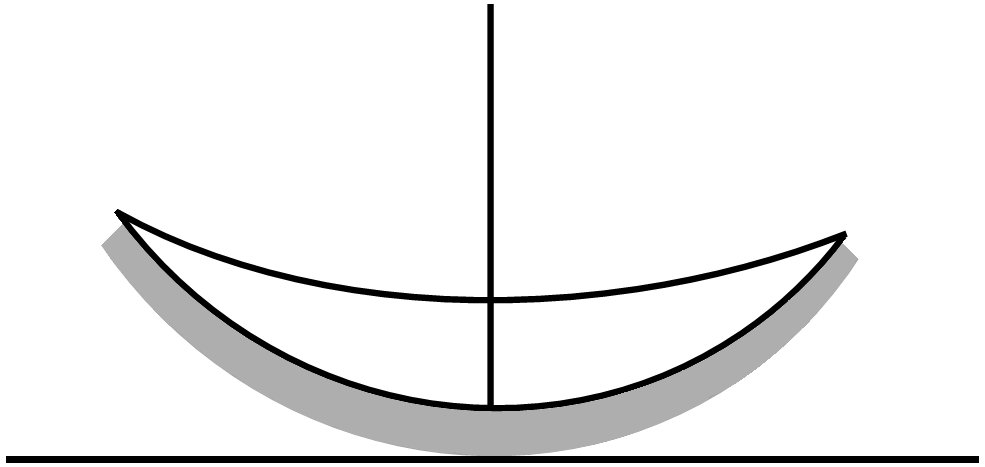
- 5The convex surface of a thin concavo-convex lens of glass of refractive index 1.5 has a radius of curvature 20cm. The concave surface has a radius of curvature 60cm. The convex side is silvered and placed on a horizontal surface as shown in figure.View Solution
- Where should a pin be placed on the axis so that its image is formed at the same place?
- If the concave part is filled with water $\Big(\mu=\frac{4}{3}\Big),$ find the distance through which the pin should be moved so that the image of the pin again coincides with the pin.
- 6View SolutionA small bulb is placed at the bottom of a tank containing water to a depth of 80cm. What is the area of the surface of water through which light from the bulb can emerge out? Refractive index of water is 1.33. (Consider the bulb to be a point source).
- 7View Solution
- An object is placed in front of a concave mirror. It is observed that a virtual image is formed. Draw the ray diagram to show the image formation and hence derive the mirror equation $\frac{1}{\text{f}}=\frac{1}{\text{u}}+\frac{1}{\text{v}}.$
- An object is placed 30cm in front of a plano-convex lens with its spherical surface of radius of curvature 20cm. If the refractive index of the material of the lens is 1.5, find the position and nature of the image formed.
- 8View SolutionA converging lens of focal length 15cm and a converging mirror of focal length 10cm are placed 50cm apart with common principal axis. A point source is placed in between the lens and the mirror at a distance of 40cm from the lens. Find the locations of the two images formed.
- 9View SolutionAn object is placed at a distance of 30cm from a converging lens of focal length 15cm. A normal eye (near point 25cm, far point infinity) is placed close to the lens on the other side.
- Can the eye see the object clearly?
- What should be the minimum separation between the lens and the eye so that the eye can clearly see the object?
- Can a diverging lens, placed in contact with the converging lens, help in seeing the object clearly when the eye is close to the lens?
- 10A point object 'O' is kept in a medium of refractive index $n_1$ in front of a convex spherical surface of radius of curvature R which separates the second medium of refractive index $n_2$ from the first one, as shown in the figure. Draw the ray diagram showing the image formation and deduce the relationship between the object distance and the image distance in terms of $n_1, n_2$ and R.View Solution
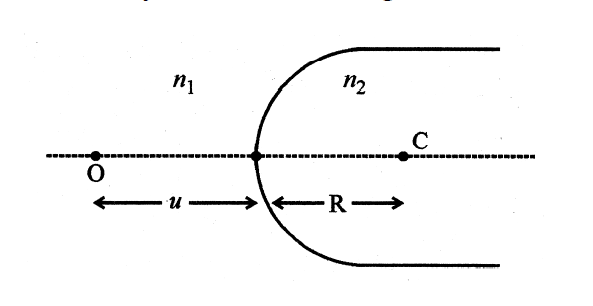
- hen the image formed above acts as a virtual object for concave spherical, surface separating the medium $n_2$ from $n_1 (n_2> n_1),$ draw this ray diagram and write the similar (similar to (a) relation. Hence obtain the expression for the lens maker's formula.