MCQ
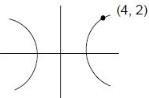
A hyperbola has its centre at the origin, passes through the point $(4, 2)$ and has transverse axis of length $4$ along the $x -$ axis. Then the eccentricity of the hyperbola is
  • $\frac {2}{\sqrt 3}$
  • B
    $\frac {3}{2}$
  • C
    $\sqrt 3$
  • D
    $2$

Answer

Correct option: A.
$\frac {2}{\sqrt 3}$
a
Given hyperbolo is

$\frac{{{x^2}}}{4} - \frac{{{y^2}}}{{{b^2}}} = 1$

Satisfying the point $\left( {4,2} \right)$

$ \Rightarrow {b^2} = \frac{4}{3}$

$ \Rightarrow e = \frac{2}{{\sqrt 3 }}$
Need a full question paper?

Generate a complete, print-ready paper with questions like this in minutes — across 16+ boards, with answer keys.

Start Generating Free

Similar questions

$\cot x - \tan x = $
The locus of the intersection point of $x\cos \alpha - y\sin \alpha = a$ and $x\sin \alpha - y\cos \alpha = b$ is
Consider a set of $3 n$ numbers having variance $4.$ In this set, the mean of first $2 n$ numbers is $6$ and the mean of the remaining $n$ numbers is $3.$ A new set is constructed by adding $1$ into each of first $2 n$ numbers, and subtracting $1$ from each of the remaining $n$ numbers. If the variance of the new set is $k$, then $9 k$ is equal to .... .
Let the latus rectum of the hyperbola $\frac{x^2}{9}-\frac{y^2}{b^2}=1$ subtend an angle of $\frac{\pi}{3}$ at the centre of the hyperbola. If $\mathrm{b}^2$ is equal to $\frac{l}{\mathrm{~m}}(1+\sqrt{\mathrm{n}})$, where $l$ and $\mathrm{m}$ are co-prime numbers, then $l^2+\mathrm{m}^2+\mathrm{n}^2$ is equal to______________.
If $\sin \theta  + 2\sin \phi  + 3\sin \psi  = 0$ and $\cos \theta  + 2\cos \phi  + 3\cos \psi  = 0$ , then the value of $\cos 3\theta  + 8\cos 3\phi  + 27\cos 3\psi  = $ 
If the chord of contact of tangents from a point $P$  to the parabola $y^2 = 4ax$  touches the parabola $x^2 = 4by$ , the locus of $P$  is :
Equations of a common tangent to the two hyperbolas $\frac{{{x^2}}}{{{a^2}}} - \frac{{{y^2}}}{{{b^2}}}$ $= 1 $ $\&$  $\frac{{{y^2}}}{{{a^2}}} - \frac{{{x^2}}}{{{b^2}}}$ $= 1 $ is :
Let $A$ and $B $ be two events such that  $P\left( {\overline {A \cup B} } \right) = \frac{1}{6}\;,P\left( {A \cap B} \right) = \frac{1}{4}$ and $P\left( {\bar A} \right) = \frac{1}{4}$ where $\bar A$ stands for the complement of the event $A$. Then the events $A$ and$B$ are
If $z =2+3 i$, then $z ^{5}+(\overline{ z })^{5}$ is equal to.
Let the set of all $a \in R$ such that the equation $\cos 2 x+a \sin x=2 a-7$ has a solution be $[p, q]$ and $\mathrm{r}=\tan 9^{\circ}-\tan 27^{\circ}-\frac{1}{\cot 63^{\circ}}+\tan 81^{\circ}$, then $pqr$ is equal to ....................