Question
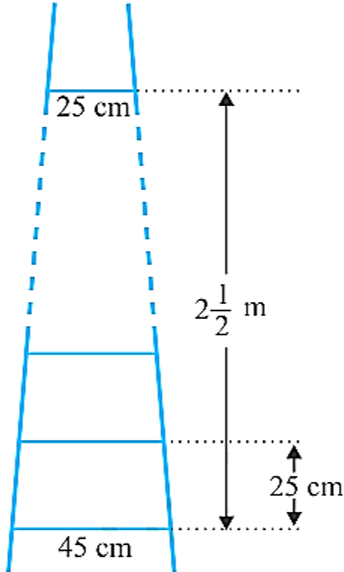
A ladder has rungs $25$ cm apart. The rungs decrease uniformly in length from $45$ cm at the bottom to $25$ cm at the top. If the top and bottom rungs are $2\frac 12$m apart, what is the length of the wood required for the rungs?
[Hint: Number of rungs = $\frac{250}{25} + 1$]
Image

Answer

It is given that the gap between two consecutive rungs is 25 cm and the top and bottom rungs are 2.5 metre i.e., 250 cm apart.
$\therefore$ Number of rungs = $\frac { 250 } { 25 } $+ 1 = 10 + 1 = 11.
It is given that the rungs are decreasing uniformly in length from 45 cm at the bottom to 25 cm at the top.
Therefore, lengths of the rungs form an A.P. with first term a = 45 cm and $11^{th}$​​​​​​​ term l = 25 cm. n = 11
$\therefore$ Length of the wood required for rungs = Sum of 11 terms of an A.P. with first term 45 cm and last term is 25 cm
$= \frac { 11 } { 2 }$ ( 45 + 25 ) cm $\left[ \because S _ { n } = \frac { n } { 2 } ( a + l ) \right]$
$= \frac { 11 } { 2 }$(70) cm
$= 11 (35) cm$
$= 385 cm$
Length of the wood required for rungs = $\frac{385}{100}$ = 3.85 metres ($\because$100 cm = 1 m)
The length of the wood required for the rungs is 3.85 metres.

Need a full question paper?

Generate a complete, print-ready paper with questions like this in minutes — across 16+ boards, with answer keys.

Start Generating Free