Sample QuestionsArithmetic Progressions questions
One sample from each question group in this chapter. Select any group above to see the full set with answer keys.
If $k, 2k - 1$ and $2k + 1$ are three consecutive terms of an $A.P.,$ the value of $k$ is :
Answer: B.
View full solution →If the $n^{th}$ term of an $A.P$. is $(2n + 1),$ then the sum of its first three terms is :
Answer: B.
View full solution →If the common difference of an $A.P$. is $3,$ then $a_{20}- a_{15}$ is :
Answer: C.
View full solution →The first three terms of an $AP$ respectively are $3y - 1, 3y + 5$ and $5y + 1$. Then $y$ equals :
Answer: C.
View full solution →The first three terms of an $AP$ respectively are $3y - 1, 3y + 5$ and $5y + 1$. Then $y$ equals :
Answer: C.
View full solution →Directions : In the following questions, the Assertions $(A)$ and Reason $(s)\ (R)$ have been put forward. Read both the statements carefully and choose the correct alternative from the following:
Assertion : The $n\ '$ term of a sequence is $3n - 2$. It is an $A.P.$
Reason : A sequence is not an $A.P.$ ifitsn is not a linear expression in $n.$
- ✓
Assertion and Reason both are correct statements and Reason is the correct explanation of Assertion.
- B
Assertion and Reason both are correct statements but Reason is not the correct explanation of Assertion.
- C
Assertion is correct statement but Reason is wrong siatement.
- D
Assertion is wrong statement but Reason is correct statement.
Answer: A.
View full solution →Directions : In the following questions, the Assertions $(A)$ and Reason $(s) \ (R)$ have been put forward. Read both the statements carefully and choose the correct alternative from the following:
Assertion : Arithmetic between $8$ and $12$ is $10.$
Reason : Arithmetic between two numbers $'a\ ’$ and $'b\ '$ is given as $\frac{\text{a}+\text{b}}{2}.$
- ✓
Both assertion $(A)$ and reason $(R)$ are true and reason $(R)$ isthe correct explanation of assertion $(A)$.
- B
Both assertion $(A)$ and reason $(R)$ are true but reason $(R)$ is not the correct explanation of assertion $(A)$.
- C
Assertion $(A)$ is true but reason $(R)$ is false.
- D
Assertion $(A)$ is false but reason $(R)$ is true
Answer: A.
View full solution →Directions : In the following questions, the Assertions $(A)$ and Reason $(s) \ (R)$ have been put forward. Read both the statements carefully and choose the correct alternative from the following:
Assertion: If $n ^{\text {th }}$ term of an $A.P$. is $7-4 n$, then its common differences is $-4 $.
Reason: Common difference of an $A.P$. is given by $d=a_{n+1}-a_n$.
- ✓
Both assertion $(A)$ and reason $(R)$ are true and reason $(R)$ isthe correct explanation of assertion $(A)$.
- B
Both assertion $(A)$ and reason $(R)$ are true but reason $(R)$ is not the correct explanation of assertion $(A)$.
- C
Assertion $(A)$ is true but reason $(R)$ is false.
- D
Assertion $(A)$ is false but reason $(R)$ is true
Answer: A.
View full solution →Directions : In the following questions, the Assertions $(A)$ and Reason $(s)\ (R)$ have been put forward. Read both the statements carefully and choose the correct alternative from the following:
Assertion : The sum of the first $n$ terms of an $AP$ is given by $S_n=3 n^2-4 n$. Then its $n^{th}$ term $a_n=6 n-7$
Reason : $n^{th}$ term of an $AP,$ who sum to $n$ terms is $S_n$, is given by $a_n=S_{n-1}$
- ✓
Both assertion $(A)$ and reason $(R)$ are true and reason $(R)$ isthe correct explanation of assertion $(A)$.
- B
Both assertion $(A)$ and reason $(R)$ are true but reason $(R)$ is not the correct explanation of assertion $(A)$.
- C
Assertion $(A)$ is true but reason $(R)$ is false.
- D
Assertion $(A)$ is false but reason $(R)$ is true
Answer: A.
View full solution →Directions : In the following questions, the Assertions $(A)$ and Reason $(s) \ (R)$ have been put forward. Read both the statements carefully and choose the correct alternative from the following :
Assertion : Three consecutive terms $2k + 1, 3k + 3$ and $5k - 1$ form an $AP$ than is equal to $6.$
Reason : In an $AP , a, a + d, a + 2d,....., n $ terms of the $AP$ be $\text{s}_\text{n}=\frac{\text{n}}{2}(2\text{a}+(\text{n-1})\text{d})$
- A
Both assertion $(A)$ and reason $(R)$ are true and reason $(R)$ isthe correct explanation of assertion $(A)$.
- ✓
Both assertion $(A)$ and reason $(R)$ are true but reason $(R)$ is not the correct explanation of assertion $(A)$.
- C
Assertion $(A)$ is true but reason $(R)$ is false.
- D
Assertion $(A)$ is false but reason $(R)$ is tru
Answer: B.
View full solution →$11^{th}$ term of an AP: – 3, $-\frac{1}{2}$ , 2, . . . is
View full solution →$30^{\text {th }}$ term of an AP: 10, 7, 4, .......... is
View full solution →For the AP $\frac{1}{3},\frac{5}{3},\frac{9}{3},\frac{{13}}{3},.....$, write the first term and the common difference.
View full solution →For the AP –5, –1, 3, 7,... write the first term and the common difference.
For the AP 3, 1, -1, -3 ......, write the first term and the common difference.
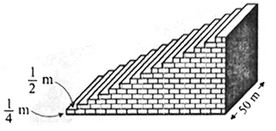
A small terrace at a football ground comprises of 15 steps each of which is 50 m long and built of solid concrete.
Each step has a rise of $\frac{1}{4}$m and a tread of $\frac{1}{2}$m. (see figure). Calculate the total volume of concrete required to build the terrace.
[Hint: Volume of concrete required to build the first step = $\frac 14 \times \frac 12 \times$ 50 $m^3$]
View full solution →Find the sum of first $51$ terms of an AP whose second and third terms are $14$ and $18$ respectively.
View full solution →The first and the last terms of an $A.P$ are $17$ and $350$ respectively. If the common difference is $9$, how many terms are there and what is their sum?
View full solution →In an AP: l = 28, S = 144, and there are total 9 terms. Find 'a'.
Find the sum of the APs: $\frac{1}{{15}},\frac{1}{{12}},\frac{1}{{10}},.....$ to 11 terms.
View full solution →The houses of a row are numbered consecutively from $1$ to $49$. Show that there is a value of x such that the sum of the numbers of the houses preceding the house numbered x is equal to the sum of the numbers of the houses following it. Find this value of $x.$
[Hint: $S_{x-1} = S_{49} - S_x]$
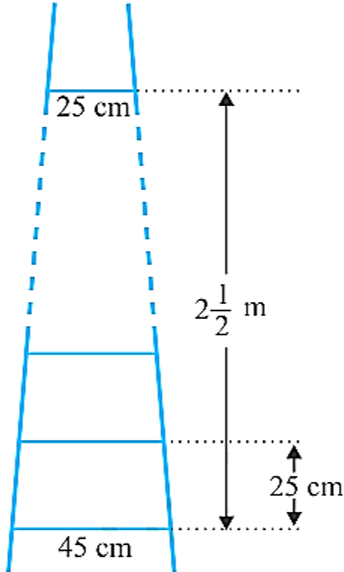
View full solution →A ladder has rungs $25$ cm apart. The rungs decrease uniformly in length from $45$ cm at the bottom to $25$ cm at the top. If the top and bottom rungs are $2\frac 12$m apart, what is the length of the wood required for the rungs?
[Hint: Number of rungs = $\frac{250}{25} + 1$]
View full solution →Which term of the AP: $121, 117, 113, ....$ is its first negative term?
[Hint: Find n for $a_n < 0]$
View full solution →If the sum of the first $7$ terms of an $A.P$. is $49$ and that of the first $17$ terms is $289$, find the sum of its first n terms.
View full solution →Find the sum of first 22 terms of an AP in which d = 7 and 22nd term is 149.
The sum of the third and the seventh terms of an AP is 6 and their product is 8. Find the sum of the first sixteen terms of the AP.
In an $AP: a_n = 4, d = 2, S_n = -14$, find n and a.
View full solution →In an AP: $a_3=15, S_{10}=125$, find $d$ and $a_{10}$.
View full solution →200 logs are stacked in the following manner: 20 logs in the bottom row, 19 in the next row, 18 in the row next to it and so on (see Fig.). In how many rows are the 200 logs placed and how many logs are in the top row?

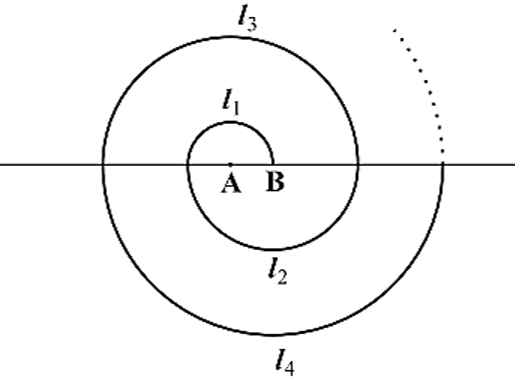
A spiral is made up of successive semicircles, with centres alternately at A and B, starting with centre at A, of radii 0.5 cm, 1.0 cm, 1.5 cm, 2.0 cm, ... as shown in Figure. What is the total length of such a spiral made up of thirteen consecutive semicircles? $(Take\; \pi = \frac { 22 } { 7 } )$
[Hint: Length of successive semicircles is$ l_1, l_2, l_3, l_4, ...$ with centres at A, B, A, B, ... respectively.]
View full solution →On Diwali occasion two rocket crackers were launched at the same time from two different places opposite to each other and the path followed by them are along the lines 3x – 2y = 6 and x + y =12.
Use the above figure to answer the questions that follow:
(i) What is the point of start i.e. the point of intersection of the first line with x -axis.
(ii) At what point the second line intersect y-axis.
(iii) What is the point of intersection of the two rockets,
OR
If both are launched from x-axis,at what height they cross each other,
In a class the teacher asks every student to write an example of A.P. Two friends Geeta and Madhuri writes their progressions as -5, -2, 1, 4, ... and 187, 184, 181,.... respectively. Now, the teacher asks various students of the class the following questions on these two rogressions. Help students to find the answers of the questions.
(i) Find the 34th term of the progression written by Madhuri.
(ii) Find the sum of common difference of the two progressions.
(iii) Find the 19th term of the progression written by Geeta.
OR
Find the sum of first 10 terms of the progression written by Geeta.
Jack is much worried about his upcoming assessment on A.P. He was vigorously practicing for the exam but unable to solve some questions. One of these questions is as shown below. If the 3rd and the 9th terms of an A.P. are 4 and - 8 respectively, then help Jack in solving the problem(i) What is the common difference?
(ii) What is the first term?
(iii) Which term of the A.P. is-160?
OR
Which of the following is not a term of the given A.P.?
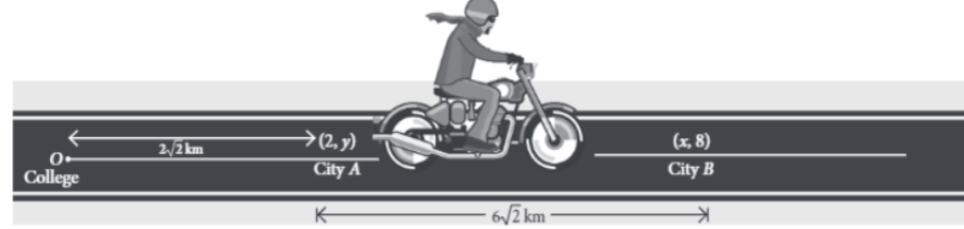
A person is riding his bike on a straight road towards East from his college to city A and then to city B. At some point in between city A and city B, he suddenly realises that there is not enough petrolfor the journey. Also, there is no petrol pump on the road between these two cities. Based on the above information, answer the following questions.
(i) Find the value of y.
(ii) Find the value of x.
(iii) If M is any point exactly in between city A and city B, then coordinates of M are
OR
The ratio in which A divides the line segment joining the points O and Mis
Abhi sees the two poles of equal heights are standing opposite each other on either side of the road, which is 80 m wide. From a point between them on the road, the angles of elevation of the top of the poles are 60° and 30°, respectively. Read the above information and answer the below questions.
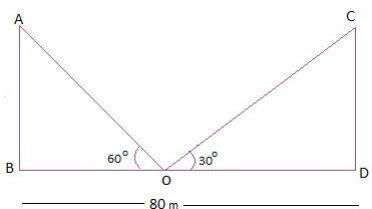
(i) What is the length of CD?
(ii) What is the length of 0D?
OR
What is the distance from the point of elevation from 60°?
(iii) What is the length of OC?