MCQ
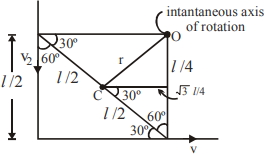
$A$ ladder of length $L$ is slipping with its ends against a vertical wall and a horizontal floor. At a certain moment, the speed of the end in contact with the horizontal floor is $v$ and the ladder makes an angle $\alpha = 30^o$ with the horizontal. Then the speed of the ladder’s center must be
  • A
    $2v / \sqrt 3$
  • B
    $v/2$
  • $v$
  • D
    None

Answer

Correct option: C.
$v$
c
$\omega=\frac{V}{l / 2}$

$\omega=\frac{2 \mathrm{v}}{l}$

Also, $v_{c}=r \omega=\sqrt{\left(\frac{\sqrt{3}}{4} l\right)^{2}+\left(\frac{l}{4}\right)^{2}} \omega$

$=\frac{1}{4} l \sqrt{3+1} \omega=\frac{l}{2} \omega$

$=\frac{l}{2} \times \frac{2 \mathrm{v}}{l}=\mathrm{v}$

Need a full question paper?

Generate a complete, print-ready paper with questions like this in minutes — across 16+ boards, with answer keys.

Start Generating Free

Similar questions

If a metallic sphere gets cooled from ${62^o}C$ to ${50^o}C$ in ${40^o}C$and in the next $10\;\min utes$gets cooled to ${42^o}C$, then the temperature of the surroundings is ......... $^oC$
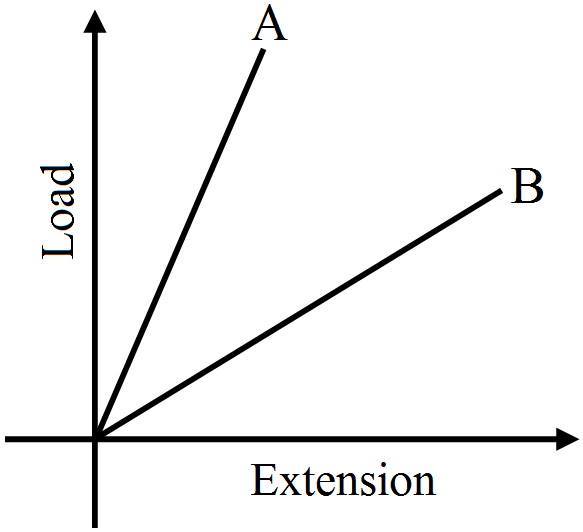
In the given figure, if the dimension of the wire are the same and materials are different, Young's modulus is more for:
Mark the correct statements:
Four particles $A, B, C$ and $D$ each of mass $m$ are kept at the corners of a square of side $L$. Now the particle $D$ is taken to infinity by an external agent keeping the other particles fixed at their respective positions. The work done by the gravitational force acting on the particle $D$ during its movement is ..........
A total of $48 \mathrm{~J}$ heat is given to one mole of helium kept in a cylinder. The temperature of helium increases by $2^{\circ} \mathrm{C}$. The work done by the gas is : (Given, $\mathrm{R}=8.3 \mathrm{~J} \mathrm{~K}^{-1} \mathrm{~mol}^{-1}$.)
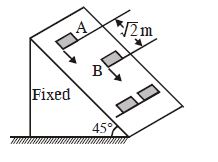
Two blocks $A$ and $B$ of equal masses are sliding down along straight parallel lines on an inclined plane of $45^o$ . Their coefficients of kinetic friction are $\mu _A = 0.2$ and $\mu _B = 0.3$ respectively. At $t = 0$ , both the blocks are at rest and block $A$ is $\sqrt 2$ metre behind block $B$ . The time and distance from the initial position where the front faces of the blocks come in line on the inclined plane as shown in figure. (Use $g = 10\, ms^{-2}$ )
A juggler maintains four ball in vertically upward motion. He attempts next ball after $1/4\, sec$. For the shows to go on, what should be the height for which he throws the ball ?.........$m$ $(g=10\,m/s^2)$
Two wave pulses travel in opposite directions on a string and approach each other. The shape of one pulse is inverted with respect to the other.
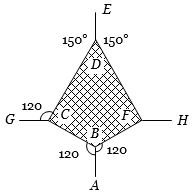
The adjacent figure is the part of a horizontally stretched net. section $AB$ is stretched with a force of $10 \,N$. The tensions in the sections $BC$ and $BF$ are
One mole of an ideal gas at an initial temperature of $T\, K$ does $6 R$ joules of work adiabatically. If the ratio of specific heats of this gas at constant pressure and at constant volume is $5/3$, the final temperature of gas will be