MCQ
A total of $48 \mathrm{~J}$ heat is given to one mole of helium kept in a cylinder. The temperature of helium increases by $2^{\circ} \mathrm{C}$. The work done by the gas is : (Given, $\mathrm{R}=8.3 \mathrm{~J} \mathrm{~K}^{-1} \mathrm{~mol}^{-1}$.)
  • A
    $72.9 \mathrm{~J}$
  • B
    $24.9 \mathrm{~J}$
  • C
    $48 \mathrm{~J}$
  • $23.1 \mathrm{~J}$

Answer

Correct option: D.
$23.1 \mathrm{~J}$
d
$1^{\text {st }}$ law of thermodynamics

$\Delta \mathrm{Q}=\Delta \mathrm{U}+\mathrm{W}$

$\Rightarrow+48=\mathrm{nC}_{\mathrm{v}} \Delta \mathrm{T}+\mathrm{W}$

$\Rightarrow 48=(1)\left(\frac{3 \mathrm{R}}{2}\right)(2)+\mathrm{W}$

$\Rightarrow \mathrm{W}=48-3 \times \mathrm{R}$

$\Rightarrow \mathrm{W}=48-3 \times(8.3)$

$\Rightarrow \mathrm{W}=23.1 \text { Joule }$

Need a full question paper?

Generate a complete, print-ready paper with questions like this in minutes — across 16+ boards, with answer keys.

Start Generating Free

Similar questions

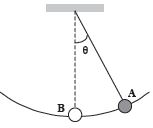
A ball attached to one end of a string swings in a vertical plane such that its acceleration at point $A$ (extreme position) is equal to its acceleration at point $B$ (mean position). The angle $\theta$ is :-
A flywheel rotates about an axis. Due to friction at the axis, it experiences an angular retardation proportional to its angular velocity. If its angular velocity falls to half while it makes $n$ rotations, how many more rotations will it make before coming to rest?
A large cylindrical tank has a hole of area A at its bottom. Water is poured in the tank by a tube of equal cross-sectional area A ejecting water at the speed v.
In a uniformly accelerated motion, the speed varies from $0$ to $20m/ s$ in $4s.$ What is the average speed during the motion?
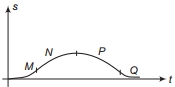
Let us cell a motion, $A$ when velocity is positive and increasing $A^{-1}$ when velocity is negative and increasing. $R$ when velocity is positive and decreasing and $R^{-1}$ when velocity is negative and decreasing. Now, match the following two columns for the given $s=t$ graph.
Colum $I$ Colum $II$
$(A)$ $M$ $(p)$ $A^{-1}$
$(B)$ $N$ $(q)$ $R^{-1}$
$(C)$ $P$ $(r)$ $A$
$(D)$ $Q$ $(s)$ $R$

A car moves for half of its time at $80\, km/h$ and for rest half of time at $40\, km/h$. Total distance covered is $60 \,km$. What is the average speed of the car.........$km/h$
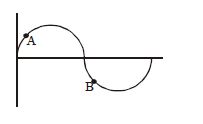
Consider the snapshot of a wave traveling in positive $x$ -direction
What is meant by mean free path?
One mole of an ideal monatomic gas requires $210 \,J$ heat to raise the temperature by $10\, K$, when heated at constant temperature. If the same gas is heated at constant volume to raise the temperature by $10\, K$ then heat required is  ....... $J$
As the temperature of water increases, its viscosity