Question
A lady cannot see objects closer than 40cm from the left eye and closer than 100cm from the right eye. While on a mountaineering trip, she is lost from her team. She tries to make an astronomical telscope from her reading glasses to look for her teammates.
  1. Which glass should she use as the eyepiece?
  2. What magnification can she get with relaxed eye?

Answer

The lady can not see objects closer than 40cm from the left eye and 100cm from the right eye.

For the left glass lens,

v = -40cm,

u = -25cm 

$\therefore \frac{1}{\text{f}}=\frac{1}{\text{v}}-\frac{1}{\text{u}}=\frac{1}{-40}-\frac{1}{-25}=\frac{1}{25}-\frac{1}{40}=\frac{3}{200}$

$\Rightarrow \text{f}=\frac{200}{3}\text{cm}$

For the right glass lens,

v = -100cm,

u = -25cm

$\frac{1}{\text{f}}=\frac{1}{\text{v}}-\frac{1}{\text{u}}=\frac{1}{-100}-\frac{1}{-25}=\frac{1}{100}=\frac{3}{100}$

$\Rightarrow\text{f}=\frac{100}{3}\text{cm}$

  1. For an astronomical telescope, the eye piece lens should have smaller focal length. So, she should

use the right lens $\big(\text{f}=\frac{100}{3}\text{cm}\big)$ as the eye piece lens.

  1. With relaxed eye, (normal adjustment)

$\text{f}_0=\frac{200}{3}\text{cm}$

$\text{f}_\text{e}=\frac{100}{3}\text{cm}$

magnification $=\text{m}=\frac{\text{f}_0}{\text{f}_\text{e}}=\frac{\big(\frac{200}{3}\big)}{\big( \frac{100}{3}\big)}=2$
Need a full question paper?

Generate a complete, print-ready paper with questions like this in minutes — across 16+ boards, with answer keys.

Start Generating Free

Similar questions

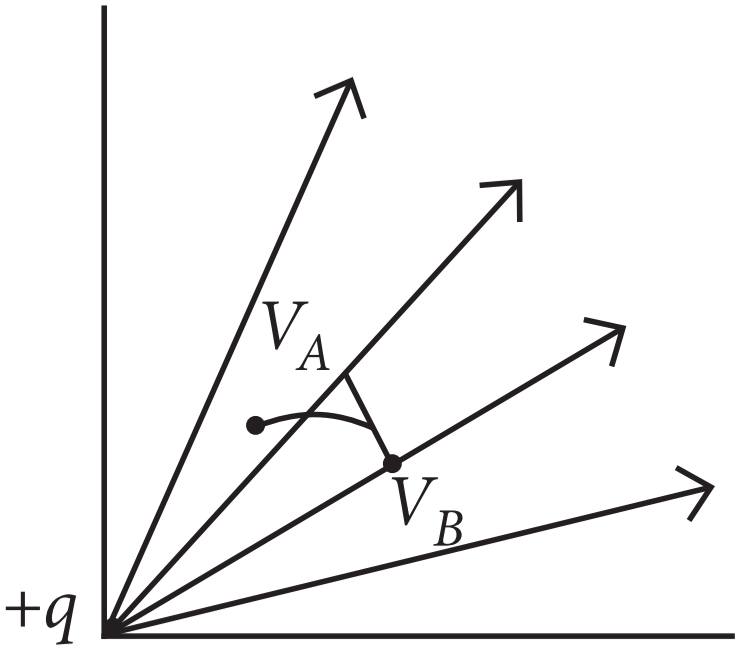
Electrostatic potential energy of a system of point charges is defined as the total amount of work done in bringing the different charges to their respective positions from infinitely charge mutual separations. The work is stored in the system of two point charges in the form of electrostatic potential energy U of the system. Electric potential difference between any points A and B in an electric field is the amount of work done in moving a unit positive test charge from A to B along any path agents the electrostatic force $\text{V}_\text{B}-\text{V}_\text{A}=\frac{\text{W}_\text{AB}}{\text{q}_\text{o}}=\int\vec{\text{E}}.\text{dl}.$

  1. A test charge is moved from lower potential point to a higher potential point. The potential energy of test charge wiII.
  1. Remain the same.
  2. Increase.
  3. Decrease.
  4. Become zero.
  1. Which of the following statement is not true?
  1. Electrostatic force is a conservative force.
  2. Potential energy of charge q at a point is the work done per unit charge in bringing a charge from any point to infinity.
  3. Spring force and gravitational force are conservative force.
  4. Both (a) and (c).
  1. Work done in moving a charge from one point to another inside a uniformly charged conducting sphere is:
  1. Always zero.
  2. Non-zero.
  3. May be zero.
  4. None of these.
  1. The work done in bringing a unit positive charge from infinite distance to a point at distance x from a positive charge Q is W. Then the potential $\phi$ at that point is:
  1. $\frac{\text{WQ}}{\text{x}}$

  2. W

  3. $\frac{\text{W}}{\text{x}}$

  4. WQ

  1. If $1\mu\text{C}$ charge is shifted from A to B and it is found that work done by an external force is $40\mu\text{J}.$ ln doing so against electrostatics force, the potential difference VA - VB is:
  1. 40V
  2. -40V
  3. 20V
  4. -60V
Explain energy generation in stars through the process of nuclear fusion and explain proton. proton cycle.
When the electron orbiting in hydrogen atom in its ground state moves to the third excited state, show how the de Broglie wavelength associated with it would be affected.
Why don't we have interference when two candles are placed close to each other and the intensity is seen at a distant screen? What happens if the candles are replaced by laser sources?
A closed bottle contains some liquid. The bottle is shaken vigorously for 5 minutes. It is found that the temperature of the liquid is increased. Is heat transferred to the liquid? Is work done on the liquid? Neglect expansion on heating.
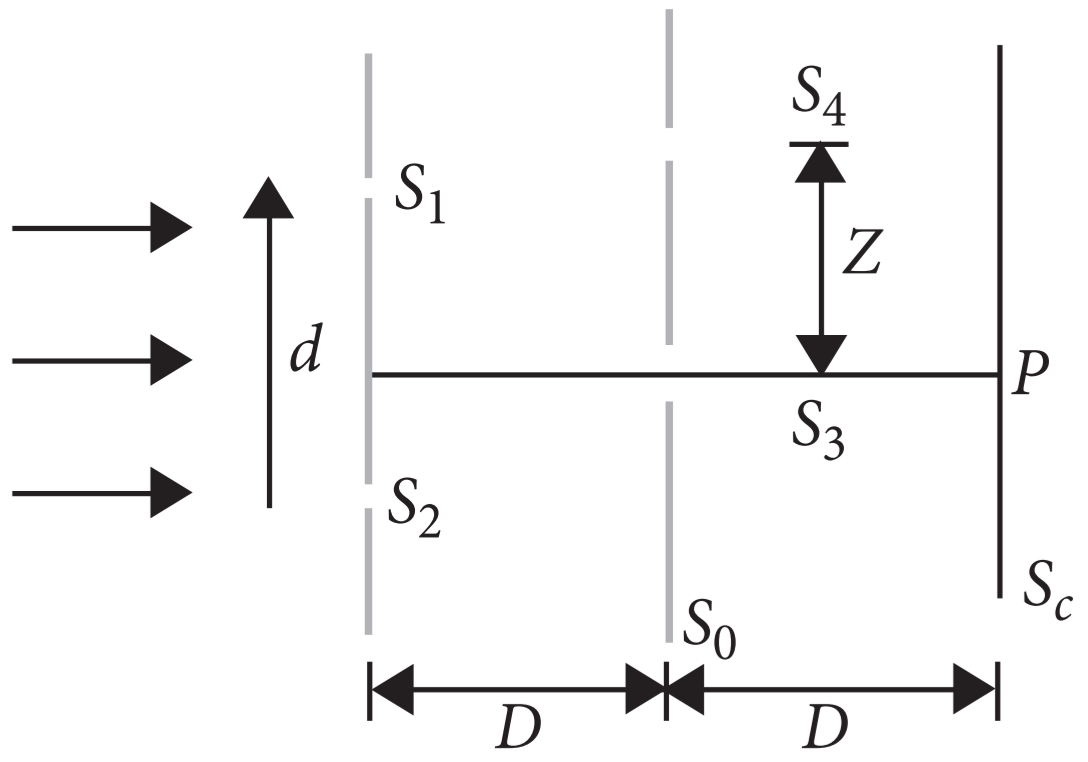
Consider the situation shown in figure. The two slits S1 and S1 placed symmetrically around the central line are illuminated by monochromatic light of wavelength $\lambda$. The separation between the slits is d. The light transmitted by the slits falls on a screen S0 place at a distance D from the slits. The slits S3 is at the central line and the slit S4 is at a distance from S3. Another screen Sc is placed a further distance D away from Sc.

  1. Find the path difference if $\text{z}=\frac{\lambda\text{D}}{2\text{d}}$.

  1. $\lambda$

  2. $\frac{\lambda}{2}$

  3. $\frac{3}{2\lambda}$

  4. $2\lambda$

  1. Find the ratio of the maximum to minimum intensity observed on Sc if $\text{z}=\frac{\lambda\text{D}}{\text{d}}$

  1. 4
  2. 2
  3. $\infty$

  4. 1
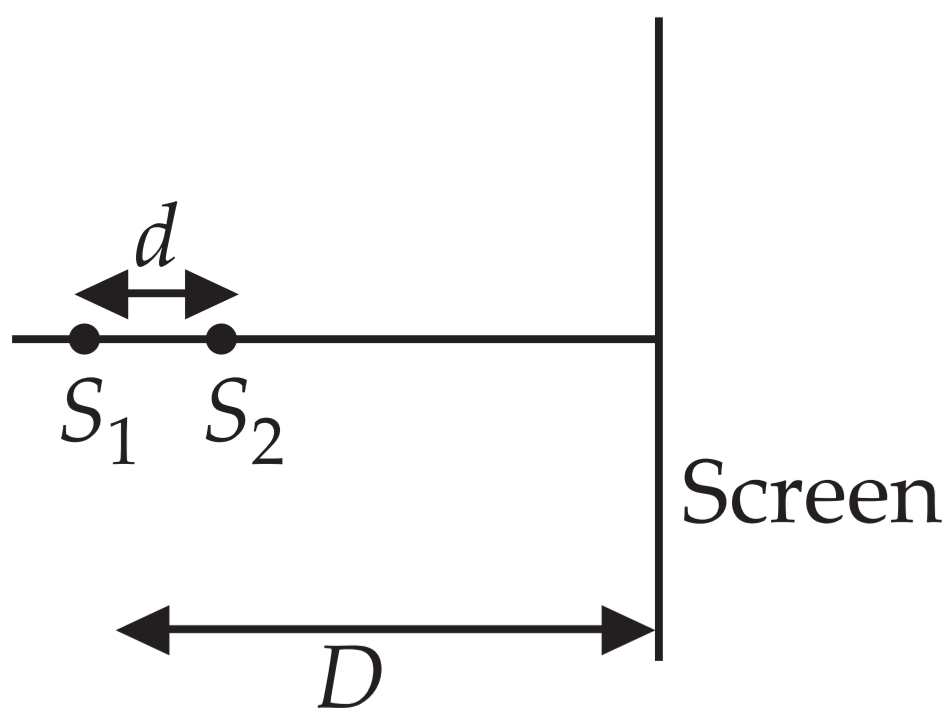
  1. Two coherent point sources S1 and S2 are separated by a small distanced as shown in figure. The fringes obtained on the screen will be:

  1. Concentric circles.
  2. Points.
  3. Straight lines.
  4. Semi-circles.
  1. ln the case of light waves from two coherent sources S1 and S2, there will be constructive interference at an arbitrary point P, if the path difference S1P - S2P is:
  1. $\Big(\text{n}+\frac{1}{2}\Big)\lambda$

  2. $\text{n}\lambda$

  3. $\Big(\text{n}-\frac{1}{2}\Big)\lambda$

  4. $\frac{\lambda}{2}$

  1. Two monochromatic light waves of amplitudes 3A and 2A interfering at a point have a phase difference of 60º. The intensity at that point will be proportional to:
  1. 5A2
  2. 13A2
  3. 7A2
  4. 19A2
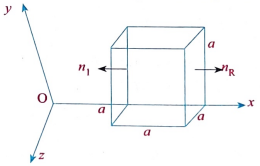
The electric field components in figure are
Image

$E _x=a x^{\frac{1}{2}}, E _y=0, E _z=0$ in which $a =800 NC ^{-1} m^{-\frac{1}{2}}$. Calculate
(a) The flux through the cube.
(b) The charge within the cube.
Assume $a=0.1 m$.
In pair annihilation, an electron and a positron destroy each other to produce gamma radiation. How is the momentum conserved?
Two point charges $+3.2 \times 10^{-19}$ Coulomb and $-3.2 \times 10^{-19}$ Coulomb are kept at a distance of 2.4 $\times 10^{-10}$ meters from each other. This dipole is placed at an angle of $30^{\circ}$ to the field direction in a uniform field of intensity of $3 \times 10^4$ Newton/Coulomb. Find the value of the moment of the couple acting on it. What will be the maximum value of this torque?
A small object is embedded in a glass sphere $(\mu=1.5)$ of radius 5.0cm at a distance 1.5cm left to the centre. Locate the image of the object as seen by an observer standing.
  1. To the left of the sphere.
  2. To the right of the sphere.