Question
When the electron orbiting in hydrogen atom in its ground state moves to the third excited state, show how the de Broglie wavelength associated with it would be affected.
Alternate Answer
As $2\pi\text{r}_{n} = \text{n}\lambda ; \lambda = \frac{2\pi\text{r}_{n}}{\text{n}}(\lambda\propto\frac{\text{r}_{n}}{\text{n}})$ $\text{r}_{n}\propto\text{n}^{2}$ $\therefore \lambda\propto\frac{\text{n}^{2}}{\text{n}}\Rightarrow\lambda\propto\text{n}$ $\therefore$ 𝑑𝑒 Broglie wavelength will increase.Generate a complete, print-ready paper with questions like this in minutes — across 16+ boards, with answer keys.
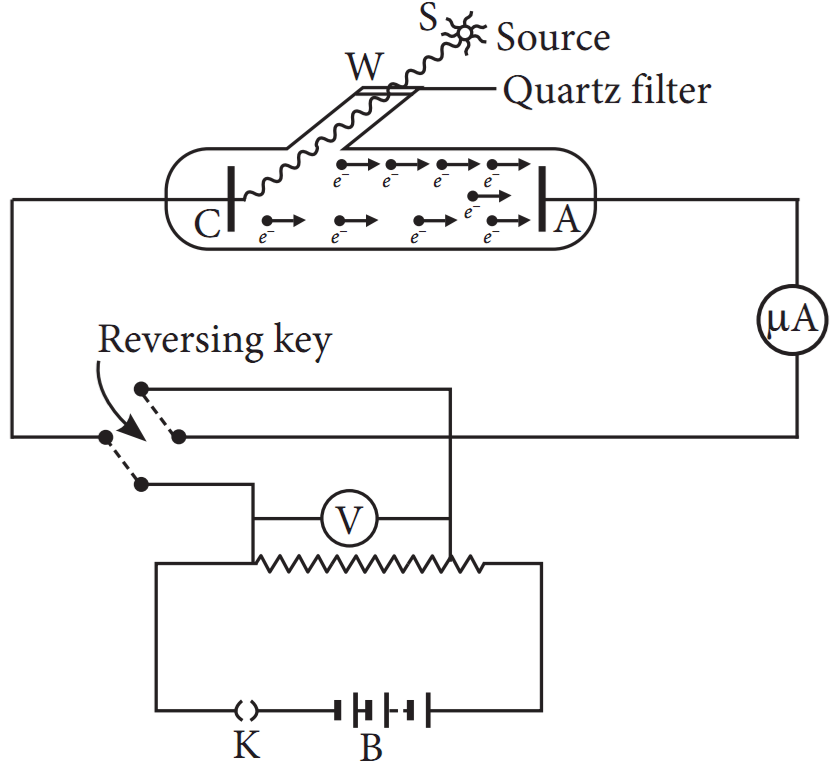
When a monochromatic radiations of suitable frequency obtained from source S, after being filtered by a filter attached on the window W, fall on the photosensitive place C, the photo electrons are emitted from C, which get accelerated towards the plate A if it is kept at positive potential. These electrons flow in the outer circuit resulting in photoelectric current. Due to it, the microammeter shows a deflection. The reading of micrommeter measures the photoelectric current.
An experimental setup of verification of photoelectric effect is shown in figure. The voltage across the electrodes is measured with the help ofan ideal voltmeter, and which can be varied by moving jockey Jon the potentiometer wire. The battery used in potentiometer circuit is of 16 V and its internal resistance is $2\Omega$. The resistance of 100cm long potentiometer wire is $8\Omega$.
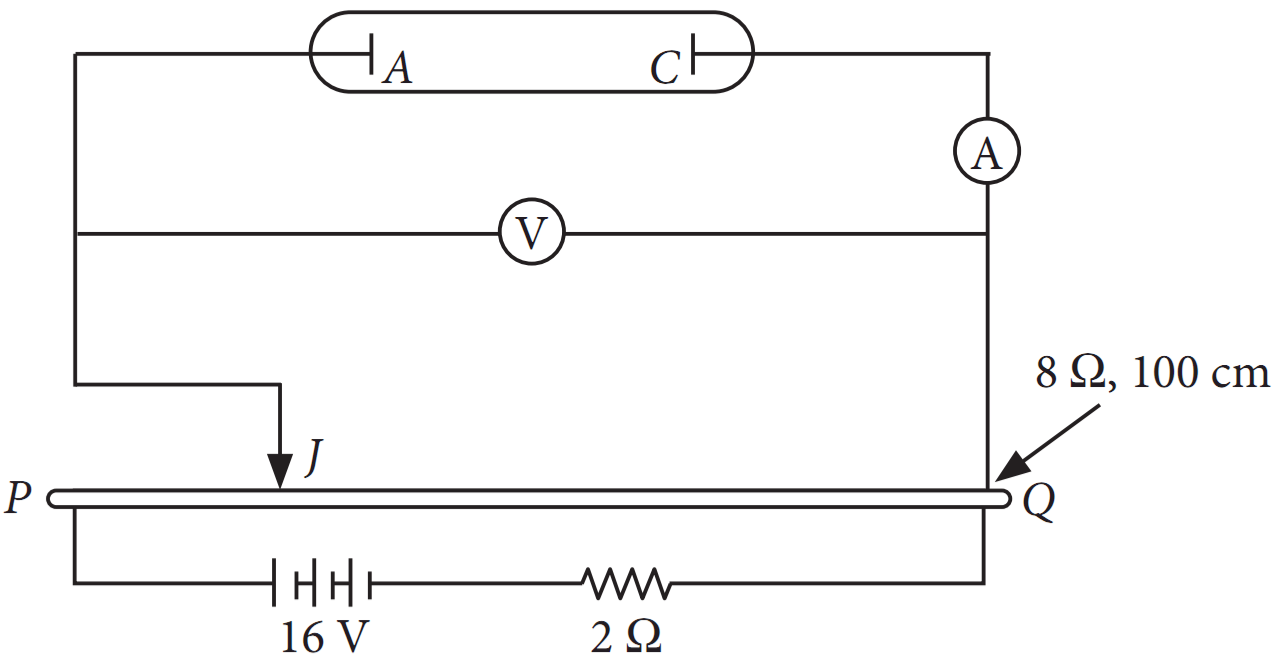
The photocurrent is measured with the help of an ideal ammeter. Two plates of potassium oxide of area 50cm2 at separation 0.5mm are used in the vacuum tube. Photocurrent in the circuit is very small, so we can treat the potentiometer circuit as an independent circuit.
Light | 1 Violet | 2 Blue | 3 Green | 4 Yellow | 5 Orange | 6 Red |
$\lambda(\text{in } \mathring{\text{A}})$ | 4000-500 | 4500-5000 | 5000-5500 | 5500-6000 | 6000-6500 | 6500-7000 |
When radiation falls on the cathode plate, a current of $2\mu\text{A}$ is recorded in the ammeter. Assuming that the vacuum tube setup follows Ohm's law, the equivalent resistance of vacuum tube operating in the case when jockey is at end P is:
$8\times10^8\Omega$
$16\times10^6\Omega$
$8\times10^6\Omega$
$10\times10^6\Omega$
It is found that ammeter current remains unchanged $(2\mu\text{A})$ even when the jockey is moved from the end P to the middle point of the potentiometer wire. Assuming that all the incident photons eject electrons and the power of the light incident is $4\times10^{-6}\Omega$. Then, the color of the incident light is: