Question
A lady cannot see objects closer than 40cm from the left eye and closer than 100cm from the right eye. While on a mountaineering trip, she is lost from her team. She tries to make an astronomical telscope from her reading glasses to look for her teammates.
  1. Which glass should she use as the eyepiece?
  2. What magnification can she get with relaxed eye?

Answer

The lady can not see objects closer than 40cm from the left eye and 100cm from the right eye.

For the left glass lens,

v = -40cm,

u = -25cm 

$\therefore \frac{1}{\text{f}}=\frac{1}{\text{v}}-\frac{1}{\text{u}}=\frac{1}{-40}-\frac{1}{-25}=\frac{1}{25}-\frac{1}{40}=\frac{3}{200}$

$\Rightarrow \text{f}=\frac{200}{3}\text{cm}$

For the right glass lens,

v = -100cm,

u = -25cm

$\frac{1}{\text{f}}=\frac{1}{\text{v}}-\frac{1}{\text{u}}=\frac{1}{-100}-\frac{1}{-25}=\frac{1}{100}=\frac{3}{100}$

$\Rightarrow\text{f}=\frac{100}{3}\text{cm}$

  1. For an astronomical telescope, the eye piece lens should have smaller focal length. So, she should

use the right lens $\big(\text{f}=\frac{100}{3}\text{cm}\big)$ as the eye piece lens.

  1. With relaxed eye, (normal adjustment)

$\text{f}_0=\frac{200}{3}\text{cm}$

$\text{f}_\text{e}=\frac{100}{3}\text{cm}$

magnification $=\text{m}=\frac{\text{f}_0}{\text{f}_\text{e}}=\frac{\big(\frac{200}{3}\big)}{\big( \frac{100}{3}\big)}=2$
Need a full question paper?

Generate a complete, print-ready paper with questions like this in minutes — across 16+ boards, with answer keys.

Start Generating Free

Similar questions

The distance between the centres of two insulated charged copper spheres ' $A$ ' and ' $B$ ' which are identical in size is 50 cm and the charge on each is $6.5 \times 10^{-7} C$. A third uncharged sphere ' C ' of the same size was first brought in contact with the sphere ' $A$ ', and then brought in contact with the second sphere ' $B$ ' and finally separated from both. Then find the magnitude of repulsive foce between ' $A$ ' and ' $B$ '.
Smallest charge that can exist in nature is the charge of an electron. During friction, it is only the transfer of electrons which makes the body charged. Hence, net charge on any body is an integral multiple of charge of an electron [1.6 x 10⁻¹⁹C] i.e.

q = ± ne

Where n = 1, 2, 3, 4,....

Hence, no body can have a charge represented as 1.1 e, 2. 7e, $\frac{3}{5}\text{e,}$ etc.

Recently, it has been discovered that elementary particles such as protons or neutrons are composed of more elemental units called quarks.

  1. Which of the following properties is not satisfied by an electric charge?
  1. Total charge conservation.
  2. Quantization of charge.
  3. Two types of charge.
  4. Circular line of force.
  1. Which one of the following charges is possible?
  1. 5.8 × 10-18C
  2. 3.2 × 10-18C
  3. 4.5 × 10-19C
  4. 8.6 × 10-18C
  1. If a charge on a body is 1nC, then how many electrons are present on the body?
  1. 6.25 × 1027
  2. 1.16 × 1019
  3. 6.25 × 1028
  4. 6.25 × 109
  1. If a body gives out 109 electrons every second, how much time is required to get a total charge of 1C from it?
  1. 190.19 years
  2. 150.12 years
  3. 198.19 years
  4. 188.21 years
  1. A polythene piece rubbed with wool is found to have a negative charge of 3.2 × 10-7 C. Calculate the number of electrons transferred.
  1. 2 × 1012
  2. 3 × 10¹²
  3. 2 × 1014
  4. 3 × 10¹⁴
Sunita and her friends visited an exhibition. The policeman asked them to pass through a metal detector. Sunita’s friends were initially scared of it. Sunita, however, explained to them the purpose and working of the metal detector.
Answer the following questions:
  1. On what principle does a metal detector work?
  2. Why does the detector emit sound when a person carrying any metallic object walks through it?
  3. State any two qualities which Sunita displayed while explaining the purpose of walking through the detector.
A magnetic dipole of magnetic moment 0.72A-m2 is placed horizontally with the north pole pointing towards bsouth. Find the position of the neutral point if the horizontal component of the earth's magnetic field is $18\mu\text{T.}$
An object of size 3.0 cm is placed 14 cm in front of a concave lens of focal length 21 cm. Describe the image produced by the lens. What happens if the object is moved further away from the lens?
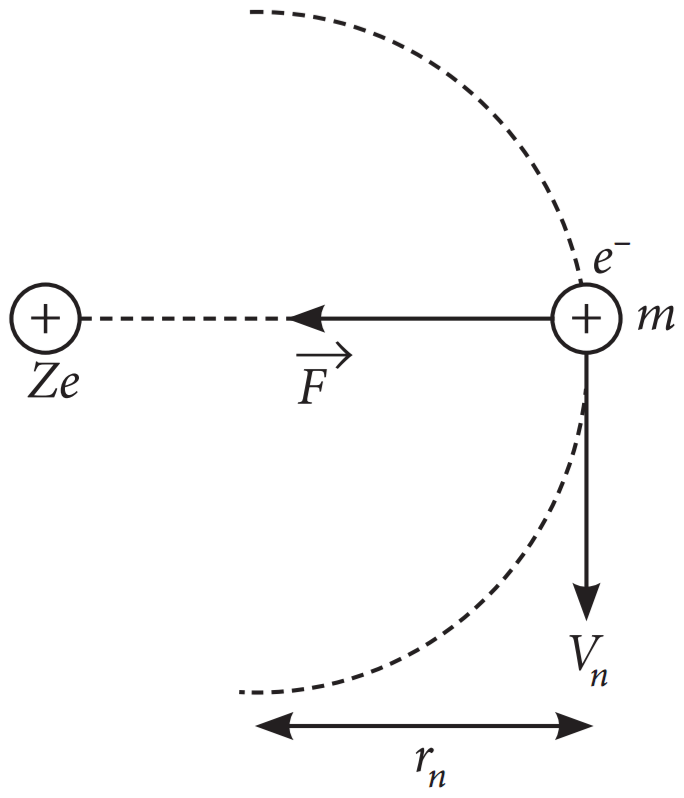
Hydrogen is the simplest atom of nature. There is one proton in its nucleus and an electron moves around the nucleus in a circular orbit. According to Niels Bohr, this electron moves in a stationary orbit. When this electron is in the stationary orbit, it emits no electromagnetic radiation.The angular momentum of the electron is quantized, i.e., ⁣$\text{mvr}=\big(\frac{\text{nh}}{2\pi}\big)$ where m = mass of the electron, v = velocity of the electron in the orbit, r = radius of the orbit and n = 1, 2, 3, .... When transition takes place from Kth orbit to Jth orbit, energy photon is emitted. If the wavelength of the emitted photon is $\lambda$ we find that $\frac{1}{\lambda}=\text{R}\bigg[\frac{1}{\text{J}^2}-\frac{1}{\text{K}^2}\bigg]$where find that On a different planet, the hydrogen atom's structure was somewhat different from ours. The angular momentum of electron was $\text{P}=2\text{n}\Big(\frac{\text{h}}{2\pi}\Big)$ i.e., an even multiple of $\Big(\frac{\text{h}}{2\pi}\Big)$.

  1. The minimum permissible radius of the orbit will be.
  1. $\frac{2\in_0\text{h}^2}{\text{m}\pi\text{e}^2}$
  2. $\frac{4\in_0\text{h}^2}{\text{m}\pi\text{e}^2}$
  3. $\frac{\in_0\text{h}^2}{\text{m}\pi\text{e}^2}$
  4. $\frac{\in_0\text{h}^2}{\text{2m}\pi\text{e}^2}$
  1. In our world, the velocity of electron is v0 when the hydrogen atom is in the ground state. The velocity of electron in this state on the other planet should be.
  1. $\text{v}_0$
  2. $\frac{\text{v}_0}{2}$
  3. $\frac{\text{v}_0}{4}$
  4. $\frac{\text{v}_0}{8}$
  1. In our world, the ionization potential energy of a hydrogen atom is 13.6eV. On the other planet, this ionization potential energy will be.
  1. 13.6eV
  2. 3.4eV
  3. 1.5eV
  4. 0.85eV
  1. Check the correctness of the following statements about the Bohr model of hydrogen atom.
  1. The acceleration of the electron in n = 2 orbit is more than that in n = 1 orbit.
  2. The angular momentum of the electron in n = 2 orbit is more than that in n = 1 orbit.
  3. The kinetic energy of the electron in n = 2 orbit is less than that in n = 1 orbit.
  1. Only (III) and (I) are correct
  2. Only (III) and (I) are correct
  3. Only (II) and (III) are correct.
  4. All the statements are correct.
  1. In Bohr's model of hydrogen atom, let PE represent potential energy and TE the total energy. In going to a higher orbit.
  1. PE increases, TE decreases
  2. PE decreases, TE increases
  3. PE increases, TE increases
  4. PE decreases, TE decreases
State Bohr's quantization condition for defining stationary orbits. How does de-Broglie hypothesis explain stationary orbits ?
When white radiation is passed through a sample of hydrogen gas at room temperature, absorption lines are observed in Lyman series only. Explain.
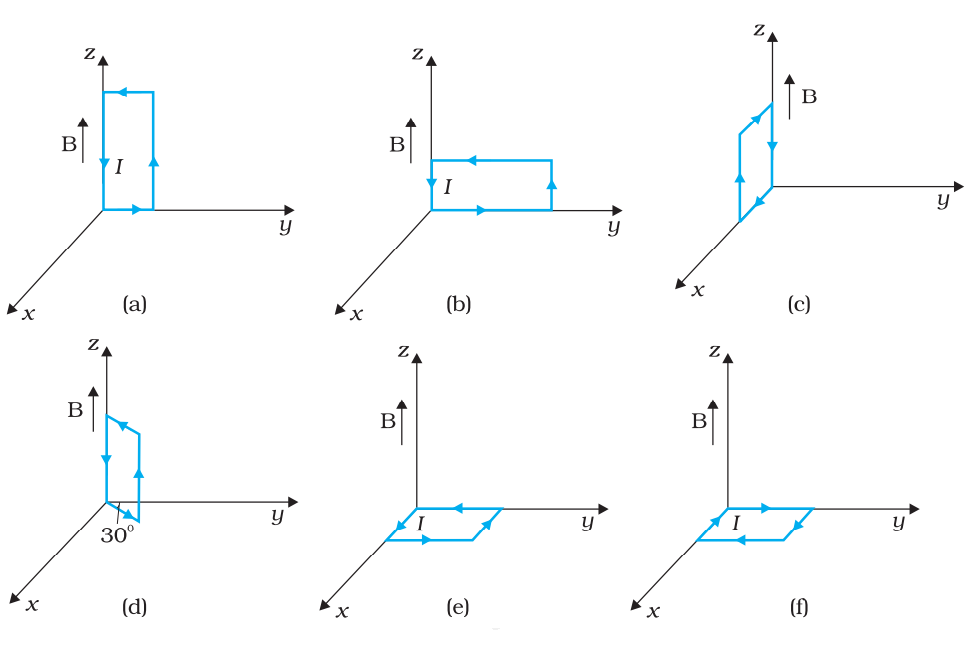
A uniform magnetic field of 3000 G is established along the positive z-direction. A rectangular loop of sides 10 cm and 5 cm carries a current of 12 A. What is the torque on the loop in the different cases shown in Fig.? What is the force on each case? Which case corresponds to stable equilibrium?

Suppose in an imaginary world the angular momentum is quantized to be even integral multiples of $\frac{\text{h}}{2\pi}$ What is the longest possible wavelength emitted by hydrogen atoms in visible range in such a world according to Bohr's model?