Question
Suppose in an imaginary world the angular momentum is quantized to be even integral multiples of $\frac{\text{h}}{2\pi}$ What is the longest possible wavelength emitted by hydrogen atoms in visible range in such a world according to Bohr's model?
Answer

Even quantum numbers are allowed,
$\text{n}_1=2,\text{n}_2=4\xrightarrow{\ \ \ }$ For minimum energy or for longest possible wavelength.
$\text{E}=13.6\bigg(\frac{1}{\text{n}^2_1}-\frac{1}{\text{n}^2_2}\bigg)$
$\text{E}=13.6\Big(\frac{1}{2^2}-\frac{1}{4^2}\Big)=2.55$
$2.55=\frac{\text{hc}}{\lambda}$
$\lambda=\frac{\text{hc}}{2.55}=\frac{1242}{2.55}$
$\lambda=487.05\text{nm}=487\text{nm}$

Need a full question paper?

Generate a complete, print-ready paper with questions like this in minutes — across 16+ boards, with answer keys.

Start Generating Free

Similar questions

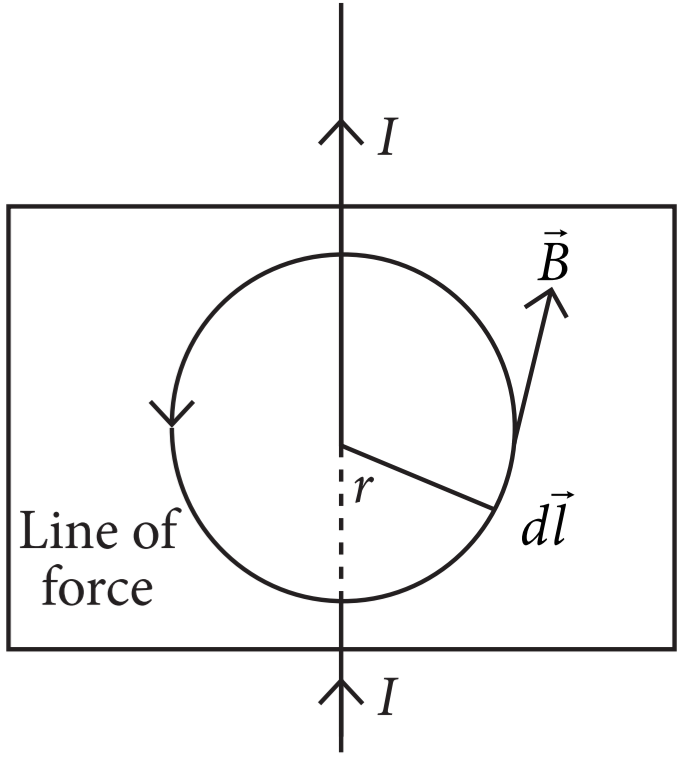
Ampere's law gives a method to calculate the magnetic field due to given current distribution. According to it, the circulation $\oint\vec{\text{B}}.\text{d}\vec{\text{l}}$ di of the resultant magnetic field along a closed plane curve is equal to $\mu_0$ times the total current crossing the area bounded by the closed curve provided the electric field inside the loop remains constant. Ampere's law is more useful under certain synunetrical conditions. Consider one such case of a long Straight wire with circular cross-section (radius R) carrying current f uniformly distributed across this cross-section.

  1. The magnetic field at a radial distance r from the centre of the wire in the region r > R, is:
  1. $\frac{\mu_0\text{I}}{2\pi\text{r}}$

  2. $\frac{\mu_0\text{I}}{2\pi\text{R}}$

  3. $\frac{\mu_0\text{IR}^2}{2\pi\text{r}}$

  4. $\frac{\mu_0\text{Ir}^2}{2\pi\text{R}}$

  1. The magnetic field at a distance r in the region r < R is:
  1. $\frac{\mu_0\text{I}}{2\text{r}}$

  2. $\frac{\mu_0\text{Ir}^2}{2\pi\text{R}^2}$

  3. $\frac{\mu_0\text{I}}{2\pi\text{r}}$

  4. $\frac{\mu_0\text{Ir}}{2\pi\text{R}^2}$

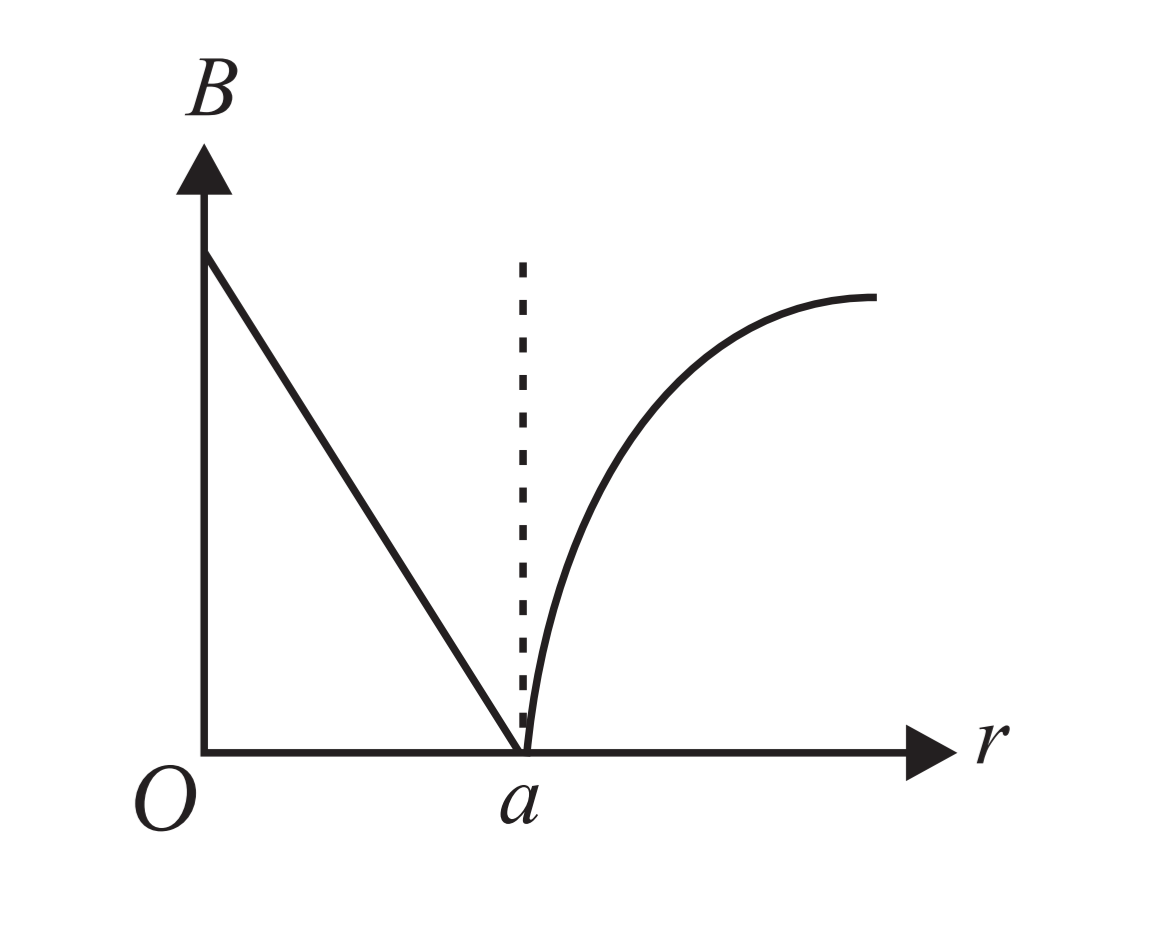
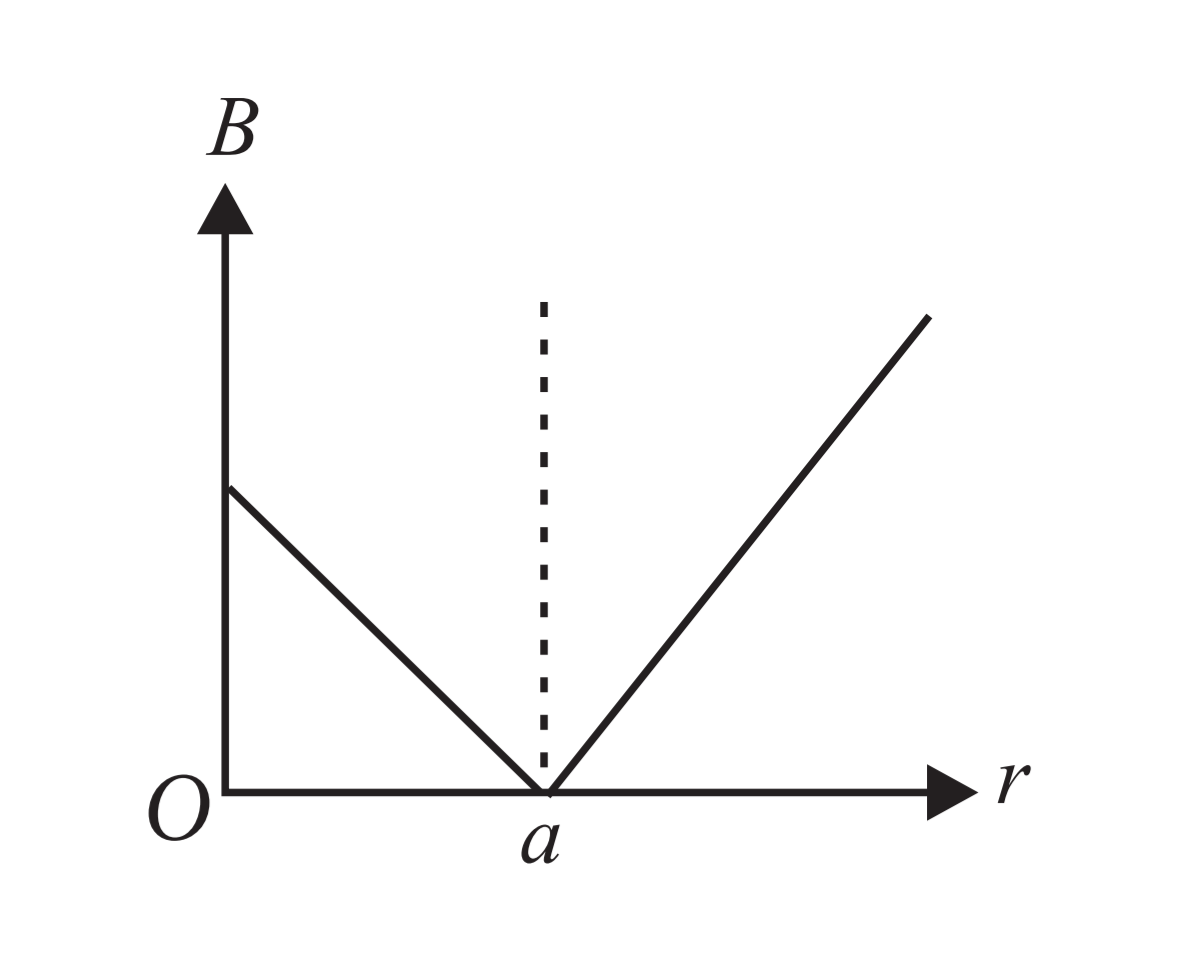
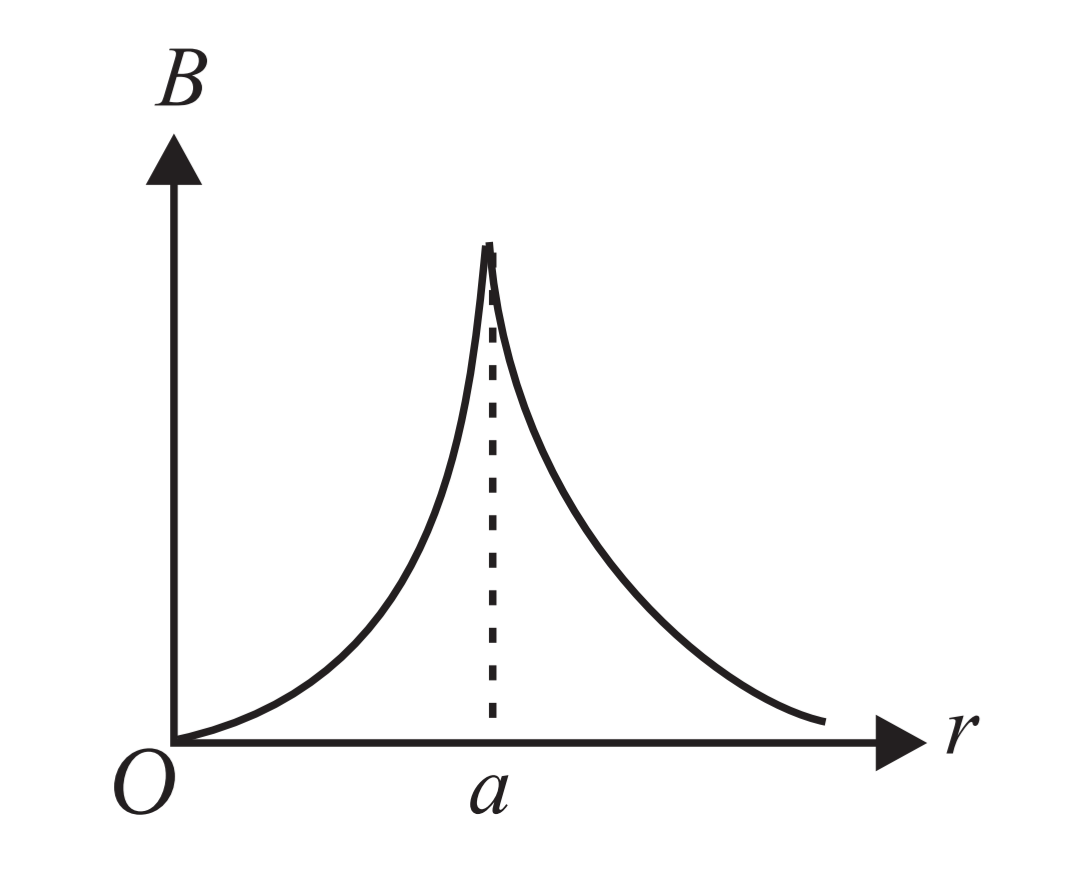
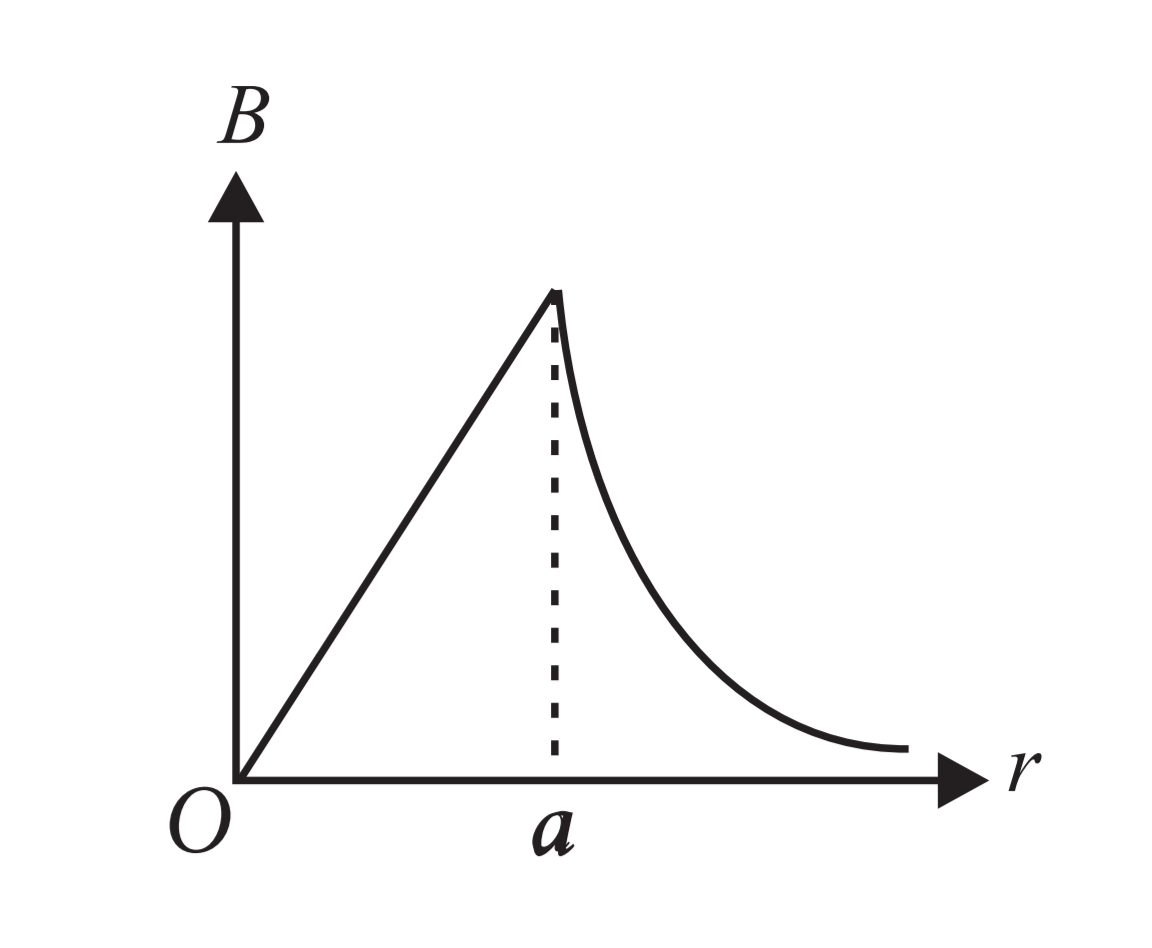
  1. A long straight wire of a circular cross section (radius a) carries a steady current I and the current I is uniformly distributed across this cross-section. Which of the following plots represents the variation of magnitude of magnetic field B with distance r from the centre of the wire?
  1.  

  1.  

  1.  

  1.  

  1. A long straight wire of radius R carries a steady current I. The current is uniformly distributed across its cross-section. The ratio of magnetic field at $\frac{\text{R}}{2}$ and 2R is:
  1. $\frac{\text{1}}{\text{2}}$

  2. $2$

  3. $\frac{\text{1}}{\text{4}}$

  4. $1$ 

  1. A direct current I flows along the length of an infinitely long straight thin walled pipe, then the magnetic field is:
  1. Uniform throughout the pipe but not zero.
  2. Zero only along the axis of the pipe.
  3. Zero at any point inside the pipe.
  4. Maximum at the centre and minimum at the edges. 
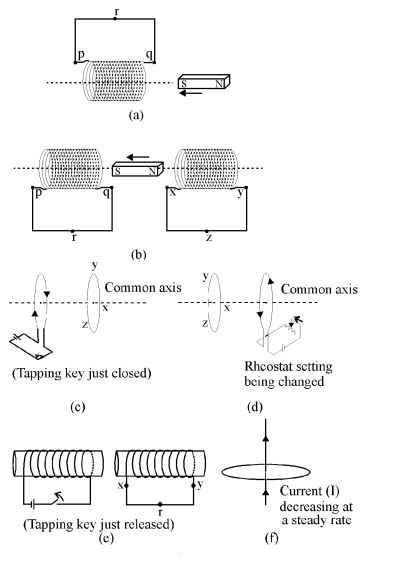
Predict the direction of induced current in the situations described by the following figures (a) to (f).
Image
The saturation current from a thoriated-tungsten cathode at 2000K is 100mA. What will be the saturation current for a pure-tungsten cathode of the same surface area operating at the same temperature? The constant A in the Richardson-Dushman equation is 60 × 104Am-2K-2 for pure tungsten and 3.0 × 10⁴Am-2k-2 for thoriated tungsten. The work function of pure tungsten is 4.5eV and that of thoriated tungsten is 2.6eV.
For a circular coil of radius R and N turns carrying current I, the magnitude of the magnetic field at a point on its axis at a distance x from its centre is given by,
$\text{B}=\frac{\mu_{0}\text{IR}^{2}\text{N}}{2(\text{x}^{2}+\text{R}^{2})^{\frac{3}{2}}}$
  1. Show that this reduces to the familiar result for field at the centre of the coil.
  2. Consider two parallel co-axial circular coils of equal radius R, and number of turns N, carrying equal currents in the same direction, and separated by a distance R. Show that the field on the axis around the mid-point between the coils is uniform over a distance that is small as compared to R, and is given by,$\text{B}=0.72\frac{\mu_{0}\text{NI}}{\text{R}}$, approximately.
[Such an arrangement to produce a nearly uniform magnetic field over a small region is known as Helmholtz coils.]
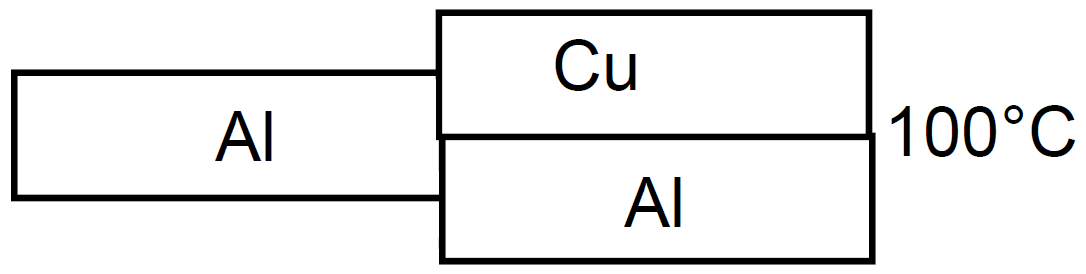
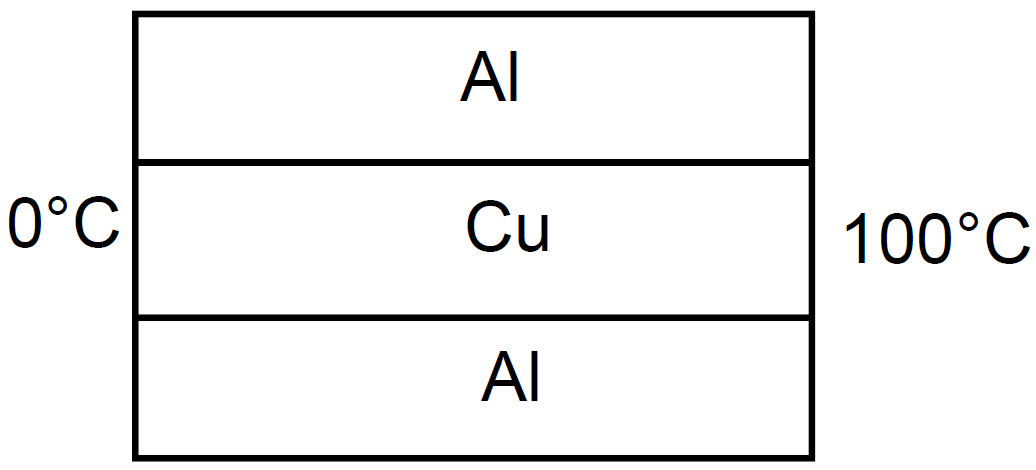
The three rods shown in figure, have identical geometrical dimensions. Heat flows from the hot end at a rate of 40 Win the arrangement (a) Find the rates of heat flow when the rods are joined as in arrangement (b) and in (c) Thermal conductivities of aluminium and copper are 200Wm-1°C-1 and 400Wm-1°C-1 respectively.

  1.  

  1.  

  1.  

Explain Bohr's atomic model.
###
State three postulates of Bohr's atomic model.
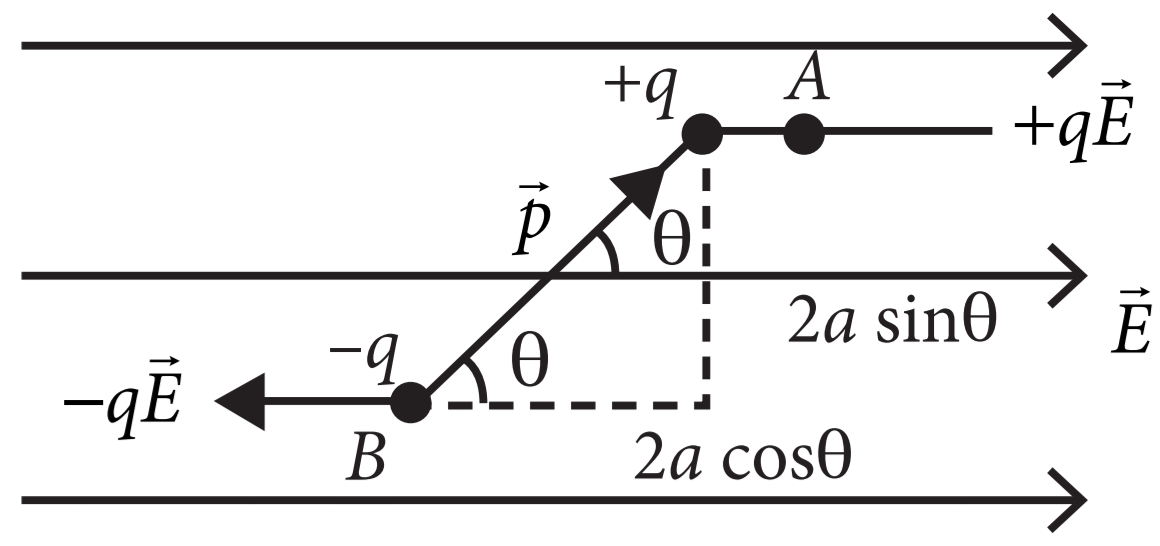
When electric dipole is placed in uniform electric field, its two charges experience equal and opposite forces, which cancel each other and hence net force on electric dipole in uniform electric field is zero. However, these forces are not collinear, so they give rise to some torque on the dipole. Since net force on electric dipole in uniform electric field is zero, so no work is done in moving the electric dipole in uniform electric field. However, some work is done in rotating the dipole against the torque acting on it.

  1. The dipole moment of a dipole in a uniform external field $\vec{\text{E}}$ is $\vec{\text{P}}.$ Then the torque 'i acting on the dipole is:
  1. $\vec{\tau}=\vec{\text{P}}\times\vec{\text{E}}$

  2. $\vec{\tau}=\vec{\text{P}}\cdot\vec{\text{E}}$

  3. $\vec{\tau}=2(\vec{\text{P}}+\vec{\text{E}})$

  4. $\vec{\tau}=(\vec{\text{P}}+\vec{\text{E}})$

  1. An electric dipole consists of two opposite charges, each of magnitude $1.0\mu\text{C}$ separated by a distance of 2.0cm. The dipole is placed in an external field of 105N C-1. The maximum torque on the dipole is:
  1. 0.2 × 10-3Nm
  2. 1 × 10⁻³Nm
  3. 2 × 10-3Nm
  4. 4 × 10⁻³Nm
  1. Torque on a dipole in uniform electric field is minimum when $\theta$ is equal to:
  1. 90º
  2. 180º
  3. Both (a) and (c)
  1. When an electric dipole is held at an angle in a uniform electric field, the net force F and torque t on the dipole are:
  1. $\text{F}=0, \tau=0$

  2. $\text{F}\not=0, \tau\not=0$

  3. $\text{F}=0, \tau\not=0$

  4. $\text{F}\not=0, \tau=0$

  1. An electric dipole of moment pis placed in an electric field of intensity E. The dipole acquires a position such that the axis of the dipole makes an angle $\theta$ with the direction of the field. Assuming that the potential energy of the dipole to be zero when $\theta=90^\circ$ the torque and the potential energy of the dipole will respectively be:
  1. $\text{pE}\sin\theta,-\text{pE}\cos\theta$

  2. $\text{pE}\sin\theta,-2\text{pE}\cos\theta$

  3. $\text{pE}\sin\theta,2\text{pE}\cos\theta$

  4. $\text{pE}\cos\theta,-2\text{pE}\sin\theta$

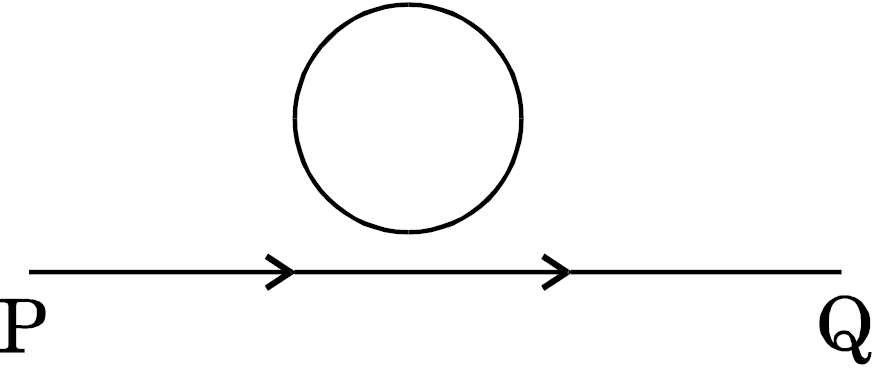
A conducting loop is held above a current carrying wire ‘PQ’ as shown in the figure. Depict the direction of the current induced in the loop when the current in the wire PQ is constantly increasing.