Question
A lamp is connected in series with a capacitor. Predict your observations for dc and ac connections. What happens in each case if the capacitance of the capacitor is reduced?

Answer

When a de source is connected to a capacitor, the capacitor gets charged and after charging no current flows in the circuit and the lamp will not glow. There will be no change even if $C$ is reduced. With ac source, the capacitor offers capacitative reactance $(1 / \omega C)$ and the current flows in the circuit. Consequently, the lamp will shine. Reducing $C$ will increase reactance and the lamp will shine less brightly than before.

Need a full question paper?

Generate a complete, print-ready paper with questions like this in minutes — across 16+ boards, with answer keys.
Start Generating Free

Similar questions

A free neutron beta $-$ decays to a proton with a half $-$ life of $14$ minutes.
  1. What is the decay constant?
  2. Find the energy liberated in the process.
A sphere of radius 5 cm has a charge of 31.41 µC. Calculate the surface density of charge.
What is point electric charge?
A short bar magnet placed with its axis at $30^\circ$ with a uniform external magnetic field of $0.25 T$ experiences a torque of magnitude equal to $4.5 \times 10^{–2}J.$ What is the magnitude of magnetic moment of the magnet?
A circular wire-loop of radius a carries a total charge Q distributed uniformly over its length. A small length dL of the wire is cut off. Find the electric field at the centre due to the remaining wire.
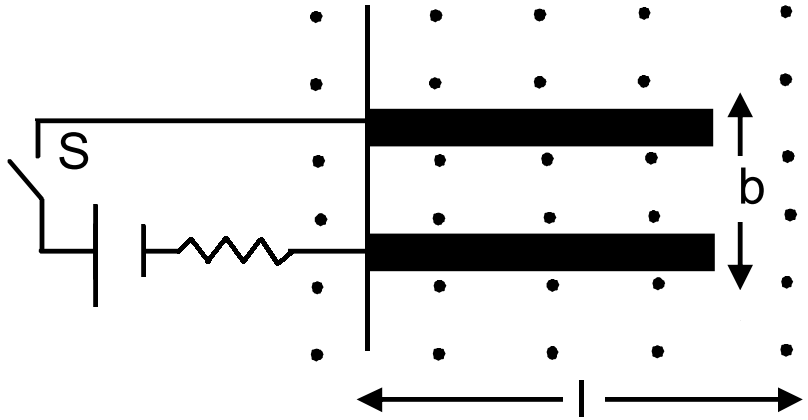
Two metal strips, each of length l, are clamped parallel to each other on a horizontal floor with a separation b between them. A wire of mass m lies on them perpendicularly, as shown in A vertically-upward magnetic field of strength B exists in the space. The metal strips are smooth but the coefficient of friction between the wire and the floor is $\mu.$ A current i is established when the switch S is closed at the instant t = 0. Discuss the motion of the wire after the switch is closed. How far away from the strips will the wire reach?
Is neutral temperature always the arithmetic mean of inversion temperature and the temperature of the cold junction? Does the unit of temperature have an effect in deciding this question?
A magnetic needle free to rotate in a vertical plane parallel to the magnetic meridian has its north tip pointing down at $22^\circ$ with the horizontal. The horizontal component of the earth’s magnetic field at the place is known to be $0.35 G.$ Determine the magnitude of the earth’s magnetic field at the place.
A and B are two conducting spheres of equal radius, in which sphere $A$ is solid and sphere $B$ is hollow. Both are charged to the same potential. What will be the relation between the charges on both the spheres?
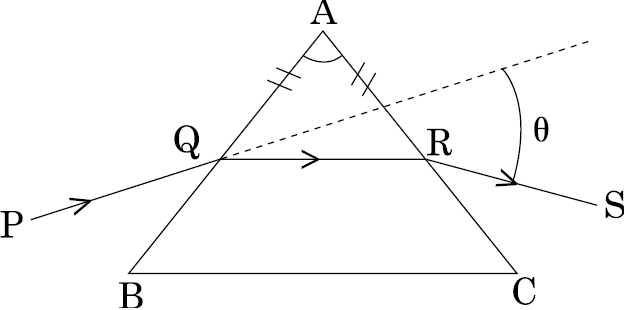
A ray $\text{PQ}$ incident on the refracting face $\text{BA}$ is refracted in the prism $\text{BAC}$ as shown in the figure and emerges from the other refracting face $\text{AC}$ as $\text{RS}$ such that $\text{AQ = AR}$. If the angle of prism $\text{A} = 60^\circ$ and refractive index of material of prism is$\sqrt{3}$, calculate angle $\theta.$