Symbol of Inductance in electric circuit is-
Question types
Alternating Current question types
472 questions across 7 question groups — pick any mix to generate a Physics paper with step-by-step answer keys.
472
Questions
7
Question groups
5
Question types
01
M.C.Q (1 Marks)
177 Q→02Assertion (A) & Reason (B) MCQ
15 Q→031 Marks Question
38 Q→042 Marks Questions
61 Q→053 Marks Question
126 Q→064 Marks Questions
12 Q→075 Marks Questions
43 Q→Sample Questions
Alternating Current questions
One sample from each question group in this chapter. Select any group above to see the full set with answer keys.
View full solution →
Which one of the following graphs in following figure represents variation of reactance $′X_c\ ′$ of a capacitor with frequency $'f\ '$ of an ac supply?
View full solution →With increase in frequency of an A.C. supply, the inductive reactance.
The line that draws power supply to your house from street has:
When a voltage measuring device is connected to $AC$ mains, the meter shows the steady input voltage of $220V.$ This means,
View full solution →For two statements are given-one labelled Assertion (A) and the other labelled Reason (R). Select the correct answer to these questions from the codes (a), (b), (c) and (d) as given below.
Reason: Magnitude of alternating current varies with time.
- Both A and R are true and R is the correct explanation of A.
- Both A and R are true but R is not the correct explanation of A.
- A is true but R is false.
- A is false and R is also false.
Reason: Magnitude of alternating current varies with time.
For two statements are given-one labelled Assertion $(A)$ and the other labelled Reason $(R)$. Select the correct answer to these questions from the codes $(a), (b), (c)$ and $(d)$ as given below.
Assertion: $A$ bulb connected in series with a solenoid is connected to $A.C.$ source.
If a soft iron core is introduced in the solenoid, the bulb will glow brighter.
Reason: On introducing soft iron core in the solenoid, the inductance decreases.
Assertion: $A$ bulb connected in series with a solenoid is connected to $A.C.$ source.
If a soft iron core is introduced in the solenoid, the bulb will glow brighter.
Reason: On introducing soft iron core in the solenoid, the inductance decreases.
- ABoth $A$ and $R$ are true and $R$ is the correct explanation of $A$.
- BBoth $A$ and $R$ are true but $R$ is not the correct explanation of $A$.
- ✓$A$ is true but $R$ is false.
- D$A$ is false and $R$ is also false.
Answer: C.
View full solution →For two statements are given-one labelled Assertion (A) and the other labelled Reason (R). Select the correct answer to these questions from the codes (a), (b), (c) and (d) as given below.
Reason: The inductive reactance increases as the frequency of A. C. source decreases.
View full solution →- Both A and R are true and R is the correct explanation of A.
- Both A and R are true but R is not the correct explanation of A.
- A is true but R is false.
- A is false and R is also false.
Reason: The inductive reactance increases as the frequency of A. C. source decreases.
For two statements are given-one labelled Assertion (A) and the other labelled Reason (R). Select the correct answer to these questions from the codes (a), (b), (c) and (d) as given below.
Reason: In L-R circuit voltage leads the current by phase angle which depends on the value ofinductance and resistance both.
View full solution →- Both A and R are true and R is the correct explanation of A.
- Both A and R are true but R is not the correct explanation of A.
- A is true but R is false.
- A is false and R is also false.
Reason: In L-R circuit voltage leads the current by phase angle which depends on the value ofinductance and resistance both.
For two statements are given-one labelled Assertion (A) and the other labelled Reason (R). Select the correct answer to these questions from the codes (a), (b), (c) and (d) as given below.
Reason: For large distance, voltage has to be large.
- Both A and R are true and R is the correct explanation of A.
- Both A and R are true but R is not the correct explanation of A.
- A is true but R is false.
- A is false and R is also false.
Reason: For large distance, voltage has to be large.
A pure inductor of $25.0 mH$ is connected to a source of $220 V$. Find the inductive reactance and rms current in the circuit if the frequency of the source is $50 Hz$.
View full solution →At an airport, a person is made to walk through the doorway of a metal detector, for security reasons. If she/he is carrying anything made of metal, the metal detector emits a sound. On what principle does this detector work?
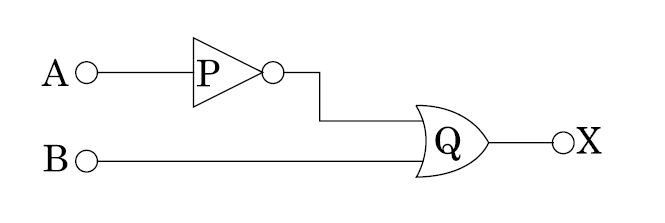
Name the logic gates marked P and Q in the given logic circuit.
Define the term relaxation time' in a conductor.
Two wires one of copper and other of manganin have same resistance and equal length. Which wire is thicker and why?
A small town with a demand of 800kW of electric power at 220V is situated 15km away from an electric plant generating power at 440V. The resistance of the two wire line carrying power is 0.5Ω per km. The town gets power from the line through a 4000-220V step-down transformer at a sub-station in the town.
- Estimate the line power loss in the form of heat.
- How much power must the plant supply, assuming there is negligible power loss due to leakage?
- Characterise the step up transformer at the plant.
A light bulb and an open coil inductor are connected to an ac source through a key as shown in Fig. 7.9.
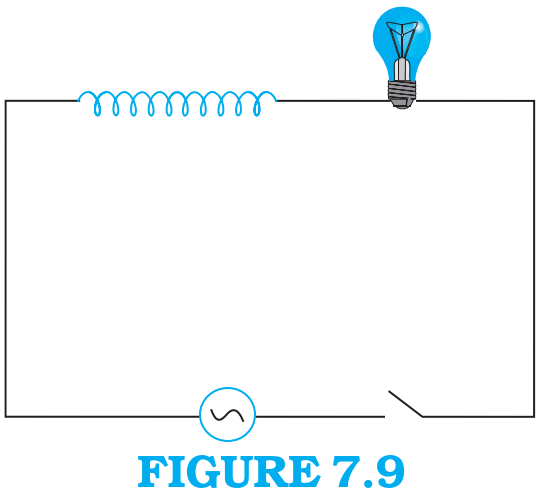
The switch is closed and after sometime, an iron rod is inserted into the interior of the inductor. The glow of the light bulb (a) increases; (b) decreases; (c) is unchanged, as the iron rod is inserted. Give your answer with reasons.
The switch is closed and after sometime, an iron rod is inserted into the interior of the inductor. The glow of the light bulb (a) increases; (b) decreases; (c) is unchanged, as the iron rod is inserted. Give your answer with reasons.
A $15.0 \mu F$ capacitor is connected to a $220 V , 50 Hz$ source. Find the capacitive reactance and the current (rms and peak) in the circuit. If the frequency is doubled, what happens to the capacitive reactance and the current?
View full solution →A lamp is connected in series with a capacitor. Predict your observations for dc and ac connections. What happens in each case if the capacitance of the capacitor is reduced?
A light bulb is rated at $100 W$ for a $220 V$ supply. Find (a) the resistance of the bulb; (b) the peak voltage of the source; and (c) the rms current through the bulb.
View full solution →A series $\text{LCR}$ circuit with $R = 20\Omega , L = 1.5H$ and $C = 35\mu F$ is connected to a variable$-$frequency $200V$ ac supply. When the frequency of the supply equals the natural frequency of the circuit, what is the average power transferred to the circuit in one complete cycle?
View full solution →Obtain the resonant frequency and $\text{Q}-$factor of a series $\text{LCR}$ circuit with $\text{L} = 3.0\text{H, C} = 27\ \mu \text{F},$ and $\text{R} = 7.4\Omega$ . It is desired to improve the sharpness of the resonance of the circuit by reducing its ‘full width at half maximum’ by a factor of $2$. Suggest a suitable way.
View full solution →Obtain the resonant frequency $ωr$ of a series $\text{LCR}$ circuit with $L = 2.0H, C = 32\mu F$ and $R = 10\Omega .$ What is the $Q-$value of this circuit?
View full solution →Suppose the circuit in Exercise $7.18$ has a resistance of $15\Omega.$ Obtain the average power transferred to each element of the circuit, and the total power absorbed
View full solution →A $60\mu F$ capacitor is connected to a $110V, 60Hz$ ac supply. Determine the rms value of the current in the circuit.
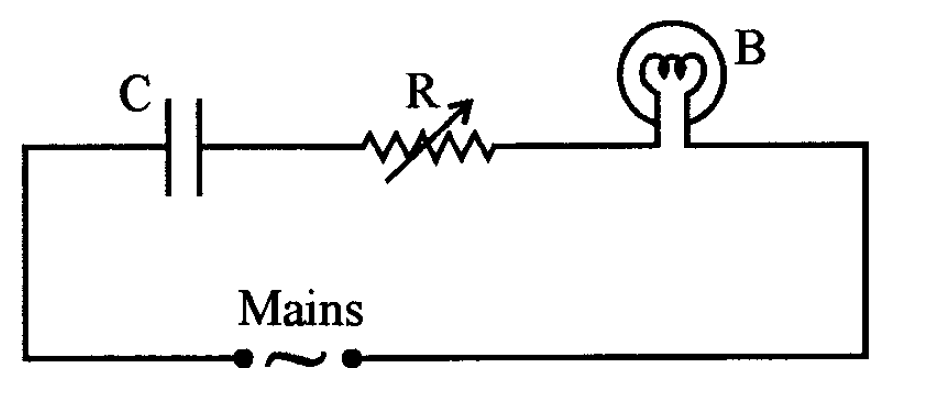
View full solution →A capacitor'C', a variable resistor 'R' and a bulb 'B' are connected in series to the ac mains in circuit as shown. The bulb glows with some brightness. How will the glow of the bulb change if (i) a dielectric slab is introduced between the plates of the capacitor, keeping resistance R to be the same; (ii) the resistance R is increased keeping the same capacitance?
A transformer is an electrical device which is used for changing the a.c. voltages. It is based on the phenomenon of mutual induction i.e. whenever the amount of magnetic flux linked with a coil changes, an $\text{e.m.f.}$ is induced in the neighbouring coil. For an ideal transformer, the resistances of the primary and secondary windings are negligible.
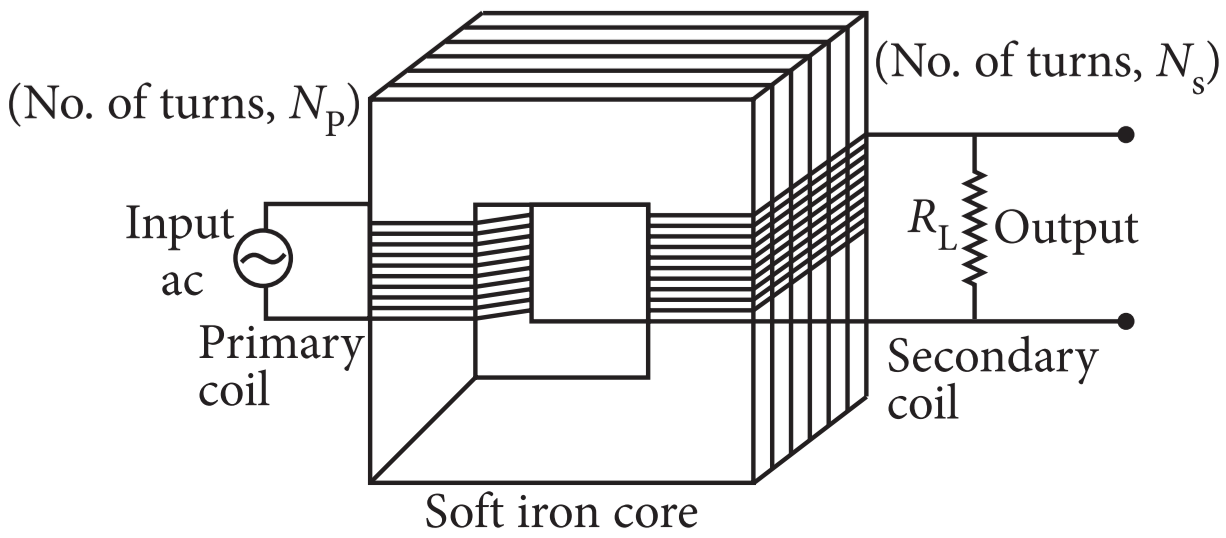
It can be shown that $\frac{\text{E}_\text{S}}{\text{E}_\text{P}}=\frac{\text{I}_\text{P}}{\text{I}_\text{S}}=\frac{\text{n}_\text{S}}{\text{n}_\text{P}}=\text{K}$
where the symbols have their standard meanings.
For a step up transformer, $\text{n}_\text{S} > \text{n}_\text{P}; \text{E}_\text{S} > \text{E}_\text{P}; \text{k} > \text{I}; \therefore \text{I}_\text{S} < \text{I}_\text{P}$
For a step down transformer, $\text{n}_\text{S} > \text{n}_\text{P}; \text{E}_\text{S} > \text{E}_\text{P}; \text{k} > \text{I};$
The above relations are on the assumptions that efficiency of transfonner is $100\%.$
lnfact, efficiency $\eta=\frac{\text{output power}}{\text{intput power }}=\frac{\text{E}_\text{S}\text{I}_\text{S}}{\text{E}_\text{P}\text{I}_\text{P}}$
View full solution →It can be shown that $\frac{\text{E}_\text{S}}{\text{E}_\text{P}}=\frac{\text{I}_\text{P}}{\text{I}_\text{S}}=\frac{\text{n}_\text{S}}{\text{n}_\text{P}}=\text{K}$
where the symbols have their standard meanings.
For a step up transformer, $\text{n}_\text{S} > \text{n}_\text{P}; \text{E}_\text{S} > \text{E}_\text{P}; \text{k} > \text{I}; \therefore \text{I}_\text{S} < \text{I}_\text{P}$
For a step down transformer, $\text{n}_\text{S} > \text{n}_\text{P}; \text{E}_\text{S} > \text{E}_\text{P}; \text{k} > \text{I};$
The above relations are on the assumptions that efficiency of transfonner is $100\%.$
lnfact, efficiency $\eta=\frac{\text{output power}}{\text{intput power }}=\frac{\text{E}_\text{S}\text{I}_\text{S}}{\text{E}_\text{P}\text{I}_\text{P}}$
- Which of the following quantity remains constant in an ideal transformer?
- Current.
- Voltage.
- Power.
- All of these.
- Transformer is used to.
- Convert ac to de voltage.
- Convert de to ac voltage.
- Obtain desired de power.
- Obtain desired ac voltage and current.
- The number of tums in primary coil of a transformer is 20 and the number of turns in a secondary is 10. If the voltage across the primary is ac 220V, what is the voltage across the secondary?
- $ac\ 100V$
- $ac\ 120V$
- $ac\ 110V$
- $ac\ 220V$
- In a transformer the number of primary turns is four times that of the secondary turns. Its primary is connected to an a.c. source of voltage $V.$ Then,
- Current through its secondary is about four times that of the current through its primary.
- Voltage across its secondary is about four times that of the voltage across its primary.
- Voltage across its secondary is about two times that of the voltage across its primary.
- voltage across its secondary is about $\frac{1}{2\sqrt{2}}$ times that of the voltage across its primary.
- A transformer is used to light $100W-110V$ lamp from $220V$ mains. If the main current is $0.5A$, the efficiency of the transformer is:
- $95\%$
- $99\%$
- $90\%$
- $96\%$
The household supply of electricity is at 220V (rms value) and 50Hz. Find the peak voltage and the least possible time in which the voltage can change from the rms value to zero.
An $LC$ circuit also called a resonant circuit, tank circuit or tuned circuit is an electric circuit consisting of an inductor represented by the letter Land a capacitor, represented by the letter $C$ connected together. An $LC$ circuit is an idealized model since it assumes there is no dissipation of energy due to resistance. An $LC$ circuit contains a $20mH$ inductor and a $50\mu\text{F}$ capacitor with an initial charge of $10mC$. The resistance of the circuit is negligible. Let the instant the circuit is closed bet $= 0$.
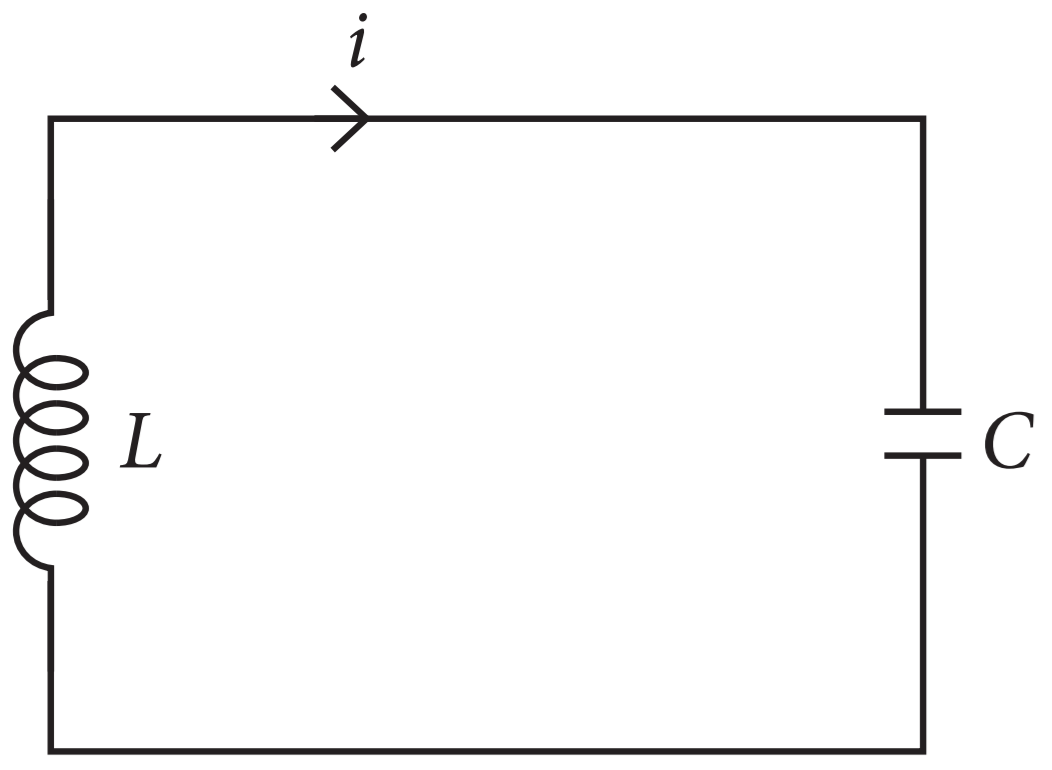
View full solution →
- The total energy stored initially is:
- $5J$
- $3J$
- $10J$
- $1J$
- The natural frequency of the circuit is:
- $159.24Hz$
- $200.12Hz$
- $110.25Hz$
- $95Hz$
- At what time is the energy stored completely electrical?
- $0, 5\text{T}, 9\text{T}$
- $0,\text{T}, 2\text{T}, 3\text{T}$
- $\frac{\text{T}}{2},\frac{\text{5T}}{2},\frac{\text{9T}}{2}$
- $0,\frac{\text{T}}{2},{\text{T}},\frac{\text{3T}}{2}$
- At what time is the energy stored completely magnetic?
- $\frac{\text{T}}{2},\frac{\text{3T}}{2},\frac{\text{T}}{4}$
- $\frac{\text{T}}{3},\frac{\text{T}}{9},\frac{\text{T}}{12}$
- $0, 2\text{T}, 3\text{T}$
- $\frac{\text{T}}{4},\frac{\text{3T}}{4},\frac{\text{5T}}{4}$
- The value of $X_L$ is:
- $20\Omega$
- $40\Omega$
- $60\Omega$
- $50\Omega$
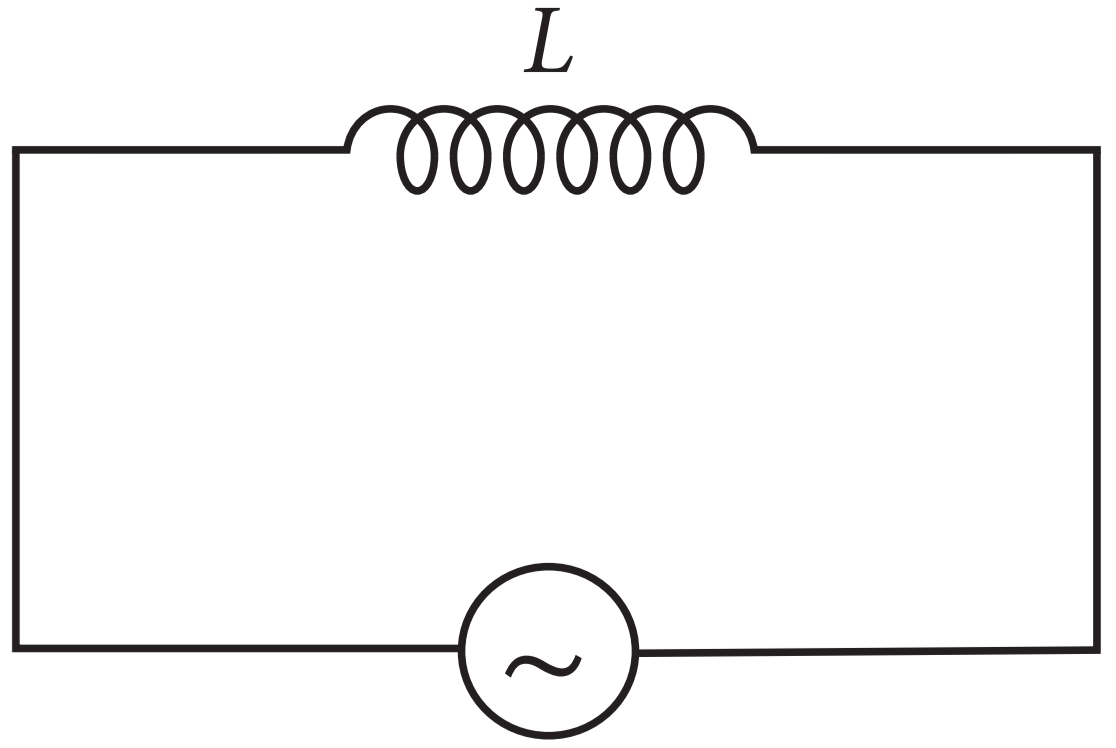
Let a source of alternating e.m.f. $\text{E} = \text{E}_\circ\sin\omega\text{t}$ be connected to a circuit containing a pure inductance L. If I is the value of instantaneous current in the circuit, then $\text{I}=\text{I}_\circ\sin\Big(\omega\text{t}-\frac{\pi}{2}\Big).$ The inductive reactance limits the current in a purely inductive circuit and is given by $\text{X}_\text{L}= \text{W}_\text{L}.$
View full solution →
- A 100 hertz a.c. is flowing in a 14mH coil. The reactance is:
- $15\Omega$
- $7.7\Omega$
- $8.8\Omega$
- $10\Omega$
- In a pure inductive circuit, resistance to the flow of current is offered by:
- Resistor
- Inductor
- Capacitor
- Resistor and inductor
- In a inductive circuit, by what value of phase angle does alternating current lags behind e.m.f.?
- 45º
- 90º
- 120º
- 75º
- How much inductance should be connected to 200V, 50Hz a.c. supply so that a maximum current of 0.9A flows through it?
- 5H
- 1H
- 10H
- 4.5H
- The maximum value of current when inductance of 2H is connected to 150V, 50Hz supply is:
- 0.337A
- 0.721A
- 1.521A
- 2.522A
A small town with a demand of $800\ \text{kW}$ of electric power at $220V$ is situated $15\ km$ away from an electric plant generating power at $440V.$ The resistance of the two wire line carrying power is $0.5\Omega$ per $ km.$ The town gets power from the line through a $4000-220V$ step$-$down transformer at a sub$-$station in the town.
View full solution →- Estimate the line power loss in the form of heat.
- How much power must the plant supply, assuming there is negligible power loss due to leakage?
- Characterise the step up transformer at the plant.
(a) For circuits used for transporting electric power, a low power factor implies large power loss in transmission. Explain.
(b) Power factor can often be improved by the use of a capacitor of appropriate capacitance in the circuit. Explain.
(b) Power factor can often be improved by the use of a capacitor of appropriate capacitance in the circuit. Explain.
During a thunderstorm the ‘live' wire of the transmission line fell down on the ground. A group of boys passing through noticed it and some of them wanted to place the wire by the side. As they were approaching the wire and trying to lift it, Bari noticed it and immediately pushed them away to prevent them from touching the wire. Two of them got hunt in the process. Bari took them to a doctor to get medical aid.
Based on the above paragraph, answer the following:
Based on the above paragraph, answer the following:
- Write two values which Bari displayed during the incident.
- Why is it that a bird can sit over a suspended ‘live' wire without any harm whereas touching it on the ground can give a fatal shock?
- The electric power from a power plant is set up to a very high voltage before transmitting it to distant consumers. Write the reason for it.
Hari is a student of Class X in a school near his village. His uncle gifted him a bicycle with a dynamo fitted in it. He was thrilled to find that while cycling during night, he could light the bulb and see the objects on the road clearly. He, however, did not know how this device works. He asked this question to his teacher. The teacher considered it an opportunity and explained the working of a dynamo to the whole class.
Answer the following questions:
Answer the following questions:
- State the principle and working of a dynamo.
- Write two values each displayed by Hari and his Science teacher.
Shiv had a high tension tower erected on his farm land. He kept complaining to the authorities to remove it since it occupied a large portion of his land. His uncle, who was a teacher, explained to him the need for erecting these towers for efficient transmission of power. As Shiv got convinced and realised significance, he stopped complaining.
Based on the above paragraph, answer the following questions:
Based on the above paragraph, answer the following questions:
- Why is it necessary to transport power at high voltages?
- ‘A low power factor implies large power loss'. Explain.
- Write the two values displayed by Shiv and his Uncle.
Generate a Alternating Current paper free
Pick question groups from the list above, set marks and difficulty, and export a branded PDF with step-by-step answer keys. First 3 chapters free — no signup.