Question
A large conducting plane has a surface charge density $1.0\times10^{-4}\text{Cm}^{-2}.$ Find the electrostatic energy stored in a cubical volume of edge 1.0cm in front of the plane.

Answer

$\sigma=1\times10^{-4}\text{c/m}^2$
$\text{a}=1\text{cm}=1\times10^{-2}\text{m}$
$\text{a}^3=10^{-6}\text{m}$
The energy stored in the plane $=\frac{1}{2}\frac{\sigma^2}{\epsilon_0}=\frac{1}{2}\frac{(1\times10^{-4})^2}{8.85\times10^{-12}}$
$=\frac{10^4}{17.7}=564.97$
The necessary electro static energy stored in a cubical volume of edge 1cm infront of the plane $=\frac{1}{2}\frac{\sigma^2}{\epsilon_0}\text{a}^3=265\times10^{-6}=5.65\times10^{-4}\text{J}$

Need a full question paper?

Generate a complete, print-ready paper with questions like this in minutes — across 16+ boards, with answer keys.
Start Generating Free

Similar questions

A $2.00m$ long rope, having a mass of $80g,$ is fixed at one end and is tied to a light string at the other end. The tension in the string is $256N.$
  1. Find the frequencies of the fundamental and the first two overtones.
  2. Find the wavelength in the fundamental and the first two overtones.
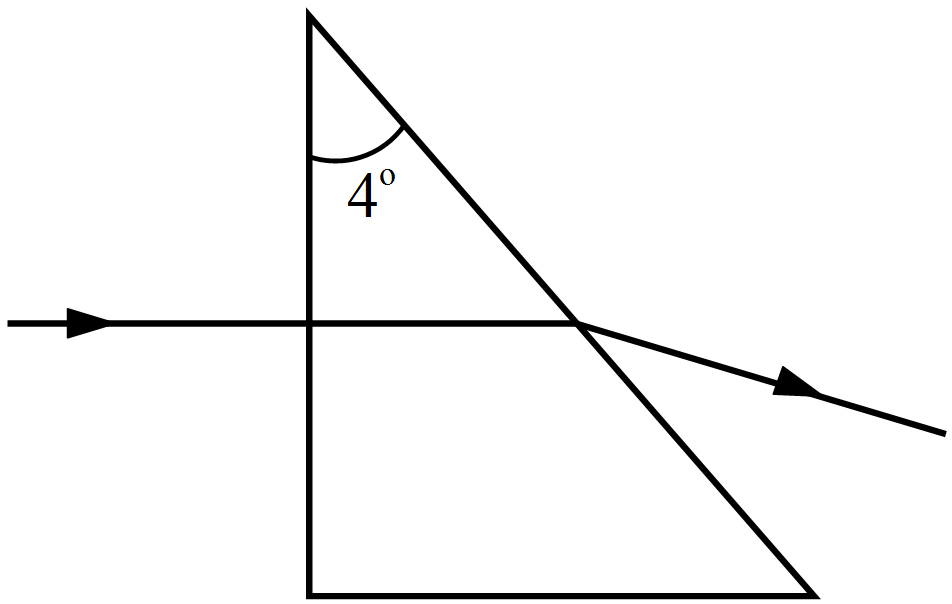
Find the angle of deviation suffered by the light ray shown in figure. The refractive index $\mu=1.5$ for the prism material.
An ideal diode should pass a current freely in one direction and should stop it completely in the opposite direction. Which is closer to ideal-vacuum diode or a p-n junction diode?
Solve the previous problem if the paperweight is inverted at its place so that the spherical surface touches the paper.
Two capacitors of capacitance $10\mu\text{F}$ and $20 \mu\text{F}$ are connected in series with a $6 V$ battery. After the capacitors are fully charged, a slab of dielectric constant $(K)$ is inserted between the plates of the two capacitors. How will the following be affected after the slab is introduced:
  1. The electric field energy stored in the capacitors.
  2. The charges on the two capacitors.
  3. The potential difference between the plates of the capacitors.
Justify your answer.
(a) Determine the electrostatic potential energy of a system consisting of two charges $7 \mu C$ and $-2 \mu C$ (and with no external field) placed at ( $-9 cm , 0,0)$ and $(9 cm , 0,0)$ respectively.
(b) How much work is required to separate the two charges infinitely away from each other?
(c) Suppose that the same system of charges is now placed in an external electric field $E=A\left(1 / r^2\right) ; A=9 \times 10^5 NC ^{-1} m ^2$. What would the electrostatic energy of the configuration be?
Should the energy of a photon be called its kinetic energy or its internal energy?
The half-life of a radioisotope is 10h. Find the total number of disintegrations in the tenth hour measured from a time when the activity was 1Ci.
Prove that the structure of helium and oxygen nuclei is more stable than that of deuterium nuclei.
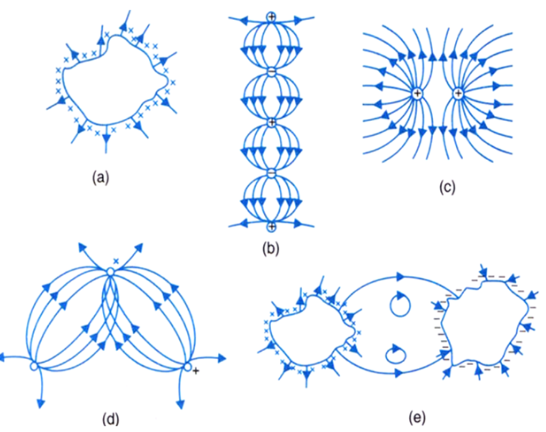
Which among the curves shown in Fig. 1.35 cannot possibly represent electrostatic field lines?