Question
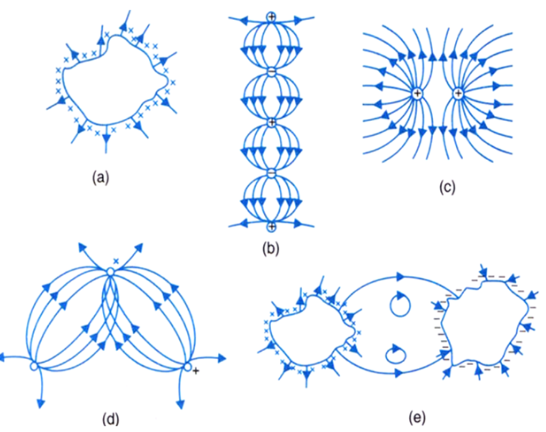
Which among the curves shown in Fig. 1.35 cannot possibly represent electrostatic field lines?

Answer

  1. Figure (a) cannot represent electrostatic field lines since electrostatic field lines start or end only at 90° to the surface of the conductor.
  2. Figure (b) too cannot represent electrostatic field lines as electrostatic field lines do not start from a negative charge. Electric field lines always traverse from a region of positive charge to a region of negative charge.
  3. Electrostatic field lines are represented by figure (c).
  4. Figure (d) cannot represent electrostatic field lines since no two such lines of force can intersect each other.
  5. As electrostatic field lines cannot form closed loop, therefore figure (d) also does not represent electrostatic field lines.

Need a full question paper?

Generate a complete, print-ready paper with questions like this in minutes — across 16+ boards, with answer keys.
Start Generating Free

Similar questions

A converging lens and a diverging mirror are placed at a separation of 15cm. The focal length of the lens is 25cm and that of the mirror is 40cm. Where should a point source be placed between the lens and the mirror so that the light, after getting reflected by the mirror and then getting transmitted by the lens, comes out parallel to the principal axis?
For a system made of two very long coaxial solenoids, explain mutual inductance. Prove $M _{12}= M _{21}= M$ $($Reciprocity Theorem$).$
Why is the mass of a nucleus always less than the sum of the masses of its constituents, neutrons and protons?If the total number of neutrons and protons in a nuclear reaction is conserved, how then is the energy absorbed or evolved in the reaction? Explain.
Figure shows a uniform rod of length $30\ cm$ having a mass of $3.0\ kg$. The strings shown in the figure are pulled by constant forces of $20N$ and $32N$. Find the force exerted by the $20\ cm$ part of the rod on the $10\ cm$ part. All the surfaces are smooth and the strings and the pulleys are light.
A small spherical ball is released from a point at a height h on a rough track shown in figure. Assuming that it does not slip anywhere, find its linear speed when it rolls on the horizontal part of the track.
A small flat search coil of area $5 \ cm^2$ with $140$ closely wound turns is placed between the poles of a powerful magnet producing magnetic field $0.09 T$ and then quickly removed out of the field region. Calculate
$a.$ change of magnetic flux through the coil, and
$b.$ emf induced in the coil.
Suppose the rod in the previous problem has a mass of $1\ kg$ distributed uniformly over its length:
  1. Find the initial angular acceleration of the rod.
  2. Find the tension in the supports to the blocks of mass $2\ kg$ and $5\ kg.$
A boy is holding a smooth, hollow and non-conducting pipe vertically with charged spherical ball of mass 10 g carrying a charge of +10 mC inside it which is free to move along the axis of the pipe. The boy is moving the pipe from East to West direction in the presence of magnetic field of 2T. With what minimum velocity, should the boy move the pipe such that the ball does not move along the axis. Also determine the direction of the magnetic field.
Two identically charged particles are fastened to the two ends of a spring of spring constant $100Nm^{-1}$ and natural length $10\ cm.$ The system rests on a smooth horizontal table. If the charge on each particle is $2.0 \times 10^{-8}C$, find the extension in the length of the spring. Assume that the extension is small as compared to the natural length. Justify this assumption after you solve the problem.
$2g$ of hydrogen is sealed in a vessel of volume $0.02m^3$ and is maintained at $300K$. Calculate the pressure in the vessel.