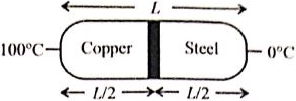
A large cylindrical rod of length $L$ is made by joining two identical rods of copper and steel of length $(\frac {L}{2})$ each . The rods are completely insulated from the surroundings. If the free end of copper rod is maintained at $100\,^oC$ and that of steel at $0\,^oC$ then the temperature of junction is........$^oC$ (Thermal conductivity of copper is $9\,times$ that of steel)
AIEEE 2012, Medium


Download our appand get started for free
Experience the future of education. Simply download our apps or reach out to us for more information. Let's shape the future of learning together!No signup needed.*
Similar Questions
- 1A human body has a surface area of approximately $1 \mathrm{~m}^2$. The normal body temperature is $10 \mathrm{~K}$ above the surrounding room temperature $T_0$. Take the room temperature to be $T_0=300 \mathrm{~K}$. For $T_0=300 \mathrm{~K}$, and the value of $\sigma \mathrm{T}_0^4=460 \mathrm{Wm}^{-2}$ (where $\sigma$ is the Stefan-Boltzmann constant). Which of the following option is/are correct?View Solution
[$A$] The amount of energy radiated by the body in $1$ second is close to $60$ Joules.
[$B$] If the surrounding temperature reduces by a small amount $\Delta \mathrm{T}_0<<\mathrm{T}_0$, then to maintain the same body temperature the same (living) human being needs to radiate $\Delta \mathrm{W}=4 \sigma \mathrm{T}_0^3 \Delta \mathrm{T}_0$ more energy per unit time.
[$C$] Reducing the exposed surface area of the body ($e.g$ by curling up) allows humans to maintain the same body temperature while reducing the energy lost by radiation.
[$D$] If the body temperature rises significantly then the peak in the spectrum of electromagnetic radiation emitted by the body would shift to longer wavelengths.
- 2Which of the following statements is/are $CORRECT$ Correct option areView Solution
$(i)$ a body with large reflectivity is a poor emitter
$(ii)$ a brass tumbler feels much colder than a wooden tray on a chilly day
$(iii)$ the earth without its atmosphere would be inhospitably cold
$(iv)$ heating systems based on circulation of steam are more efficient in warming a building than those based on circulation of hot water
- 3Four rods of indentical cross-sectional area and made from the same metal form the sides of a square. The temperature of two diagonally opposite points are $\theta$ and $\sqrt2 \theta$ respectively in the teady state. Assuming that only heat conduction takes place, what will be the temperature difference between other two points ?View Solution
- 4The maximum wavelength of radiation emitted at $2000\;K$is $4\mu m$. What will be the maximum wavelength of radiation emitted at $2400\,K$ is ...... $\mu m$View Solution
- 5A container contains hot water at ${100^o}C$. If in time ${T_1}$ temperature falls to ${80^o}C$ and in time ${T_2}$ temperature falls to ${60^o}C$ from ${80^o}C$, thenView Solution
- 6The black body spectrum of an object $O _1$ is such that its radiant intensity (i.e. intensity per unit wavelength interval) is maximum at a wavelength of $200\,nm$. Another object $O _2$ has the maximum radiant intensity at $600\,nm$. The ratio of power emitted per unit area by source $O _1$ to that of source $O _2$ isView Solution
- 7Two metallic blocks $M_{1}$ and $M_{2}$ of same area of cross-section are connected to each other (as shown in figure). If the thermal conductivity of $M _{2}$ is $K$ then the thermal conductivity of $M _{1}$ will be ]...............$K$ [Assume steady state heat conduction]View Solution

- 8A solid cylinder of length $L$ and radius $r$ is heat upto same temperature as that of a cube of edge length $a$. If both have same material, volume and allowed to cool under similar conditions, then ratio of amount of radiations radiated will be (Neglect radiation emitted from flat surfaces of the cylinder)View Solution
- 9The end $A$ of a rod $AB$ of length $1\,m$ is maintained at $80\,^oC$ and the end $B$ at $0\,^oC.$ The temperature at a distance of $60\,\,c.m.$ from the end $A$ is......... $^oC$View Solution
- 10View SolutionAir is bad conductor of heat or partly conducts heat, still vacuum is to be placed between the walls of the thermos flask because