Four rods of indentical cross-sectional area and made from the same metal form the sides of a square. The temperature of two diagonally opposite points are $\theta$ and $\sqrt2 \theta$ respectively in the teady state. Assuming that only heat conduction takes place, what will be the temperature difference between other two points ?
Medium
Download our app for free and get started

Download our appand get started for free
Experience the future of education. Simply download our apps or reach out to us for more information. Let's shape the future of learning together!No signup needed.*
Similar Questions
- 1If the temperature of the sun were to be increased from $T$ to $2T$ and its radius from $R$ to $2R$ , then the ratio of the radiant energy received on the earth to what it was previously will beView Solution
- 2View SolutionAt a certain temperature for given wave length, the ratio of emissive power of a body to emissive power of black body in same circumstances is known as
- 3A partition wall has two layers $A$ and $B$ in contact, each made of a different material. They have the same thickness but the thermal conductivity of layer $A$ is twice that of layer $B$. If the steady state temperature difference across the wall is $60K$, then the corresponding difference across the layer $A$ is ....... $K$View Solution
- 4The sun emits a light with maximum wavelength $510\, mm$ while another star $X$ emits a light with maximum wavelength of $350\, nm$. What is the ratio of surface temperature of sun and the star $X$View Solution
- 5A body takes $5$ minutes to cool from $90^oC$ to $60^oC$. If the temperature of the surroundings is $20^oC$, the time taken by it to cool from $60^oC$ to $30^oC$ will be ...... $\min.$View Solution
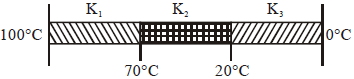
- 6Three rods of identical cross-section and lengths are made of three different materials of thermal conductivity $K _{1}, K _{2},$ and $K _{3}$, respectively. They are joined together at their ends to make a long rod (see figure). One end of the long rod is maintained at $100^{\circ} C$ and the ther at $0^{\circ} C$ (see figure). If the joints of the rod are at $70^{\circ} C$ and $20^{\circ} C$ in steady state and there is no loss of energy from the surface of the rod, the correct relationship between $K _{1}, K _{2}$ and $K _{3}$ isView Solution
- 7The two ends of a metal rod are maintained at temperatures $100 ^o C$ and $110^o C$. The rate of heat flow in the rod is found to be $4.0\ J/s$. If the ends are maintained at temperatures $200^o\ C$ and $210^o\ C$, the rate of heat flow will be.... $J/s$View Solution
- 8View SolutionHeat travels through vacuum by
- 9View SolutionIf the initial temperatures of metallic sphere and disc, of the same mass, radius and nature are equal, then the ratio of their rate of cooling in same environment will be
- 10The total radiant energy per unit area, normal to the direction of incidence, received at a distance $R$ from the centre of a star of radius $r$, whose outer surface radiates as a black body at a temperature $T\ K$ is given byView Solution