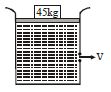
A large cylindrical tank of cross-sectional area $1\ m^2 $ is filled with water. It has a small hole at a height of $1\ m $ from the bottom. $A$ movable piston of mass $5$ $kg$ is fitted on the top of the tank such that it can slide in the tank freely without friction. A load of $45$ $kg$ is applied on the top of water by piston, as shown in figure. The value of $v$ when piston is $7$ $m$ above the bottom is $(g = 10\ m/s^2)$ ....... $m/s$
Diffcult


Download our appand get started for free
Experience the future of education. Simply download our apps or reach out to us for more information. Let's shape the future of learning together!No signup needed.*
Similar Questions
- 1View SolutionThe displacement of a ball falling from rest in a viscous medium is platted against time. Choose a possible option
- 2A cylindrical vessel of cross-section $A$ contains water to a height $h$ . There is a hole in the bottom of radius $'a'$ . The time in which it will be emptied isView Solution
- 3The density of the atmosphere is $1.29\, kg/m^3$, then how high would the atmosphere extend ? $(g = 9.81\, m/sec^2)$ ........ $km$View Solution
- 4A cylinder of height $ 20\; m$ is completely filled with water. The velocity of efflux of water (in $ m/s$) through a small hole on the side wall of the cylinder near its bottom is ....... $m/s$View Solution
- 5A tank $5\, m$ high is half-filled with water and then is filled to the top with oil of density $0.85\, g/cm^3$. The pressure at the bottom of the tank, due to these liquids is ....... $g\, dyne/cm^2$View Solution
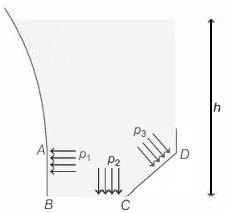
- 6A tall tank filled with water has an irregular shape as shown. The wall $C D$ makes an angle of $45^{\circ}$ with the horizontal, the wall $A B$ is normal to the base $B C$. The lengths $A B$ and $C D$ are much smaller than the height $h$ of water (figure not to scale). Let $p_1, p_2$ and $p_3$ be the pressures exerted by the water on the wall $A B$, base $B C$ and the wall $C D$ respectively. Density of water is $\rho$ and $g$ is acceleration due to gravity. Then, approximatelyView Solution
- 7A rectangular block is $5 cm × 5 cm × 10cm$ in size. The block is floating in water with $ 5 cm $ side vertical. If it floats with $10 cm $ side vertical, what change will occur in the level of water?View Solution
- 8A uniform solid cylinder of density $0.8$ $g/cm^3$ floats in equilibrium in a combination of two non-mixing liquid $A$ and $B$ with its axis vertical. The densities of liquid $A$ and $B$ are $0.7$ $g/cm^3$ and $1.2$ $gm/cm^3$. The height of liquid $A$ is $h_A = 1.2$ $cm$ and the length of the part of cylinder immersed in liquid $B$ is $h_B = 0.8$ $cm$. Then the length part of the cylinder in air is ....... $cm$View Solution
- 9View SolutionWhy the dam of water reservoir is thick at the bottom
- 10The rate of flow of liquid in a tube of radius $r,$ length $ l,$ whose ends are maintained at a pressure difference $P$ is $V = \frac{{\pi QP\,{r^4}}}{{\eta l}}$ where $\eta $ is coefficient of the viscosity and $Q$ isView Solution