Why the dam of water reservoir is thick at the bottom
Easy
Download our app for free and get started
(c)A torque is acting on the wall of the dam trying to make it topple. The bottom is made very broad so that the dam will be stable.

Download our appand get started for free
Experience the future of education. Simply download our apps or reach out to us for more information. Let's shape the future of learning together!No signup needed.*
Similar Questions
- 1A cubical block is floating in a liquid with one fourth of its volume immersed in the liquid. If whole of the system accelerates upward with acceleration $g / 4$, the fraction of volume immersed in the liquid will be ..........View Solution
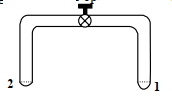
- 2A glass tube of uniform internal radius ( $\mathrm{r}$ ) has a valve separating the two identical ends. Initially, the valve is in a tightly closed position. End $1$ has a hemispherical soap bubble of radius $\mathrm{r}$. End $2$ has sub-hemispherical soap bubble as shown in figure. Just after opening the valve,View Solution
Figure: $Image$
- 3A plane is in level flight at constant speed and each of its two wings has an area of $40 \mathrm{~m}^2$. If the speed of the air is $180 \mathrm{~km} / \mathrm{h}$ over the lower wing surface and $252 \mathrm{~km} / \mathrm{h}$ over the upper wing surface, the mass of the plane is______ $\mathrm{kg}$. (Take air density to be $1 \mathrm{~kg} \mathrm{~m}^{-3}$ and $\mathrm{g}=10 \mathrm{~ms}^{-2}$ )View Solution
- 4A large vessel of height $H$, is filled with a liquid of density $\rho$, upto the brim. A small hole of radius $r$ is made at the side vertical face, close to the base. The horizontal force is required to stop the gushing of liquid is ...........View Solution
- 5A solid sphere, of radius $R$ acquires a terminal velocity $\nu_1 $ when falling (due to gravity) through a viscous fluid having a coefficient of viscosity $\eta $. The sphere is broken into $27$ identical solid spheres. If each of these spheres acquires a terminal velocity, $\nu_2$, when falling through the same fluid, the ratio $(\nu_1/\nu_2)$ equalsView Solution
- 6A vessel of area of cross-section A has liquid to a height $H$ . There is a hole at the bottom of vessel having area of cross-section a. The time taken to decrease the level from ${H_1}$ to ${H_2}$ will beView Solution
- 7Two cubes of size $1.0$ $m$ sides, one of relative density $0.60$ and another of relative density $=$ $1.15$ are connected by weightless wire and placed in a large tank of water. Under equilibrium the lighter cube will project above the water surface to a height of ........ $cm$View Solution
- 8A tank is filled with water of density $1\,g$ per $cm^3$ and oil of density $0.9\,g$ per $cm^3$ . The height of water layer is $100\,cm$ and of the oil layer is $400\,cm.$ If $g = 980\,cm/sec^2,$ then the velocity of efflux from an opening in the bottom of the tank isView Solution
- 9A cylindrical tank of height $1$ $m$ and cross section area $A$ $=$ $4000$ $cm^2$ is initially empty when it is kept under a tap of cross sectional area $1$ $cm^2$. Water starts flowing from the tap at $t$ $=$ $0$, with a speed $= $ $2$ $m/s$. There is a small hole in the base of the tank of cross-sectional area $0.5$ $cm^2$. The variation of height of water in tank (in meters) with time $t$ is best depicted byView Solution
- 10Water from a pipe is coming at a rate of $100\, litres$ per minute. If the radius of the pipe is $5\, cm$, the Reynolds number for the flow is of the order of : (density of water $= 1000\, kg/m^3$, coefficient of viscosity of water $= 1\, mPa\, s$)View Solution