Question
A large force is needed to normally separate two glass plates having a thin layer of water between them. Why?

Answer

The thin layer of water between the glass plates forms a concave surface all around. This decreases the pressure on the inner side of the liquid film. Thus, a large amount of force is required to pull them apart against the atmospheric pressure.

Need a full question paper?

Generate a complete, print-ready paper with questions like this in minutes — across 16+ boards, with answer keys.
Start Generating Free

Similar questions

At what temperatures ($in ^oC$) will the speed of sound in air be 3 times its value at $O^oC$?
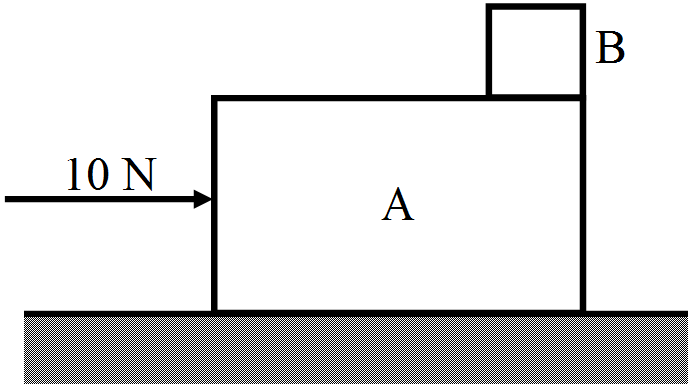
A small block B is placed on another block A of mass 5kg and length 20cm. Initially the block B is near the right end of block A. A constant horizontal force of 10N is applied to the block A. All the surfaces are assumed frictionless. Find the time elapsed before the block B separates from A.
Air pressure in a car tyre increases during driving. Explain.
What is the difference between head-on collision and glancing collision? Define coefficient of restitution.
Show graphically how g varies as you move from the centre of earth to great heights above the surface.
A ring, a disc and a sphere all of the same radius and same mass roll down on an inclined plane from the same height h. Which of the three reaches the bottom (i) earliest (ii) latest?
${ }^{57} \mathrm{Co}$ decays to ${ }^{57} \mathrm{Fe}$ by $\beta^{+}-$emission.- emission. The resulting ${ }^{57} \mathrm{Fe}$ is in its excited state and comes to the ground state by emitting $\gamma$ - rays. The half-life of $\beta^{+}-$ decay is 270 days and that of the $\gamma-$ emissions is $10^{-8} \mathrm{~s}$. A sample of ${ }^{57}$ Co gives $5.0 \times 10^9$ gamma rays per second. How much time will elapse before the emission rate of gamma rays drops to $2.5 \times 10^9$ per second?
Is the bulb of a thermometer made of diathermic or adiabatic wall?
Choose the correct alternative: If the zero of potential energy is at infinity, the total energy of an orbiting satellite is negative of its kinetic/ potential energy.
Which of the following functions of time represent (a) simple harmonic, (b) periodic but not simple harmonic, and (c) non-periodic motion? Give period for each case of periodic motion ($\omega$ is any positive constant): $3\cos\Big(\frac{\pi}{4}-2\omega\text{t}\Big)$