Question
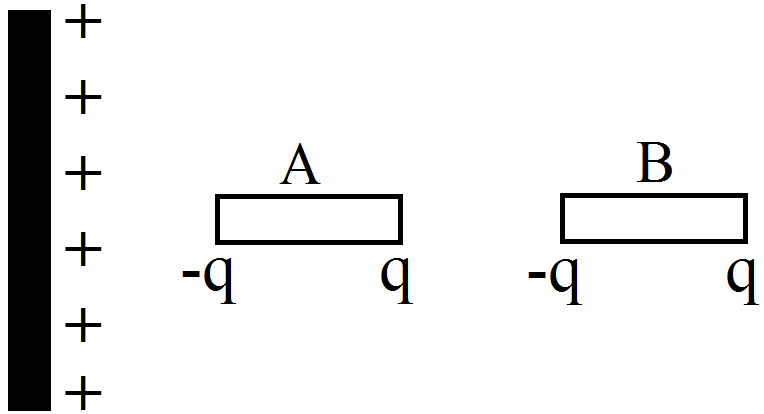
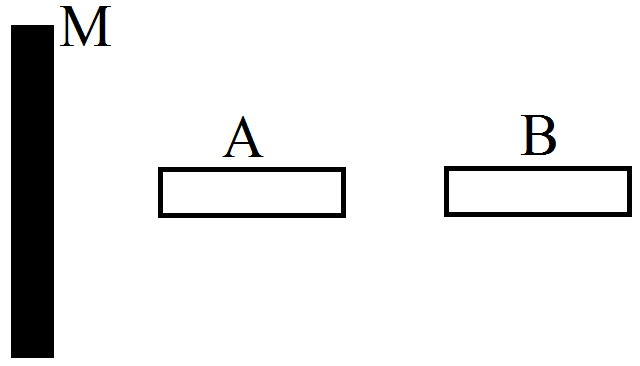
A large nonconducting sheet M is given a uniform charge density. Two uncharged small metal rods A and B are placed near the sheet as shown in figure:
  1. M attracts A.
  2. M attracts B.
  3. A attracts B.
  4. B attracts A.

Answer

  1. B attracts A.

Explanation:

Charge distribution or M, A & B

So, we can say that M attracts A, M attracts B, A attracts B and 'B' attracts A.

Need a full question paper?

Generate a complete, print-ready paper with questions like this in minutes — across 16+ boards, with answer keys.

Start Generating Free

Similar questions

In an interference experiment, the spacing between successive maxima or minima is  (Where the symbols have their usual meanings)

(a)        

(b)  

(c)        

(d)  

At the magnetic north pole of the earth, the value of horizontal component of earth's magnetic field and angle of dip are, respectively

(a) Zero, maximum

(b) Maximum, minimum

(c) Maximum, maximum

(d) Minimum, minimum

Liquid oxygen remains suspended between two pole faces of a magnet because it is

(a) Diamagnetic

(b) Paramagnetic

(c) Ferromagnetic

(d) Antiferromagnetic

Unit of magnetic flux density (or magnetic induction) is

(a) Tesla

(b) Weber/metre2

(c) Newton/ampere-metre

(d) All of the above

A piece of copper and the other of germanium are cooled from the room temperature to 80 K, then which of the following would be a correct statement

(a) Resistance of each increases

(b) Resistance of each decreases

(c) Resistance of copper increases while that of germanium decreases

(d) Resistance of copper decreases while that of germanium increases

Find out the minimum energy required to take out the only one electron from the ground state of Li+?

Angle of prism is A and its one surface is silvered. Light rays falling at an angle of incidence 2A on first surface return back through the same path after suffering reflection at second silvered surface. Refractive index of the material of prism is

(a) 2 sin A

(b) 2 cos A

(c)  

(d) tan A

The X – 1/T graph for an alloy of paramagnetic nature is shown in Fig. The curie constant is, then

(a) 57 K

(b) 2.8  

(c) 570 K 

(d) 17.5  

Time period for a magnet is T. If it is divided in four equal parts along its axis and perpendicular to its axis as shown then time period for each part will be

(a) 4T  

(b) T/4

(c) T/2     

(d) T

An electron jumps from the 4th orbit to the 2nd orbit of hydrogen atom. Given the Rydberg's constant  . The frequency in Hz of the emitted radiation will be

(a)  

(b)  

(c)  

(d)