Question types

Gausss Law question types

46 questions across 5 question groups — pick any mix to generate a Physics paper with step-by-step answer keys.

46
Questions
5
Question groups
5
Question types
Sample Questions

Gausss Law questions

One sample from each question group in this chapter. Select any group above to see the full set with answer keys.

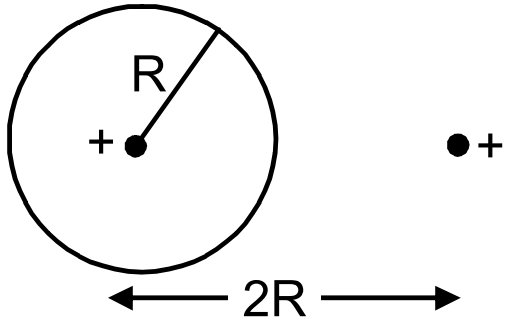
Find the flux of the electric field through a spherical surface of radius R due to a charge of 10-7C at the centre and another equal charge at a point 2R away from the centre.
View full solution
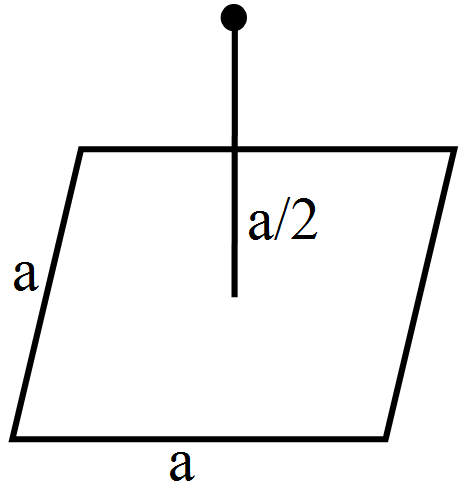
A charge Q is placed at a distance $\frac{\text{a}}{2}$ above the centre of a horizontal, square surface of edge a as shown in figure. Find the flux of the electric field through the square surface.

View full solution
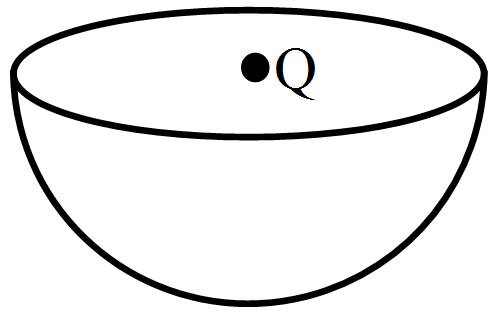
A charge Q is placed at the centre of an imaginary hemispherical surface. Using symmetry arguments and the Gauss's law, find the flux of the electric field due to this charge through the surface of the hemisphere (figure).

View full solution
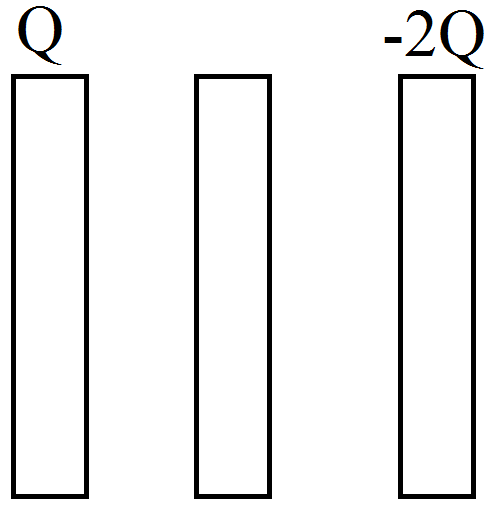
Three identical metal plates with large surface areas are kept parallel to each other as shown in figure. The leftmost plate is given a charge Q, the rightmost a charge -2Q and the middle one remains neutral. Find the charge appearing on the outer surface of the rightmost plate.

View full solution
A charge Q is uniformly distributed over a rod of length l. Consider a hypothetical cube of edge l with the centre of the cube at one end of the rod. Find the minimum possible flux of the electric field through the entire surface of the cube.
View full solution
A charged particle having a charge of -2.0 × 10⁻⁶C is placed close to a nonconducting plate having a surface charge density 4.0 × 10⁻⁵Cm-2. Find the force of attraction between the particle and the plate.
View full solution
A circular ring of radius r made of a nonconducting material is placed with its axis parallel to a uniform electric field. The ring is rotated about a diameter through 180°. Does the flux of electric field change? If yes, does it decrease or increase?
View full solution
Q 103 Marks Question3 Marks
The electric field in a region is given by $\overrightarrow{\text{E}}=\frac{3}{5}\text{E}_0\overrightarrow{\text{i}}+\frac{4}{5}\text{E}_0\overrightarrow{\text{j}}$ with $\text{E}_0=2.0\times10^3\text{NC}^{-1}.$ Find the flux of this field through a rectangular surface of area 0.2m2 parallel to the y-z plane.
View full solution
A rubber balloon is given a charge Q distributed uniformly over its surface. Is the field inside the balloon zero everywhere if the balloon does not have a spherical surface?
View full solution
A point charge q is placed in a cavity in a metal block. If a charge Q is brought outside the metal, will the charge q feel an electric force?
View full solution
Q 13M.C.Q (1 Marks)1 Mark
If flux of the electric field through a closed surface is zero:
  1. The electric field must be zero everywhere on the surface.
  2. The electric field may be zero everywhere in the surface.
  3. The charge inside the surface must be zero.
  4. The charge in the vicinity of the surface must be zero.
View full solution
Q 14M.C.Q (1 Marks)1 Mark
Electric charges are distributed in a small volume. The flux of the electric field through a spherical surface of radius 10cm surrounding the total charge is 25V-m. The flux over a concentric sphere of radius 20cm will be:
  1. 25V-m
  2. 50V-m
  3. 100V-m
  4. 200V-m
View full solution
Q 15M.C.Q (1 Marks)1 Mark
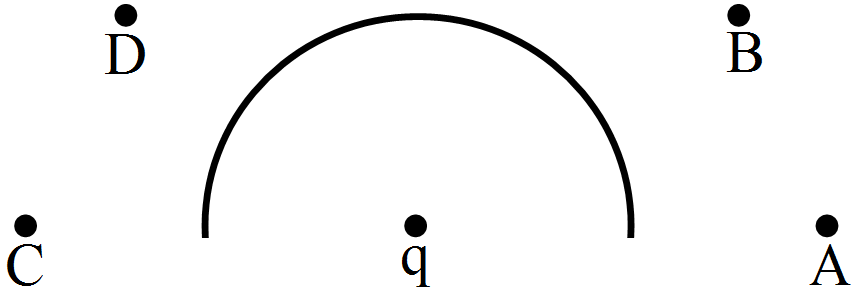
Figure shows a charge q placed at the centre of a hemisphere. A second charge Q is placed at one of the positions A, B, C and D. In which position(s) of this second charge, the flux of the electric field through the hemisphere remains unchanged?

  1. A
  2. B
  3. C
  4. D
View full solution
Q 16M.C.Q (1 Marks)1 Mark
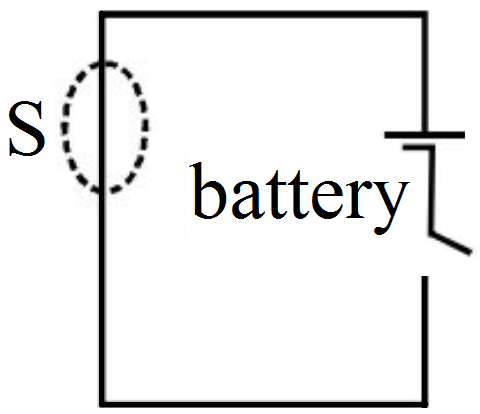
A closed surface S is constructed around a conducting wire connected to a battery and a switch (figure). As the switch is closed, the free electrons in the wire start moving along the wire. In any time interval, the number of electrons entering the closed surface S is equal to the number of electrons leaving it. On closing the switch, the flux of the electric field through the closed surface:

  1. Is increased.
  2. Is decreased.
  3. Remains unchanged.
  4. Remains zero.
View full solution
Q 17M.C.Q (1 Marks)1 Mark
A metallic particle having no net charge is placed near a finite metal plate carrying a positive charge. The electric force on the particle will be:
  1. Towards the plate.
  2. Away from the plate.
  3. Parallel to the plate.
  4. Zero.
View full solution
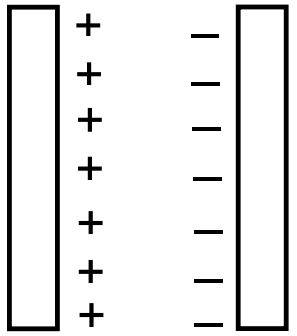
Two large conducting plates are placed parallel to each other and they carry equal and opposite charges with surface density $\sigma$ as shown in figure. Find the electric field:
  1. At the left of the plates.
  2. In between the plates.
  3. At the right of the plates.

View full solution
One end of a 10cm long silk thread is fixed to a large vertical surface of a charged nonconducting plate and the other end is fastened to a small ball having a mass of 10g and a charge of 4.0 × 10⁻⁵C. In equilibrium, the thread makes an angle of 60° with the vertical. Find the surface charge density on the plate.
View full solution
Consider the following very rough model of a beryllium atom. The nucleus has four protons and four neutrons confined to a small volume of radius 10-15m. The two 1s electrons make a spherical charge cloud at an average distance of 1.3 × 10⁻¹¹m from the nucleus, whereas the two 2s electrons make another spherical cloud at an average distance of 5.2 × 10⁻¹¹m from the nucleus. Find the electric field at:
  1. A point just inside the 1s cloud.
  2. A point just inside the 2s cloud.
View full solution
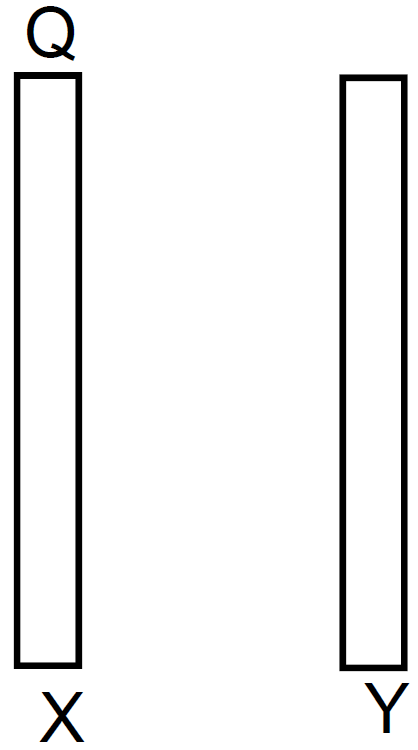
Two conducting plates X and Y, each having large surface area A (on one side), are placed parallel to each other as shown in figure. The plate X is given a charge Q whereas the other is neutral. Find:

  1. The surface charge density at the inner surface of the plate X.
  2. The electric field at a point to the left of the plates.
  3. The electric field at a point in between the plates.
  4. The electric field at a point to the right of the plates.
View full solution

Generate a Gausss Law paper free

Pick question groups from the list above, set marks and difficulty, and export a branded PDF with step-by-step answer keys. First 3 chapters free — no signup.

Download App