MCQ
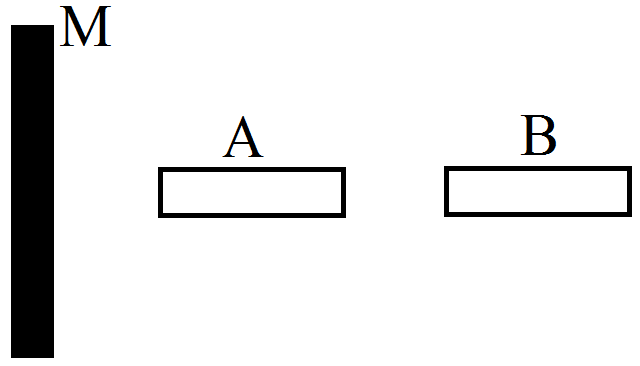
A large nonconducting sheet $M$ is given a uniform charge density. Two uncharged small metal rods $A$ and $B$ are placed near the sheet as shown in figure:
  • A
    $M$ attracts $A.$
  • B
    $M$ attracts $B.$
  • C
    $A$ attracts $B.$
  • $B$ attracts $A$.

Answer

Correct option: D.
$B$ attracts $A$.

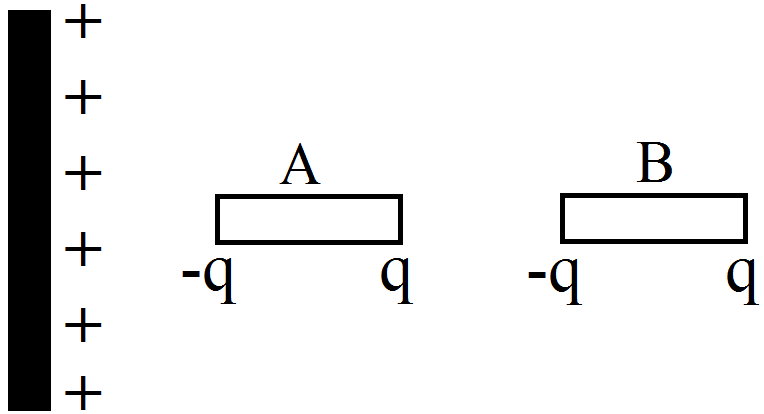
Charge distribution or $M, A\ \&\ B$
So, we can say that $M$ attracts $A, M$ attracts $B, A$ attracts $B$ and $'B'$ attracts $A$.

Need a full question paper?

Generate a complete, print-ready paper with questions like this in minutes — across 16+ boards, with answer keys.

Start Generating Free

Similar questions

An $AC$ source producing emf $\in=\in_{0}\Big[\cos\big(100\pi\text{s}^{-1}\big)\text{t}+\cos\big(500\pi\text{s}^{-1}\big)\text{t}\Big]$ is connected in series with a capacitor and a resistor. The steady-state current in the circuit is found to be $\text{i}=\text{i}_1\cos\Big[\big(100\pi\text{s}^{-1}\big)\text{t}+\phi_1\Big]+\text{i}_2\cos\Big[\big(500\pi\text{s}^{-1}\big)\text{t}+\phi_2\Big].$
Infinite number of cells having $emf$ and internal resistance $\left( {E,r} \right)$, $\left( {\frac{E}{n},\frac{r}{n}} \right)$, $\left( {\frac{E}{{{n^2}}},\frac{r}{{{n^2}}}} \right)$, $\left( {\frac{E}{{{n^3}}},\frac{r}{{{n^3}}}} \right)$..... are connected in series in same manner across an external resistance of $\frac{{nr}}{{n + 1}}$ . Current flowing through the external resistor is
A point charge $q$ is placed in a cavity in a metal block. If a charge $Q$ is brought outside the metal, then the electric force experienced by $q$ is
The large scale destruction, that would be caused due to the use of nuclear weapons is called
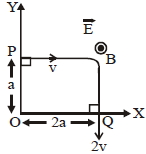
A charged particle of mass $\mathrm{m}$ and charge $q$ moving under the influence of uniform electric field $E\hat{i }$ and a uniform magnetic field $B\hat{k}$ follows a trajectory from point $\mathrm{P}$ to $\mathrm{Q}$ as shown in figure. The velocities at $P$ and $Q$ are respectively, $v\hat i$ and $-2 v \hat j$. Then which of the following statements $(\mathrm{A}, \mathrm{B}, \mathrm{C}, \mathrm{D})$ are the correct $?$ (Trajectory shown is schematic and not to scale)

$(A)$ $\mathrm{E}=\frac{3}{4}\left(\frac{\mathrm{mv}^{2}}{\mathrm{qa}}\right)$

$(B)$ Rate of work done by the electric field at $\mathrm{P}$ is $\frac{3}{4}\left(\frac{\mathrm{mv}^{3}}{\mathrm{a}}\right)$

$(C)$ Rate of work done by both the fields at $\mathrm{Q}$ is zero

$(D)$ The difference between the magnitude of angular momentum of the particle at $\mathrm{P}$ and $Q$ is $2 mav$.

The potential difference between $A$ and $B$ in the Figure is ................. $V$
Penetrating power of $X$-rays increases with increase in
Select the correct statement
For an $RLC$ circuit driven with voltage of amplitude $v_m$ and frequency ${\omega _0} = \frac{1}{{\sqrt {LC} }}$ the current exhibits resonance. The quality factor, $Q$ is given by:
A charge of 5C experiences a force of 5000 N when it is kept in a uniform electric field. What is the potential difference between two points separated by a distance of 1 cm