MCQ
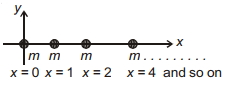
A large number of identical point masses $m$ are placed along $x$-axis, at $x=0,1,2,4$, The magnitude of gravitational force on mass at origin $(x=0)$, will be ............
  • A
    $G m^2$
  • $\frac{4}{3} G m^2$
  • C
    $\frac{2}{3} G m^2$
  • D
    $\frac{5}{4} G m^2$

Answer

Correct option: B.
$\frac{4}{3} G m^2$
b
(b)

Let, $F_1, F_2, F_4, F_8 \ldots \ldots$ be the forces of gravitation due masses ' $m$ ' at $x=1,2,4,8 \ldots$ respectively.

$\Rightarrow F_1=\frac{G m^2}{1^2}$

$F_2=\frac{G m^2}{2^2}$

$F_4=\frac{G m^2}{4^2}$

$F_8 =\frac{G m^2}{8^2}$

$F_1+F_2+F_4+F_8 \ldots=G m^2\left(\frac{1}{1}+\frac{1}{4}+\frac{1}{16}+\frac{1}{64} \ldots\right)$

infinite $G.P$. with common ratio $=\frac{1}{4}$

For an infinite $G.P$, sum $=\left(\frac{a}{1-r}\right)$

$a$ is the first term

$r$ is the common ratio

$\Rightarrow \text { Sum }=\frac{1}{1-\frac{1}{4}}=\left(\frac{4}{3}\right)$

$\Rightarrow F_1+F_2+F_4+F_8 \ldots \ldots=\frac{4}{3} G m^2$
Need a full question paper?

Generate a complete, print-ready paper with questions like this in minutes — across 16+ boards, with answer keys.

Start Generating Free

Similar questions

Which of the following is not the characteristic of turbulent flow
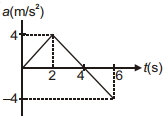
For the acceleration-time $(a-t)$ graph shown in figure, the change in velocity of particle from $t=0$ to $t=6 \,s$ is ........ $m / s$
Range of a bullet fired at $45^o$ to horizontal is $980m$. If the bullet is fired at same  angle from a car travelling horizontally at $18\, km/hr$ towards target then range will be  increased by :-
Water falls from a height $500m$. What is the rise in temperature of water at bottom if whole energy remains in the water ........... $^\circ \mathrm{C}$
In an experiment to determine the acceleration due to gravity $g$, the formula used for the time period of a periodic motion is $T=2 \pi \sqrt{\frac{7(R-r)}{5 g}}$. The values of $R$ and $r$ are measured to be $(60 \pm 1) \mathrm{mm}$ and $(10 \pm 1) \mathrm{mm}$, respectively. In five successive measurements, the time period is found to be $0.52 \mathrm{~s}, 0.56 \mathrm{~s}, 0.57 \mathrm{~s}, 0.54 \mathrm{~s}$ and $0.59 \mathrm{~s}$. The least count of the watch used for the measurement of time period is $0.01 \mathrm{~s}$. Which of the following statement($s$) is(are) true?

($A$) The error in the measurement of $r$ is $10 \%$

($B$) The error in the measurement of $T$ is $3.57 \%$

($C$) The error in the measurement of $T$ is $2 \%$

($D$) The error in the determined value of $g$ is $11 \%$

A body is sliding down an inclined plane (angle of inclination $45^o$). If the coefficient of friction is $0.5$ and $g = 9.8\, m/s^2$. then the acceleration of the body downwards in $m/s^2$ is
Which pair of the following forces will never give resultant force of $2\, N$
The moment of inertia of a body depends on
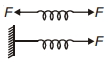
Figure shows two cases. In first case a spring (spring constant $K$ ) is pulled by two equal and opposite forces $F$ at both ends and in second case is pulled by a force $F$ at one end. Extensions $(x)$ in the springs will be
A car, moving with a speed of $50 \,km/hr$, can be stopped by brakes after at least $6\,m$. If the same car is moving at a speed of $100 \,km/hr$, the minimum stopping distance is..........$m$