Question
A less obvious example of electron transfer is realised when hydrogen combines with oxygen to form water by the reaction: $2\text{H}_2(\text{g}) + \text{O}_2 (\text{g}) → 2\text{H}_2\text{O} (\text{l})$ Though not simple in its approach, yet we can visualise the H atom as going from a Neutral (zero) state in H2 to a positive state in H2O, the O atom goes from a zero state in O2 To a dinegative state in H2O. It is assumed that There is an electron transfer from H to O and Consequently H2 is oxidised and O2 is reduced. However, as we shall see later, the charge Transfer is only partial and is perhaps better Described as an electron shift rather than a Complete loss of electron by H and gain by O. Two examples of this class Of the reactions are: $\text{H}_2 (\text{s}) + \text{Cl}_2(\text{g}) → 2\text{HCl} (\text{g})$ And, $\text{CH}_4 (\text{g}) + 4\text{Cl}_2 (\text{g}) → \text{CCl}_4(\text{l}) + 4\text{HCl (g)}$ In order to keep track of electron shifts in Chemical reactions involving formation of Covalent compounds, a more practical method Of using oxidation number has been Developed. In this method, it is always Assumed that there is a complete transfer of Electron from a less electronegative atom to a More electonegative atom. For example, we Rewrite equations to show Charge on each of the atoms forming part of The reaction: 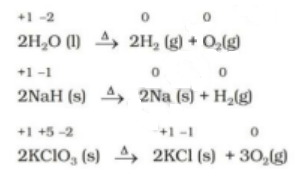 It may be emphasised that the assumption Of electron transfer is made for book-keeping Purpose only and it will become obvious at a Later stage in this unit that it leads to the simple Description of redox reactions. Oxidation number denotes the Oxidation state of an element in a Compound ascertained according to a set Of rules formulated on the basis that electron pair in a covalent bond belongs Entirely to more electronegative element. It is not always possible to remember or Make out easily in a compound/ ion, which Element is more electronegative than the other. Therefore, a set of rules has been formulated To determine the oxidation number of an Element in a compound/ ion. We may at this stage, state the rules for the Calculation of oxidation number. These rules are: 1.) In elements, in the free or the uncombined State, each atom bears an oxidation Number of zero. Evidently each atom in H2, O2, Cl2, O3, P4, S8, Na, Mg, Al has the Oxidation number zero. 2.) For ions composed of only one atom, the Oxidation number is equal to the charge On the ion. Thus Na+ Ion has an oxidation Number of +1, Mg2+ ion +2 , Fe3+ ion, +3, Cl – Ion, –1, O2 – ion, –2; and so on. In their Compounds all alkali metals have Oxidation number of +1, and all alkaline Earth metals have an oxidation number of +2. Aluminium is regarded to have an Oxidation number of +3 in all its Compounds. 3.) The oxidation number of oxygen in most Compounds is –2. However, we come across Two kinds of exceptions here. One arises In the case of peroxides and superoxides, The compounds of oxygen in which oxygen Atoms are directly linked to each other. While in peroxides (e.g., H2 O2, Na2 O2), each Oxygen atom is assigned an oxidation Number of –1, in superoxides (e.g., K O2, Rb O2) each oxygen atom is assigned an Oxidation number of –(½). The second Exception appears rarely, i.e. when oxygen Is bonded to fluorine. In such compounds e.g., oxygen difluoride (OF2) and dioxygen difluoride (O2F2), the oxygen is assigned an oxidation number of +2 and +1, respectively. The number assigned to oxygen will depend upon the bonding state of oxygen but this number would now be a positive figure only. 4.) The oxidation number of hydrogen is +1, Except when it is bonded to metals in binary Compounds (that is compounds containing Two elements). For example, in LiH, NaH, And Ca H2, its oxidation number is –1. 5.) In all its compounds, fluorine has an Oxidation number of –1. Other halogens (Cl, Br, and I) also have an oxidation number Of –1, when they occur as halide ions in Their compounds. Chlorine, bromine and Iodine when combined with oxygen, for Example in oxoacids and oxoanions, have Positive oxidation numbers. 6.) The algebraic sum of the oxidation number Of all the atoms in a compound must be Zero. In polyatomic ion, the algebraic sum Of all the oxidation numbers of atoms of The ion must equal the charge on the ion. Thus, the sum of oxidation number of three Oxygen atoms and one carbon atom in the Carbonate ion, (CO3) 2– must equal –2. A term that is often used interchangeably With the oxidation number is the oxidation State. Thus in CO2, the oxidation state of Carbon is +4, that is also its oxidation number And similarly the oxidation state as well as Oxidation number of oxygen is – 2. This implies That the oxidation number denotes the Oxidation state of an element in a compound. The oxidation number/state of a metal in a Compound is sometimes presented according To the notation given by German chemist, Alfred Stock. It is popularly known as Stock Notation. According to this, the oxidation Number is expressed by putting a Roman Numeral representing the oxidation number In parenthesis after the symbol of the metal in The molecular formula. Thus aurous chloride And auric chloride are written as Au(I)Cl and Au(III)Cl3. Similarly, stannous chloride and Stannic chloride are written as Sn(II) Cl2 and Sn(IV)Cl4. This change in oxidation number Implies change in oxidation state, which in Turn helps to identify whether the species is Present in oxidised form or reduced form. Thus, Hg2(I) Cl2 is the reduced form of Hg(II) Cl2.
It may be emphasised that the assumption Of electron transfer is made for book-keeping Purpose only and it will become obvious at a Later stage in this unit that it leads to the simple Description of redox reactions. Oxidation number denotes the Oxidation state of an element in a Compound ascertained according to a set Of rules formulated on the basis that electron pair in a covalent bond belongs Entirely to more electronegative element. It is not always possible to remember or Make out easily in a compound/ ion, which Element is more electronegative than the other. Therefore, a set of rules has been formulated To determine the oxidation number of an Element in a compound/ ion. We may at this stage, state the rules for the Calculation of oxidation number. These rules are: 1.) In elements, in the free or the uncombined State, each atom bears an oxidation Number of zero. Evidently each atom in H2, O2, Cl2, O3, P4, S8, Na, Mg, Al has the Oxidation number zero. 2.) For ions composed of only one atom, the Oxidation number is equal to the charge On the ion. Thus Na+ Ion has an oxidation Number of +1, Mg2+ ion +2 , Fe3+ ion, +3, Cl – Ion, –1, O2 – ion, –2; and so on. In their Compounds all alkali metals have Oxidation number of +1, and all alkaline Earth metals have an oxidation number of +2. Aluminium is regarded to have an Oxidation number of +3 in all its Compounds. 3.) The oxidation number of oxygen in most Compounds is –2. However, we come across Two kinds of exceptions here. One arises In the case of peroxides and superoxides, The compounds of oxygen in which oxygen Atoms are directly linked to each other. While in peroxides (e.g., H2 O2, Na2 O2), each Oxygen atom is assigned an oxidation Number of –1, in superoxides (e.g., K O2, Rb O2) each oxygen atom is assigned an Oxidation number of –(½). The second Exception appears rarely, i.e. when oxygen Is bonded to fluorine. In such compounds e.g., oxygen difluoride (OF2) and dioxygen difluoride (O2F2), the oxygen is assigned an oxidation number of +2 and +1, respectively. The number assigned to oxygen will depend upon the bonding state of oxygen but this number would now be a positive figure only. 4.) The oxidation number of hydrogen is +1, Except when it is bonded to metals in binary Compounds (that is compounds containing Two elements). For example, in LiH, NaH, And Ca H2, its oxidation number is –1. 5.) In all its compounds, fluorine has an Oxidation number of –1. Other halogens (Cl, Br, and I) also have an oxidation number Of –1, when they occur as halide ions in Their compounds. Chlorine, bromine and Iodine when combined with oxygen, for Example in oxoacids and oxoanions, have Positive oxidation numbers. 6.) The algebraic sum of the oxidation number Of all the atoms in a compound must be Zero. In polyatomic ion, the algebraic sum Of all the oxidation numbers of atoms of The ion must equal the charge on the ion. Thus, the sum of oxidation number of three Oxygen atoms and one carbon atom in the Carbonate ion, (CO3) 2– must equal –2. A term that is often used interchangeably With the oxidation number is the oxidation State. Thus in CO2, the oxidation state of Carbon is +4, that is also its oxidation number And similarly the oxidation state as well as Oxidation number of oxygen is – 2. This implies That the oxidation number denotes the Oxidation state of an element in a compound. The oxidation number/state of a metal in a Compound is sometimes presented according To the notation given by German chemist, Alfred Stock. It is popularly known as Stock Notation. According to this, the oxidation Number is expressed by putting a Roman Numeral representing the oxidation number In parenthesis after the symbol of the metal in The molecular formula. Thus aurous chloride And auric chloride are written as Au(I)Cl and Au(III)Cl3. Similarly, stannous chloride and Stannic chloride are written as Sn(II) Cl2 and Sn(IV)Cl4. This change in oxidation number Implies change in oxidation state, which in Turn helps to identify whether the species is Present in oxidised form or reduced form. Thus, Hg2(I) Cl2 is the reduced form of Hg(II) Cl2. - H atom goes from a … state in H2 to a positive state in H2O in water formation.
- Neutral
- Positive
- Negative
- All the above
- In oxidation number method, there is a complete transfer of electron from a …. electronegative atom to a … electonegative atom.
- more, less
- less, more
- non, more
- non, less
- Oxidation number of Mg2 + ion is:
- -2
- -1
- +2
- +1
- In Na2O2 each oxygen atom is assigned an oxidation number of …
- +1
- -2
- +2
- -1
- The algebraic sum of the oxidation number of all the atoms in a compound must be…
- 0
- 1
- 2
- -2