A light balloon filled with helium of density $\rho_{ He }$ is tied to a long light string of length $l$ and the string is attached to the ground. If the balloon is displaced slightly in the horizontal direction from the equilibrium and released. Then,
KVPY 2016, Advanced
Download our app for free and get started
$(c)$ When balloon is slightly displaced horizontally component of buoyant force produces a torque about the end of string attached to ground. This torque produces side ways oscillations of balloon.
Restoring torque is
$\tau_1=F_b \sin \theta \times l=V\left(\rho_{ air }-\rho_{ He }\right) g l \sin \theta$
$=V\left(\rho_{ air }-\rho_{ He }\right) g l \theta$
For small angular displacements, $\sin \theta \approx \theta$
And the inertial torque an balloon is
$\tau_2=l \alpha=m l^2 \alpha=V \cdot \rho_{ He } \cdot l^2 \cdot \alpha$
Helium balloon can be viewed as a mass tied to end of a string.
Equating both torques, we have
$V \cdot \rho_{ He } \cdot l^2 \cdot \alpha=-V\left(\rho_{ air }-\rho_{ He }\right) l \theta$
(Negative sign appears as both torques are in opposite directions)
$\alpha=-\left(\frac{\rho_{ air }-\rho_{ He }}{\rho_{ He }}\right) \cdot \frac{g}{l} \cdot \theta$
So, if $\omega$ is angular frequency, then
$\omega^2=\left(\frac{\rho_{ air }-\rho_{ He }}{\rho_{ He }}\right) \cdot \frac{g}{l}$
$\therefore$ Time period of oscillations of balloon is
$T=\frac{2 \pi}{\omega}=2 \pi \sqrt{\left(\frac{\rho_{ He }}{\rho_{ air }-\rho_{ He }}\right) \cdot \frac{l}{g}}$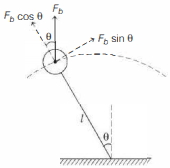

Download our appand get started for free
Experience the future of education. Simply download our apps or reach out to us for more information. Let's shape the future of learning together!No signup needed.*
Similar Questions
- 1View SolutionTime period of a simple pendulum will be double, if we
- 2The time period of a mass suspended from a spring is $T$. If the spring is cut into four equal parts and the same mass is suspended from one of the parts, then the new time period will beView Solution
- 3If a particle under S.H.M. has time period 0.1 sec and amplitude $2 \times 10^{-3}$. It has maximum velocityView Solution
- 4The period of simple pendulum is measured as $T$ in a stationary lift. If the lift moves upwards with an acceleration of $5\, g$, the period will beView Solution
- 5A particle is performing simple harmonic motion along $x$ -axis with amplitude $4\, cm$ and time period $1.2\, sec$. The minimum time taken by the particle to move from $x = 2\, cm$ to $x =+ 4 \,cm$ and back again is given by .... $s$View Solution
- 6The amplitude of a particle executing $S.H.M.$ with frequency of $60 \,Hz$ is $0.01 \,m$. The maximum value of the acceleration of the particle isView Solution
- 7A particle with restoring force proportional to displacement and resisting force proportional to velocity is subjected to a force $F\sin \omega t$. If the amplitude of the particle is maximum for $\omega = {\omega _1}$ and the energy of the particle is maximum for $\omega = {\omega _2}$, then (where ${\omega _0}$ natural frequency of oscillation of particle)View Solution
- 8A particle performs $S.H.M.$ of amplitude $A$ with angular frequency $\omega$ along a straight line. Whenit is at a distance $\frac{{\sqrt 3 }}{2}$ $A$ from mean position, its kinetic energy gets increased by an amount $\frac{1}{2}m{\omega ^2}{A^2}$ due to an impulsive force. Then its new amplitude becomesView Solution
- 9A body executing simple harmonic motion has a maximum acceleration equal to $ 24\,metres/se{c^2} $ and maximum velocity equal to $ 16\;metres/sec $. The amplitude of the simple harmonic motion isView Solution
- 10The amplitude of a damped oscillator becomes one third in $2\, sec$. If its amplitude after $6\, sec$ is $1/n$ times the original amplitude then the value of $n$ isView Solution