A particle performs $S.H.M.$ of amplitude $A$ with angular frequency $\omega$ along a straight line. Whenit is at a distance $\frac{{\sqrt 3 }}{2}$ $A$ from mean position, its kinetic energy gets increased by an amount $\frac{1}{2}m{\omega ^2}{A^2}$ due to an impulsive force. Then its new amplitude becomes
Medium


Download our appand get started for free
Experience the future of education. Simply download our apps or reach out to us for more information. Let's shape the future of learning together!No signup needed.*
Similar Questions
- 1View SolutionA simple pendulum is set into vibrations. The bob of the pendulum comes to rest after some time due to
- 2View SolutionIn a simple harmonic oscillator, at the mean position
- 3The period of oscillation of a simple pendulum of length $L$ suspended from the roof of a vehicle which moves without friction down an inclined plane of inclination $\alpha$, is given byView Solution
- 4A vibratory motion is represented by $x = 2\,A\,\cos \,\omega t + A\,\cos \,\left( {\omega t + \frac{\pi }{2}} \right) + A\,\cos \,\left( {\omega t + \pi } \right) + \frac{A}{2}\,\cos \,\left( {\omega t + \frac{{3\pi }}{2}} \right)$ The resultant amplitude of motion isView Solution
- 5View SolutionTwo mutually perpendicular simple harmonic vibrations have same amplitude, frequency and phase. When they superimpose, the resultant form of vibration will be
- 6The total energy of a particle executing $S.H.M.$ is $80 \,J$. What is the potential energy when the particle is at a distance of $\frac{3}{4}$ of amplitude from the mean position..... $J$View Solution
- 7A body executes simple harmonic motion. The potential energy $(P.E.)$, the kinetic energy $(K.E.)$ and total energy $(T.E.)$ are measured as a function of displacement $x$. Which of the following statements is trueView Solution
- 8The acceleration of a particle performing S.H.M. is at a distance of $3\; cm$ from the mean position is $ 12\,cm/sec^2 $. Its time period is ..... $\sec$View Solution
- 9Two simple harmonic motions, as shown, are at right angles. They are combined to form Lissajous figuresView Solution
$x\left( t \right) = A\,\sin \,\left( {at + \delta } \right)$
$y\left( t \right) = B\,\sin \,\left( {bt} \right)$
Identify the correct match below
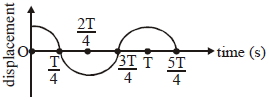
- 10The displacement time graph of a particle executing $S.H.M.$ is given in figure: (sketch is schematic and not to scale) Which of the following statements is are true for this motion?View Solution
$(A)$ The force is zero $t=\frac{3 T}{4}$
$(B)$ The acceleration is maximum at $t=T$
$(C)$ The speed is maximum at $t =\frac{ T }{4}$
$(D)$ The $P.E.$ is equal to $K.E.$ of the oscillation at $t=\frac{T}{2}$