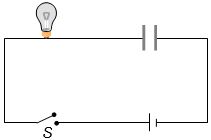
A light bulb, a capacitor and a battery are connected together as shown here, with switch $S$ initially open. When the switch $S$ is closed, which one of the following is true
Medium


Download our appand get started for free
Experience the future of education. Simply download our apps or reach out to us for more information. Let's shape the future of learning together!No signup needed.*
Similar Questions
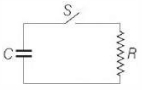
- 1The capacitor of capacitance $C$ in the circuit shown is fully charged initially resistance is $R$. After the switch $S$ is closed, the time taken to reduce the stored energy in the capacitor to half its initial value isView Solution
- 2A capacitor of $10\,\mu F$ charged up to $250\, volts$ is connected in parallel with another capacitor of $5\,\mu F$ charged up to $100\, volts$. The common potential is.....$V$View Solution
- 3$1000$ small water drops each of capacitance $C$ join together to form one large spherical drop. The capacitance of bigger sphere is ......... $C$View Solution
- 4View SolutionA capacitor is charged by a battery. The battery is removed and another identical uncharged capacitor is connected in parallel. The total electrostatic energy of resulting system
- 5Two capacitors of capacitances $3\,\mu \,F$ and $6\,\mu F$ are charged to a potential of $12 \,V$ each. They are now connected to each other, with the positive plate of each joined to the negative plate of the other. The potential difference across each will be......$volt$View Solution
- 6Three point charges $q, q$ and $-2 q$ are placed at the corners of an equilateral triangle of side '$L$'. Calculate work done by extemal force in moving all the charges far apart without accelerationView Solution
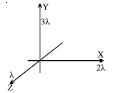
- 7The diagram shows three infinitely long uniform line charges placed on the $X, Y $ and $Z$ axis. The work done in moving a unit positive charge from $(1, 1, 1) $ to $(0, 1, 1) $ is equal toView Solution
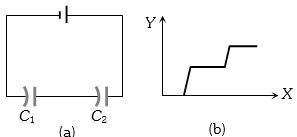
- 8Figure $(A)$ shows two capacitors connected in series and joined to a battery. The graph in figure $(B)$ shows the variation in potential as one moves from left to right on the branch containing the capacitors, ifView Solution
- 9View SolutionThe value of electric potential at any point due to any electric dipole is
- 10The distance between the two plates of a parallel plate capacitor is doubled and the area of each plate is halved. If $C$ is its initial capacitance, its final capacitance is equal toView Solution