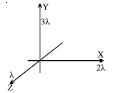
The diagram shows three infinitely long uniform line charges placed on the $X, Y $ and $Z$ axis. The work done in moving a unit positive charge from $(1, 1, 1) $ to $(0, 1, 1) $ is equal to
Advanced


Download our appand get started for free
Experience the future of education. Simply download our apps or reach out to us for more information. Let's shape the future of learning together!No signup needed.*
Similar Questions
- 1An uncharged parallel plate capacitor having a dielectric of constant $K$ is connected to a similar air-cored parallel capacitor charged to a potential $V$. The two share the charge and the common potential is $V'$. The dielectric constant $K$ isView Solution
- 2Two parallel plate capacitors of capacity $C$ and $3\,C$ are connected in parallel combination and charged to a potential difference $18\,V$. The battery is then disconnected and the space between the plates of the capacitor of capacity $C$ is completely filled with a material of dielectric constant $9$. The final potential difference across the combination of capacitors will be $V$View Solution
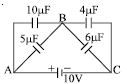
- 3In the circuit shown in figure, four capacitors are connected to a battery. The charge on the $5$ $\mu$$F$ capacitor is.......$ \mu C$View Solution
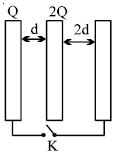
- 4Three large plates are arranged as shown. How much charge will flow through the key $k $ if it is closed?View Solution
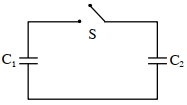
- 5Two capacitors having capacitance $C _{1}$ and $C _{2}$ respectively are connected as shown in figure. Initially, capacitor $C _{1}$ is charged to a potential difference $V$ volt by a battery. The battery is then removed and the charged capacitor $C_{1}$ is now connected to uncharged capacitor $C _{2}$ by closing the switch $S$. The amount of charge on the capacitor $C _{2}$, after equilibrium isView Solution
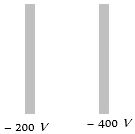
- 6Two points $P$ and $Q$ are maintained at the potentials of $10\, V$ and $-4\,V$, respectively. The work done in moving $100$ electrons from $P$ and $Q$ isView Solution
- 7The work done to take an electron from rest where potential is $-60\, V$ to another point where potential is $-20\, V$ is given by.....$eV$View Solution
- 8Two capacitors of $3\,pF$ and $6\,pF$ are connected in series and a potential difference of $5000\,V$ is applied across the combination. They are then disconnected and reconnected in parallel. The potential between the plates isView Solution
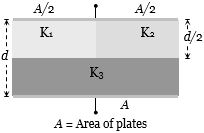
- 9View SolutionIn the figure a capacitor is filled with dielectrics. The resultant capacitance is
- 10View SolutionIn the following figure two parallel metallic plates are maintained at different potential. If an electron is released midway between the plates, it will move