Question
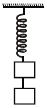
A light spring of length $20\, cm$ and force constant $2\, kg/cm$ is placed vertically on a table. A small block of mass $1\, kg$. falls on it. The length $h$ from the surface of the table at which the ball will have the maximum velocity is ............... $\mathrm{cm}$

Answer

Let the spring be compressed by a distance of "x" at a certain moment(as shown in the figure attached below).

Therefore, by using the law of conservation of energy at this moment, we can write

$\operatorname{mg}(h+x)=1 / 2 m v^{2}+1 / 2 k x^{2}$

$\Rightarrow 1 / 2 mv ^{2}= mg ( h + x )-1 / 2 kx ^{2} \ldots$ (i)

[The velocity of the block will be maximum when the kinetic energy is maximum. Also, the velocity keeps on increasing as long its acceleration is increasing]

$\therefore d \left[1 / 2 mv ^{2}\right] / d x = mg - k x =0$

$\Rightarrow mg - kx =0$

$\Rightarrow x=m g / k$

Now, to get the height "h" from the surface of the table at which the velocity is maximum, we need to subtract the distance of compression in the spring from the length of the spring, so,

$h = I - mg / k \ldots \ldots .$ [from (i) $]$

$\Rightarrow h=20-\left[1^{*} 9.8 / 2\right] \ldots \ldots\left[\operatorname{taking} g=9.8 m / s ^{2}\right]$

$\Rightarrow h=20-4.9$

$\Rightarrow h =15.1 cm =15 cm$
Need a full question paper?

Generate a complete, print-ready paper with questions like this in minutes — across 16+ boards, with answer keys.

Start Generating Free

Similar questions

A hollow sphere is filled with water through a small hole in it. It is then hung by a long thread and made to oscillate. As the water slowly flows out of the hole at the bottom, the period of oscillation will
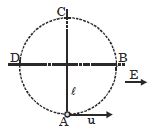
A simple pendulum with a bob of mass $m = 1\ kg$ , charge $q = 5\mu C$ and string length $l = 1\ m$ is given a horizontal velocity $u$ in a uniform electric field $E = 2 × 10^6\ V/m$ at its bottom most point $A$ , as shown in figure. It is given a speed $u$ such that the particle leave the circular path at its topmost point $C$ . Find the speed $u$ . (Take $g = 10\ m/s^2$ )
A flask contains hydrogen and oxygen in the ratio of $2: 1$ by mass at temperature $27^{\circ} C$. The ratio of average kinetic energy per molecule of hydrogen and oxygen respectively is :
Two identical containers $A$ and $B$ with frictionless pistons contain the same ideal gas at the same temperature and the same volume $V$. The mass of the gas in $A$ is ${m_A}$ and that in $B$ is ${m_B}$. The gas in each cylinder is now allowed to expand isothermally to the same final volume $2V$. The changes in the pressure in $A$ and $B$ are found to be $\Delta P$ and $1.5  \Delta P$ respectively. Then
The ends of a metal bas of constant cross-sectional area are maintained at temperatures $T_1$ and $T_2$ which are both higher than the temperature of the surroundings. If the bar is unlagged, which one of the following sketches best represents the variation of temperature with distance along the bar?
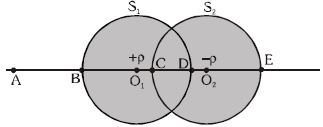
Two uniform spherical charge regions $S_1$ and $S_2$ having positive and negative charges overlap each other as shown in the figure. Point $O_1$ and $O_2$ are their centres and points $A, B, C$ and $D$ are on the line joining centres $O_1$ and $O_2$. Electric field from $C$ to $D$
If $M$ the mass of the earth and $R$ its radius, the ratio of the gravitational acceleration and the gravitational constant is
Two small bodies of mass of $2\, kg$ each attached to each other using a thread of length $10\, cm$, hang on a spring whose force constant is $200\, N/m$, as shown in the figure. We burn the thread. What is the distance between the two bodies when the top body first arrives at its highest position .... $cm$ ? (Take $\pi^2 = 10$)
Fly-wheel is used with an engine because it
The speed of a body moving with uniform acceleration is $u$. This speed is doubled while covering a distance $S$. When it covers an additional distance $S$, its speed would become