The ends of a metal bas of constant cross-sectional area are maintained at temperatures $T_1$ and $T_2$ which are both higher than the temperature of the surroundings. If the bar is unlagged, which one of the following sketches best represents the variation of temperature with distance along the bar?
Advanced
Download our app for free and get started
This is a question of unsteady state conduction, which is exponential. That leaves us with options $\mathrm{c} \& \mathrm{D}$
since it is given that both the end temperatures were higher than surroundings at the beginning. heat will start to flow from ends towards the centre. Hence option $\mathrm{C}$.

Download our appand get started for free
Experience the future of education. Simply download our apps or reach out to us for more information. Let's shape the future of learning together!No signup needed.*
Similar Questions
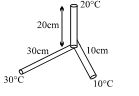
- 1Three rods made of the same material and having same cross-sectional area but different lengths $10\,\,cm$, $\,\,20 cm$ and $30\,\,cm$ are joined as shown. The temperature of the joint is ....... $^oC$View Solution
- 2The wavelength of maximum emitted energy of a body at $700 K$ is $4.08$ $\mu m$. If the temperature of the body is raised to $1400 K$ , the wavelength of maximum emitted energy will be ........ $\mu m$View Solution
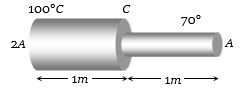
- 3$A$ metal rod of length $2$$m$ has cross sectional areas $2A$ and $A$ as shown in figure. The ends are maintained at temperatures $100°C$ and $70°C$ . The temperature at middle point $C$ is...... $^oC$View Solution
- 4$A$ cylinder of radius $R$ made of a material of thermal conductivity ${K_1}$ is surrounded by a cylindrical shell of inner radius $R$ and outer radius $2R$ made of material of thermal conductivity ${K_2}$. The two ends of the combined system are maintained at two different temperatures. There is no loss of heat across the cylindrical surface and the system is in steady state. The effective thermal conductivity of the system isView Solution
- 5View SolutionA block of metal is heated to a temperature much higher than the room temperature and allowed to cool in a room free from air currents. Which of the following curves correctly represents the rate of cooling
- 6Steel wire of length ' $L$ ' at $40^{\circ} C$ is suspended from the ceiling and then a mass ' $m$ ' is hung from its free end. The wire is cooled down from $40^{\circ} C$ to $30^{\circ} C$ to regain its original length ' $L$ '. The coefficient of linear thermal expansion of the steel is $10^{-5} /{ }^{\circ} C$, Young's modulus of steel is $10^{11} N / m ^2$ and radius of the wire is $1 \ mm$. Assume that $L \gg$ diameter of the wire. Then the value of ' $m$ ' in $kg$ is nearlyView Solution
- 7Two sphere of radius $R_1$ and $R_2$ have densities ${\rho _1}$ and ${\rho _2}$ and specific heat $S_1$ and $S_2$ if they are heated to the same temperature the ratio of their rates of falling temperature will beView Solution
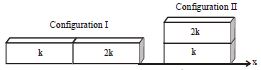
- 8Two rectangular blocks, having identical dimensions, can be arranged either in configuration $I$ or in configuration $II$ as shown in the figure. One of the blocks has thermal conductivity $k$ and the other $2k$. The temperature difference between the ends along the $x-$ axis is the same in both the configurations. It takes $9s$ to transport a certain amount of heat from the hot end to the cold end in the configuration $I$. The time to transport the same amount of heat in the configuration $II$ is .......... $\sec$View Solution
- 9A cup of tea cools from $80\,^oC$ to $60\,^oC$ in one minute. The ambient temperature is $30\,^oC$. In cooling from $60\,^oC$ to $50\,^oC$, it will take ....... $\sec$View Solution
- 10Two bodies $A$and $B$ have thermal emissivities of $0.01$ and $0.81$ respectively. The outer surface areas of the two bodies are the same. The two bodies emit total radiant power at the same rate. The wavelength ${\lambda _B}$ corresponding to maximum spectral radiancy in the radiation from $B$ is shifted from the wavelength corresponding to maximum spectral radiancy in the radiation from $A$, by $1.00\mu m$. If the temperature of $A$ is $5802\;K$View Solution