MCQ
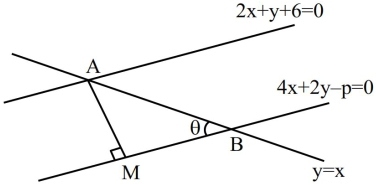
A line passes through the origin and makes equal angles with the positive coordinate axes. It intersects the lines
$
L_1: 2 x+y+6=0 \text { and } L_2: 4 x+2 y-p=0, p>0
$
at the points $A$ and $B$, respectively. If $A B=\frac{9}{\sqrt{2}}$ and the foot of the perpendicular from the point A on the line $L_2$ is $M$, then $\frac{A M}{B M}$ is equal to
  • A
    5
  • B
    4
  • C
    2
  • D
    3

Need a full question paper?

Generate a complete, print-ready paper with questions like this in minutes — across 16+ boards, with answer keys.

Start Generating Free

Similar questions

Let an ellipse $E: \frac{x^{2}}{a^{2}}+\frac{y^{2}}{b^{2}}=1, a^{2}>b^{2}$, passes through $\left(\sqrt{\frac{3}{2}}, 1\right)$ and has ecentricity $\frac{1}{\sqrt{3}} .$ If a circle, centered at focus $\mathrm{F}(\alpha, 0), \alpha>0$, of $\mathrm{E}$ and radius $\frac{2}{\sqrt{3}}$, intersects $\mathrm{E}$ at two points $\mathrm{P}$ and $\mathrm{Q}$, then $\mathrm{PQ}^{2}$ is equal to:
On which of the following intervals is the function $f$ given by $f(x)=x^{100}+\sin x-1$ decreasing $?$
The equation of the straight line which is perpendicular to $y = x$ and passes through $(3, 2)$ is
Suppose $f(x) = {(x + 1)^2}$ for $x \ge - 1$. If $g(x)$ is the function whose graph is the reflection of the graph of $f(x)$ with respect to the line $y = x$, then $g(x)$ equals
If ${x_1} = 3$ and $x > 0$ then $\mathop {\lim }\limits_{n \to \infty } {x_n}$ is equal to
The area enclosed by the curve $y = (x - 1) (x - 2) (x - 3)$ between the co-ordinate axes and the ordinate at $x = 3$ is :
If $\mathrm{a, b, c},$ are in $\mathrm{A.P}$, then the determinant

$\left|\begin{array}{lll}x+2 & x+3 & x+2 a \\ x+3 & x+4 & x+2 b \\ x+4 & x+5 & x+2 c\end{array}\right|$ is

A curve passing through $(2, 3)$ and satisfying the differential equation $\int\limits_0^x {t\,y(t)\,dt} = x^2y (x), (x >0)$ is
The range of the function,

$\mathrm{f}(\mathrm{x})=\log _{\sqrt{5}}(3+\cos \left(\frac{3 \pi}{4}+\mathrm{x}\right)+\cos \left(\frac{\pi}{4}+\mathrm{x}\right)+\cos \left(\frac{\pi}{4}-\mathrm{x}\right)$

$-\cos \left(\frac{3 \pi}{4}-\mathrm{x}\right))$ is :

There are $(n + 1)$ white and $(n + 1)$ black balls each set numbered $1$ to $n + 1$. The number of ways in which the balls can be arranged in a row so that the adjacent balls are of different colours is