MCQ 14 Marks
Line $L_1$ passes through the point $(1,2,3)$ and is parallel to z-axis. Line $L_2$ passes through the point $(\lambda, 5,6)$ and is parallel to $y$ -axis. Let for $\lambda=\lambda_1, \lambda_2, \lambda_2<\lambda_1$, the shortest distance between the two lines be 3 . Then the square of the distance of the point $\left(\lambda_1, \lambda_2, 7\right)$ from the line $L_1$ is
Answer(C). 25
$\begin{array}{l}L_1 \equiv \frac{x-1}{0}=\frac{y-2}{0}=\frac{z-3}{1} \\ L_2 \equiv \frac{x-\lambda}{0}=\frac{y-5}{1}=\frac{z-6}{0} \\ S D=\frac{\left|\begin{array}{ccc}\lambda-1 & 3 & 3 \\ 0 & 0 & 1 \\ 0 & 1 & 0\end{array}\right|}{\left|\begin{array}{ccc}\hat{ i } & \hat{j} & \hat{k} \\ 0 & 0 & 1 \\ 0 & 1 & 0\end{array}\right|}\end{array}$
$
\begin{array}{l}
=|\lambda-1|=3 \\
\lambda=4,-2 \\
\lambda_1=4 \\
\lambda_2=-2
\end{array}
$
Let foot of perpendicular from
$P (4,-2,7)$ is $Q (1,2, t +3)$
So $(3,-4,4- t ) \cdot(0,0,1)=0$
$
t=4
$
So $Q (1,2,7)$
$
\begin{array}{l}
PQ^2=9+16 \\
PQ^2=25
\end{array}
$
View full question & answer→MCQ 24 Marks
Let $f( x )=\left\{\begin{array}{lll}(1+ ax )^{1 / x } & , & x < 0 \\ 1+ b & , & x =0 \\ \frac{( x +4)^{1 / 2}-2}{( x + c )^{1 / 3}-2} & , & x >0\end{array}\right.$
be continuous at $x=0$. Then $e^u$ bc is equal to
Answer(C). 48
$
\begin{array}{l}
f\left(0^{-}\right)=e^{\lim _{x \rightarrow 0 \rightarrow 2 x}^{ax}}=e^{a} \\
f(0)=1+b \\
f\left(0^{+}\right)=\frac{\frac{1}{2 \sqrt{x+4}}}{\frac{1}{3}(x+c)^{-\frac{2}{3}}}=\frac{\frac{1}{2(2)}}{\frac{1}{3} \cdot c^{-\frac{2}{3}}} \\
=\frac{3}{4} c^{2 / 3}
\end{array}
$
Also at $x =0$;
$
c^{1 / 3}=2 \Rightarrow c=8
$
So $f \left(0^{+}\right)=\frac{3}{4}(8)^{2 / 3}=3$
Now, $e ^{ a }= b +1=3$
$e ^{ a } \cdot b \cdot c =3 \cdot 2 \cdot 8=48$
View full question & answer→MCQ 34 Marks
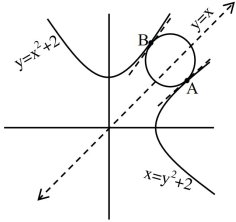
The radius of the smallest circle which touches the parabolas $y=x^2+2$ and $x=y^2+2$ is
- A
$\frac{7 \sqrt{2}}{2}$
- B
$\frac{7 \sqrt{2}}{16}$
- C
$\frac{7 \sqrt{2}}{4}$
- D
$\frac{7 \sqrt{2}}{8}$
View full question & answer→MCQ 44 Marks
Let the domain of the function $f(x)=\log _2 \log _4 \log _6\left(3+4 x-x^2\right)$ be $(a, b)$. If $\int_0^{b-a}\left[x^2\right] d x=p-\sqrt{q}-\sqrt{r}, p, q, r \in N, \operatorname{gcd}(p, q, r)=1$, where [ $\cdot]$ is the greatest integer function, then $p + q + r$ is equal to
View full question & answer→MCQ 54 Marks
Let $a_1, a_2, a_3, \ldots$ be a G. P. of increasing positive numbers. If $a_3 a_5=729$ and $a_2+a_4=\frac{111}{4}$, then $24\left(a_1+a_2+a_3\right)$ is equal to
View full question & answer→MCQ 64 Marks
Let $f(x)=\int x ^3 \sqrt{3- x ^2}$ dx. If $5 f(\sqrt{2})=-4$, then $f(1)$ is equal to
- A
$-\frac{2 \sqrt{2}}{5}$
- B
$-\frac{8 \sqrt{2}}{5}$
- C
$-\frac{4 \sqrt{2}}{5}$
- D
$-\frac{6 \sqrt{2}}{5}$
View full question & answer→MCQ 74 Marks
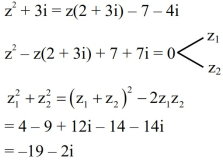
Let $z \in C$ be such that $\frac{z^2+3 i}{z-2+i}=2+3 i$. Then the sum of all possible values of $z^2$ is
- A
$19-2 i$
- B
$-19-2 i$
- C
$19+2 i$
- D
$-19+2 i$
View full question & answer→MCQ 84 Marks
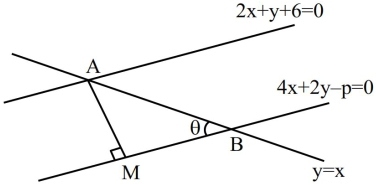
A line passes through the origin and makes equal angles with the positive coordinate axes. It intersects the lines
$
L_1: 2 x+y+6=0 \text { and } L_2: 4 x+2 y-p=0, p>0
$
at the points $A$ and $B$, respectively. If $A B=\frac{9}{\sqrt{2}}$ and the foot of the perpendicular from the point A on the line $L_2$ is $M$, then $\frac{A M}{B M}$ is equal to
View full question & answer→MCQ 94 Marks
Let $g$ be a differentiable function such that $\int_0^x g(t) d t=x-\int_0^x \operatorname{tg}(t) d t, x \geq 0$ and let $y=y(x)$ satisfy the differential equation $\frac{d y}{d x}-y \tan x=$ $2(x+1) \sec x g(x), x \in\left[0, \frac{\pi}{2}\right)$. If $y(0)=0$, then $y \left(\frac{\pi}{3}\right)$ is equal to
View full question & answer→MCQ 104 Marks
View full question & answer→MCQ 114 Marks
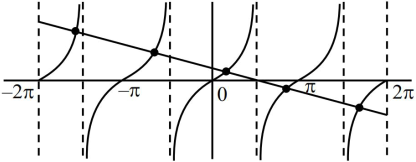
The number of solutions of the equation $2 x+3 \tan x=\pi, x \in[-2 \pi, 2 \pi]-\left\{ \pm \frac{\pi}{2}, \pm \frac{3 \pi}{2}\right\}$ is
View full question & answer→MCQ 124 Marks
If $\sum_{ r =1}^9\left(\frac{ r +3}{2^r}\right) \cdot{ }^9 C _{ r }=\alpha\left(\frac{3}{2}\right)^9-\beta, \quad \alpha, \beta \in N , \quad$ then $(\alpha+\beta)^2$ is equal to
Answer(C). 81
Given that
$
\sum_{r=1}^9\left(\frac{r+3}{2^{r}}\right) \cdot{ }^9 C_{r}=\alpha\left(\frac{3}{2}\right)^9-\beta, \alpha, \beta \in N
$
Now,
$
\begin{array}{l}
\sum_{r=1}^9\left(\frac{r+3}{2^{r}}\right) \cdot{ }^9 C_{r}=\sum_{r=1}^9\left(\frac{r}{2^{r}}\right) \cdot{ }^9 C_{r}+\sum_{r=1}^9\left(\frac{3}{2^{r}}\right) \cdot{ }^9 C_{r} \\
=\sum_{r=1}^9\left(\frac{9}{2^{r}}\right) \cdot{ }^8 C_{r-1}+3 \sum_{r=1}^9{ }^9 C_{r}\left(\frac{1}{2}\right)^{r}\left[U \sin g \frac{{ }^9 C_{r}}{{ }^8 C_{r-1}}=\frac{9}{r}\right]
\end{array}
$
$
\begin{array}{l}
=\frac{9}{2} \sum_{r=1}^9{ }^8 C_{r-1}\left(\frac{1}{2}\right)^{r-1}+3\left(\sum_{r=0}^9\left({ }^9 C_{r}\left(\frac{1}{2}\right)^{r}\right)-1\right) \\
=\frac{9}{2}\left(1+\frac{1}{2}\right)^8+3\left(\left(1+\frac{1}{2}\right)^9-1\right) \\
=\frac{9}{2} \cdot\left(\frac{3}{2}\right)^8+3\left(\frac{3}{2}\right)^9-3=6 \cdot\left(\frac{3}{2}\right)^9-3
\end{array}
$
Hence, $\alpha=6, \beta=3$
Thus $(\alpha+\beta)^2=81$
View full question & answer→MCQ 134 Marks
If the domain of the function $f(x)=\log _e\left(\frac{2 x-3}{5+4 x}\right)+\sin ^{-1}\left(\frac{4+3 x}{2-x}\right)$ is $[\alpha, \beta)$, then $\alpha^2+4 \beta$ is equal to
AnswerB
Given function is
$
f(x)=\log _e\left(\frac{2 x-3}{5+4 x}\right)+\sin ^{-1}\left(\frac{4+3 x}{2-x}\right)
$
For domain, the conditions are
$
\frac{2 x-3}{5+4 x}>0 \text { and }\left|\frac{4+3 x}{2-x}\right| \leq 1
$
Now, $\frac{2 x -3}{5+4 x }>0 \Rightarrow x \in\left(-\infty,-\frac{5}{4}\right) \cup\left[\frac{3}{2}, \infty\right)$
$
\begin{array}{l}
\text { and } \quad-1 \leq \frac{4+3 x}{2-x} \leq 1 \\
\Rightarrow\left(-1 \leq \frac{4+3 x}{2-x}\right) \cap\left(\frac{4+3 x}{2-x} \leq 1\right) \\
\Rightarrow\left(\frac{6+2 x}{2-x} \geq 0\right) \cap\left(\frac{2+4 x}{2-x} \leq 0\right)
\end{array}
$
$
\begin{array}{l}
\Rightarrow \frac{6+2 x}{2-x} \cdot \frac{2+4 x}{2-x} \leq 0 \\
\Rightarrow x \in\left[-3,-\frac{1}{2}\right]
\end{array}
$
Hence, we get the domain of $f$ as $x \in\left[-3,-\frac{5}{4}\right)$
This means that $\alpha=-3, \beta=-\frac{5}{4}$
Thus, $\alpha^2+4 \beta=9-5=4$
View full question & answer→MCQ 144 Marks
The sum $1+3+11+25+45+71+.$. upto 20 terms, is equal to
View full question & answer→MCQ 154 Marks
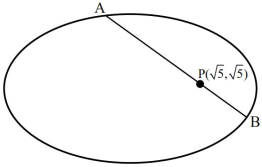
A line passing through the point $P (\sqrt{5}, \sqrt{5})$ intersects the ellipse $\frac{ x ^2}{36}+\frac{ y ^2}{25}=1$ at $A$ and $B$ such that $(P A) .(P B)$ is maximum. Then $5\left(P A^2+P B^2\right)$ is equal to :
View full question & answer→MCQ 164 Marks
Let $A=\{-3,-2,-1,0,1,2,3$,$\} . Let ~R$ be a relation on A defined by $x R y$ if and only if $0 \leq x^2+2 y \leq 4$. Let $l$ be the number of elements in $R$ and $m$ be the minimum number of elements required to be added in $R$ to make it a reflexive relation. then $l+m$ is equal to
Answer(D). 18
$\begin{array}{l} A =\{-3,-2,-1,0,1,2,3\} \\ -2 y \leq x ^2 \leq 4-2 y \end{array}$
$\begin{array}{lll}y=-3 & 6 \leq x^2 \leq 10 & \Rightarrow x \in\{-3,3\} \\ y=-2 & 4 \leq x^2 \leq 8 & \Rightarrow x \in\{-2,2\} \\ y=-1 & 2 \leq x^2 \leq 6 & \Rightarrow x \in\{-2,2\} \\ y=0 & 0 \leq x^2 \leq 4 & \Rightarrow x \in\{-2,-1,0,1,2\} \\ y=1 & -2 \leq x^2 \leq 2 & \Rightarrow x \in\{-1,0,1\} \\ y=2 & -4 \leq x^2 \leq 0 & \Rightarrow x \in\{0\} \\ y=3 & -6 \leq x^2 \leq-2 & \Rightarrow \text { No } x-\text { Exist }\end{array}$
$
\begin{array}{l}
R=\{(-3,-3)(-3,3),(-2,-2)(-2,2)(-1,-2)(-1,2) \\
(0,-2)(0,-1)(0,0)(0,1)(0,2)(1,-1)(1,0)(1,1) \\
(2,0)\} \\
\therefore \ell=15
\end{array}
$
To make it reflexive we will add
$
\begin{array}{l}
\{(-1,-1),(2,2),(3,3)\} \quad \therefore m=3 \\
\therefore \ell+m=15+3=18
\end{array}
$
View full question & answer→MCQ 174 Marks
The sum of all rational terms in the expansion of $(2+\sqrt{3})^8$ is
Answer(D). 18817
$S=(2+\sqrt{3})^{\circ}$
For sum of rational terms
$
\begin{array}{l}
={ }^8 C_0(2)^8+{ }^8 C_2(2)^6 \cdot(\sqrt{3})^2+{ }^8 C_4(2)^4(\sqrt{3})^4 \\
\quad \quad+{ }^8 C_6(2)^2(\sqrt{3})^6+{ }^8 C_8(\sqrt{3})^8 \\
=2^8+28 \times 2^6 \cdot 3+70.2^4 \cdot 9+28.2^2 \cdot 27+81 \\
=256+5376+10080+3024+81 \\
=18817
\end{array}
$
View full question & answer→MCQ 184 Marks
Let $\alpha$ and $\beta$ be the roots of $x^2+\sqrt{3 x}-16=0$, and $\gamma$ and $\delta$ be the roots of $x^2+3 x-1=0$. If $P_n=\alpha^n+\beta^n$ and $Q_n=\gamma^n+\delta^n$, then $\frac{ P _{25}+\sqrt{3 P _{24}}}{2 P _{23}}+\frac{ Q _{25}- Q _{23}}{ Q _{24}}$ is equal to
View full question & answer→MCQ 194 Marks
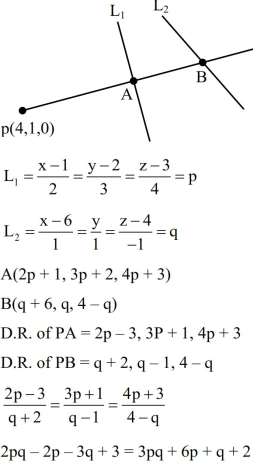
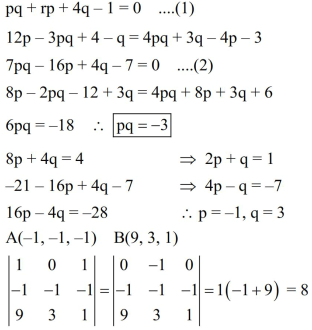
Let a line passing through the point $(4,1,0)$ intersect the line $L_1 ; \frac{x-1}{2}=\frac{y-2}{3}=\frac{z-3}{4}$ at the point $A \quad(\alpha, \beta, \quad \gamma)$ and the line $L_2: x-6=y=-z+4$ at the point $B(a, b, c)$.
Then $\left|\begin{array}{lll}1 & 0 & 1 \\ \alpha & \beta & \gamma \\ a & b & c \end{array}\right|$ is equal to
View full question & answer→MCQ 204 Marks
Let $A$ be a matrix of order $3 \times 3$ and $|A|=5$. If
$|2 \operatorname{adj}(3 A \operatorname{adj}(2 A))|=2^\alpha \cdot 3^\beta \cdot 5^\gamma \alpha, \beta, \gamma \in N$ then $\alpha+\beta+\gamma$ is equal to
Answer(C). 26
$\begin{array}{l}|2 \operatorname{adj}(3 A \operatorname{adj}(2 A))| \end{array}$
$\begin{array} 22^3 \cdot|3 A \operatorname{adj}(2 A)|^2 \end{array}$
$\begin{array} 22^3 \cdot\left(3^3\right)^2 \cdot|A|^2 \cdot|\operatorname{adj}(2 A)|^2 \end{array}$
$\begin{array} 2 2^3 \cdot 3^6 \cdot|A|^2 \cdot\left(|2 A|^2\right)^2 \end{array}$
$\begin{array} 22^3 \cdot 3^6 \cdot|A|^2\left[\left(2^3\right)^2 \cdot|A|^2\right]^2 \end{array}$
$\begin{array} 22^3 \cdot 3^6 \cdot|A|^2 \cdot 2^{12} \cdot|A|^4 \end{array}$
$\begin{array} 22^{15} \cdot 3^6 \cdot|A|^6 \end{array}$
$\begin{array} 22^{15} \cdot 3^6 \cdot 5^6=2^\alpha \cdot 3^\beta \cdot 5^\gamma \end{array}$
$\begin{array} \ \alpha=15, \quad \beta=6, \quad \gamma=6 \end{array}$
$\begin{array} \ \alpha+\beta+\gamma=27\end{array}$
View full question & answer→