MCQ
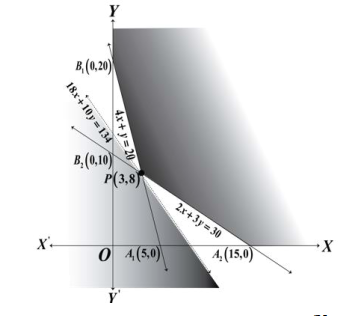
A linear programming problem (LPP) along eith the graph of its constraints is shown below.The correspondig objective function is :Z = 18x + 10y which has to be minimized. The smallest value of the objective function Z is 134 and is obtained at the corner point (3,8).
Image
The optimal solution of the above linear programming problem_______________.
  • A
    does not exist as the feasible region is unbounded.
  • B
    does not exist as the inequality 18x + 10y < 134 does not have any point in common with the feasible region.
  • C
    exists as the inequality 18x + 10y > 134 has infinitely many points in common with the feasible region.
  • D
    exists as the inequality 18x + 10y < 134 does not have any point in common with the feasible region.

Answer

Since the inequality Z = 18x + 10y < 134 has no point in common with the feasible region hence the minimum value of the objective function Z = 18x + 10y is 134 at P(3,8).

Need a full question paper?

Generate a complete, print-ready paper with questions like this in minutes — across 16+ boards, with answer keys.

Start Generating Free

Similar questions

ox, oy are positive x-axis, positive y-axis respectively where O = (0, 0,0) The d.c.s of the llne which bisects $\angle\text{xoy}$ are:
if $\int_{- a }^{ a }(| x |+| x -2| d x =22,( a >2)$ and $[ x ]$ denotes the greatest integer $\leq x ,$ then $\int_{ a }^{- a }( x +[ x ]) d x$ is equal to ...........
The function $S(x) =\int\limits_0^x {\sin \left( {\frac{{\pi {t^2}}}{2}} \right)\,dt} $ has two critical points in the interval $[1, 2.4]$. One of the critical points is a local minimum and the other is a local maximum. The local minimum occurs at $x =$
On the interval $I = [- 2, 2]$, the function

$f(x) =$ $\left\{ {\begin{array}{*{20}{c}}   {(x\, + \,1)\,\,{e^{ - \,\left[ {\tfrac{1}{{|x|}}\,\, + \,\,\tfrac{1}{x}} \right]}}}&{(x\,\, \ne \,\,0)} \\    {0\,\,\,\,\,\,\,\,\,\,\,\,\,\,\,\,\,\,\,\,\,\,\,\,\,\,\,\,\,}&{(x\,\, = \,\,0)} \end{array}} \right.$

then which one of the following does not hold good ?

Assume that in a family, each chold is equally likely to be a boy or a girl. A family with tree cgildren is chosen at random. Tere probability that the eldest child is a girl given that the family has at least oe girl.
The value of $\frac{e^{-\frac{\pi}{4}}+\int \limits_0^{\frac{\pi}{4}} e^{-x} \tan ^{50} x d x}{\int \limits_0^{\frac{\pi}{4}} e^{-x}\left(\tan ^{49} x+\tan ^{51} x\right) d x}$ is
If ${\tan ^{ - 1}}2x + {\tan ^{ - 1}}3x = \frac{\pi }{4}$, then $x =$
If a line makes angle $\alpha,\beta$ and $\gamma$ with the axes respectively, then $\cos2\alpha+\cos2\beta+\cos2\gamma=$
If $f(x) = \cos (\log x)$, then $f(x)f(y) - \frac{1}{2}[f(x/y) + f(xy)] = $
Let $f:\left[ {0,2} \right] \to R$ be a twice differentiable function such that $f''\left( x \right) > 0$, for all $x \in \left( {0,2} \right)$. If $\phi \left( x \right) = f\left( x \right) + f\left( {2 - x} \right)$, then $\phi $ is