MCQ 11 Mark
A student observes an open-air Honeybee nest on the branch of a tree, whose plane figure is parabolic shape given by $x^2=4 y$ .Then the area (in sq units) of the region bounded by parabola $x^2=4 y$ and the line y = 4 is
- A
$\frac{32}{3}$
- B
$\frac{64}{3}$
- C
$\frac{128}{3}$
- D
$\frac{256}{3}$
AnswerThe required region is symmetric about the $y$-axis.
So, required area (in sq units) is $=\left|2 \int_0^4 2 \sqrt{y} d y\right|=4\left[\frac{y^{\frac{3}{2}}}{\frac{3}{2}}\right]_0^4=\frac{64}{3}$.
View full question & answer→MCQ 21 Mark
The function f : R → Z defined by$f(x)=[x]$; where $[$.$]$ denotes the greatest integer function, is
- A
Continuous at x = 2.5 but not differentiable at x = 2.5
- B
Not Continuous at x = 2.5 but differentiable at x = 2.5
- C
Not Continuous at x = 2.5 and not differentiable at x = 2.5
- D
Continuous as well as differentiable at x = 2.5
AnswerThe graph of the function $f: R \rightarrow R$ defined by $f(x)=[x]$; (where[.]denotes G.I.F ) is a straight continuous and differentiable at $x = 2 . 5$.
View full question & answer→MCQ 31 Mark
A linear programming problem (LPP) along eith the graph of its constraints is shown below.The correspondig objective function is :Z = 18x + 10y which has to be minimized. The smallest value of the objective function Z is 134 and is obtained at the corner point (3,8).
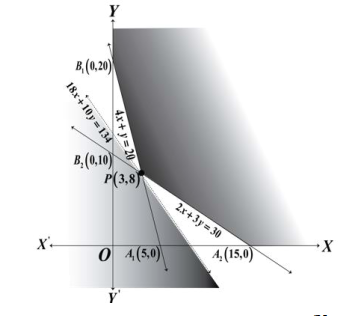
The optimal solution of the above linear programming problem_______________.
- A
does not exist as the feasible region is unbounded.
- B
does not exist as the inequality 18x + 10y < 134 does not have any point in common with the feasible region.
- C
exists as the inequality 18x + 10y > 134 has infinitely many points in common with the feasible region.
- D
exists as the inequality 18x + 10y < 134 does not have any point in common with the feasible region.
AnswerSince the inequality Z = 18x + 10y < 134 has no point in common with the feasible region hence the minimum value of the objective function Z = 18x + 10y is 134 at P(3,8).
View full question & answer→MCQ 41 Mark
The graph drawn below depicts
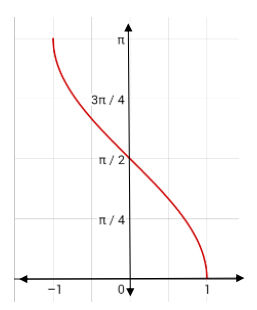
AnswerThe graph represents $y =\cos ^{-1} x$ whose domain is $[- 1 , 1 ]$ and range is $[ 0 , \pi]$.
View full question & answer→MCQ 51 Mark
What is the general solution of the differential equation $e ^{ y ^{\prime}}= x ?$
- A
$y=x \log x+c$
- ✓
$y=x \log x-x+c$
- C
$y=x \log x+x+c$
- D
$y=x+c$
AnswerCorrect option: B. $y=x \log x-x+c$
The given differential equation $e^{y^{\prime}}=x$
$\Rightarrow \frac{d y}{d x}=\log x$
$ d y=\log x d x$
$\Rightarrow\int d y=\int \log x d x$
$y=x \log x-x+c$
hence the correct option is $(B).$
View full question & answer→MCQ 61 Mark
$\int_0^{2 \pi} \operatorname{cosec}^7 x d x=$
AnswerWe know, $\int_0^{2 a} f(x) d x=0$, if $f(2 a-x)=-f(x)$
Let $f(x)=\operatorname{cosec}^7 x$
Now, $f(2 \pi-x)=\operatorname{cosec}^7(2 \pi-x)=-\operatorname{cosec}^7 x=-f(x)$
$\therefore \int_0^{2 \pi} \operatorname{cosec}^7 x d x=0 ;$ Using the property $\int_0^{2 a} f(x) d x=0$, if $f(2 a-x)=-f(x)$
View full question & answer→MCQ 71 Mark
$\int \frac{d x}{x^3\left(1+x^4\right)^{\frac{1}{2}}} \quad$ equals
- A
$-\frac{1}{2 x^2} \sqrt{1+x^4}+c$
- ✓
$\frac{1}{2 x} \sqrt{1+x^4}+c$
- C
$-\frac{1}{4 x} \sqrt{1+x^4}+c$
- D
$\frac{1}{4 x^2} \sqrt{1+x^4}+c$
AnswerCorrect option: B. $\frac{1}{2 x} \sqrt{1+x^4}+c$
$\int \frac{d x}{x^3\left(1+x^4\right)^{\frac{1}{2}}}=\int \frac{d x}{x^5\left(1+\frac{1}{x^4}\right)^{\frac{1}{2}}}$
$\left(\text { Let } 1+x^{-4}=1+\frac{1}{x^4}=t, d t=-4 x^{-5} d x=-\frac{4}{x^5} d x \Rightarrow \frac{d x}{x^5}=-\frac{1}{4} d t \text { ) }\right.$
$=-\frac{1}{4} \int \frac{d t}{t^{\frac{1}{2}}}=-\frac{1}{4} \times 2 \times \sqrt{t}+c,$
where $'c\ '$ denotes any arbitrary constant of integration.
$=-\frac{1}{2} \sqrt{1+\frac{1}{x^4}}+c$
View full question & answer→MCQ 81 Mark
For the linear programming problem $\text{(LPP),}$ the objective function is $Z= 4x+3y$ and the feasible region determined by a set of constraints is shown in the graph:
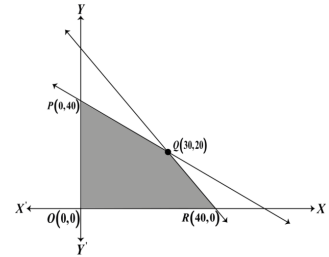
Which of the following statements is true? - A
Maximum value of $Z$ is at $R(40, 0)$
- ✓
Maximum value of $Z$ is at $Q(30, 20)$
- C
Value of $Z$ at $R(40, 0)$ is less than the value at $P(0,40)$
- D
The value of $Z$ at $Q(30, 20)$ is less than the value at $R(40, 0)$
AnswerCorrect option: B. Maximum value of $Z$ is at $Q(30, 20)$
| Corner point |
Value of the objective function $Z = 4x + 3y$ |
| $1. O(0, 0)$ |
$z = 0$ |
| $2. R(40, 0)$ |
$z = 160$ |
| $3. Q(30,20)$ |
$z = 120 + 60 = 180$ |
| $4. P(0,40)$ |
$z = 120$ |
Since, the feasible region is bounded so the maximum value of the objective function $z = 180$ is at $Q(30, 20)$ View full question & answer→MCQ 91 Mark
If $|\vec{a}|=3,|\vec{b}|=4$ and $|\vec{a}+\vec{b}|=5$, then $|\vec{a}-\vec{b}|=$
View full question & answer→MCQ 101 Mark
The value of $\alpha$ if the angle between $\vec{p}=2 \alpha^2 \hat{\imath}-3 \alpha \hat{\jmath}+\hat{k}$ and $\vec{q}=\hat{\imath}+\hat{\jmath}+\alpha \hat{k}$ is obtuse, is
- A
- B
- C
$[0, \infty)$
- D
$[1, \infty)$
AnswerFor obtuse angle, $\cos \theta<0=>\vec{p} \cdot \vec{q}<0$
$2 \alpha^2-3 \alpha+\alpha<0 \Rightarrow 2 \alpha^2-2 \alpha<0 \Rightarrow \alpha\in(0,1)$
View full question & answer→MCQ 111 Mark
For any two events $A$ and $B,$ if $P(\bar{A})=\frac{1}{2}, P(\bar{B})=\frac{2}{3}$ and $P(A \cap B)=\frac{1}{4}$, then $P(\bar{A} / \bar{B})$ equals:
- A
$\frac{3}{8}$
- B
$\frac{8}{9}$
- ✓
$\frac{5}{8}$
- D
$\frac{1}{4}$
AnswerCorrect option: C. $\frac{5}{8}$
$P(\bar{A})=\frac{1}{2} ; P(\bar{B})=\frac{2}{3} ; P(A \cap B)=\frac{1}{4}$
$\Rightarrow P(A)=\frac{1}{2} ; P(B)=\frac{1}{3}$
Wehave, $P(A \cup B)=P(A)+P(B)-P(A \cap B)$
$=\frac{1}{2}+\frac{1}{3}-\frac{1}{4}$
$=\frac{7}{12}$
$P\left(\frac{\bar{A}}{\bar{B}}\right)$
$=\frac{P(\bar{A} \cap \bar{B})}{P(\bar{B})}$
$=\frac{P \overline{(A \cup B)}}{P(\bar{B})}$
$=\frac{1-P(A \cup B)}{P(\bar{B})}$
$=\frac{1-\frac{7}{12}}{\frac{2}{3}}$
$=\frac{5}{8} .$
View full question & answer→MCQ 121 Mark
If $A=\left[\begin{array}{ccc}0 & 1 & c \\ -1 & a & -b \\ 2 & 3 & 0\end{array}\right]$ is a skew-symmetric matrix then the value of a + b + c =
View full question & answer→MCQ 131 Mark
If the points $\left(x_1, y_1\right),\left(x_2, y_2\right)$ and $\left(x_1+x_2, y_1+y_2\right)$ are collinear, then $x_1 y_2$ is equal to
- ✓
$x_2 y_1$
- B
$x_1 y_1$
- C
$x_2 y_2$
- D
$x_1 x_2$
AnswerCorrect option: A. $x_2 y_1$
Method $1 : ($ Short cut$)$
When the points $\left(x_1, y_1\right),\left(x_2, y_2\right)$ and $\left(x_1+x_2, y_1+y_2\right)$ are collinear in the Cartesian plane then
$\left|\begin{array}{cc}x_1-x_2 y_1-y_2 \\x_1-\left(x_1+x_2\right) y_1-\left(y_1+y_2\right. \end{array}\right|=0$
$ \Rightarrow\left|\begin{array}{cc} x_1-x_2 y_1-y_2 \\-x_2 -y_2 \end{array}\right|$
$=\left(-x_1 y_2+x_2 y_2+x_2 y_1-x_2 y_2\right)=0 $
$\Rightarrow x_2 y_1=x_1 y_2 $
Method $2$ :
When the points $\left(x_1, y_1\right),\left(x_2, y_2\right)$ and $\left(x_1+x_2, y_1+y_2\right)$ are collinear in the Cartesian plane then
$\left|\begin{array}{ccc}x_1 & y_1 & 1 \\ x_2 & y_2 & 1 \\ x_1+x_2 & y_1+y_2 & 1\end{array}\right|=0$
When the matrix $A$ is skew symmetric then $A^T=-A$
$ \Rightarrow a_j=-a_j$
$\Rightarrow c=-2 ; a=0 $ and $ b=3$
So, $a+b+c=0+3-2=1$.
View full question & answer→MCQ 141 Mark
The value of 'n', such that the differential equation $x^n \frac{d y}{d x}=y(\log y-\log x+1) ;$ (where $x, y \in R^{+}$) is homogeneous,is
AnswerA differential equation of the form $\frac{d y}{d x}=f(x, y)$ is said to be homogeneous, if $f(x, y)$ is a homogeneous function of degree 0.
Now, $x^n \frac{d y}{d x}=y\left(\log _e \frac{y}{x}+\log _e e\right) \Rightarrow \frac{d y}{d x}=\frac{y}{x^n}\left(\log _e e \cdot\left(\frac{y}{x}\right)\right)=f(x, y) ;($ Let $)\cdot f(x, y)$ will be a homogeneous function of degree 0, if n = 1
View full question & answer→MCQ 151 Mark
If A and B are non-singular matrices of same order with det(A) = 5, then $\operatorname{det}\left(B^{-1} A B\right)^2$ is is equal to.
Answer$|A|=5,\left|B^{-1} A B\right|^2=\left(\left|B^{-1} \| A\right||B|\right)^2=|A|^2=5^2$
View full question & answer→MCQ 161 Mark
The interval in which the function f defined by $f(x)=e^x$ is strictly increasing, is
- A
$[1, \infty)$
- B
$(-\infty, 0)$
- C
$(-\infty, \infty)$
- D
$(0, \infty)$
Answer$y=e^x=>\frac{d y}{d x}=e^x$
In the domain (R) of the function.$\frac{d y}{d x}>0$,hence the function is strictly increasing in $(-\infty, \infty)$
View full question & answer→MCQ 171 Mark
Assume X, Y, Z, W and P are matrices of order $2 \times n, 3 \times k, 2 \times p, n \times 3$ and $p \times k$ respectively. Then the restriction on n, k and p so that PY + WY will be defined are:
View full question & answer→MCQ 181 Mark
If for a square matrix A, A.(adjA) $=\left[\begin{array}{ccc}2025 & 0 & 0 \\ 0 & 2025 & 0 \\ 0 & 0 & 2025\end{array}\right]$ then the value of $|A|+|a d j A |$ is equal to.
- A
- B
- C
$(2025)^2+45$
- D
$2025+(2025)^2$
AnswerFor a square matrix A of order nn we have $A \cdot(\operatorname{adj} A)=|A| I_n$, where $I_n$ is the identity matrix of order n x n
So, $A \cdot(\operatorname{adj} A)=\left[\begin{array}{ccc}2025 & 0 & 0 \\ 0 & 2025 & 0 \\ 0 & 0 & 2025\end{array}\right]=2025 I_3 \quad \Rightarrow|A|=2025 \quad \& \quad|a d j A|=|A|^{3-1}=(2025)^2$
$\therefore|A|+\mid$ adj $A \mid=2025+(2025)^2$.
View full question & answer→