MCQ
A liquid drop of diameter $D$ breaks into $27$ tiny drops. The change in energy is
  • $2\pi \,TD^2$
  • B
    $4\pi \,TD^2$
  • C
    $\pi \,TD^2$
  • D
    None of these

Answer

Correct option: A.
$2\pi \,TD^2$
a
$\Delta SE = 4\pi R^2T\,\,(n^{1/3}-1)$

             $= 4\pi \frac {D^2}{4}T [(27)^{1/3}-1] = 2\pi D^2T$

Need a full question paper?

Generate a complete, print-ready paper with questions like this in minutes — across 16+ boards, with answer keys.
Start Generating Free

Similar questions

The maximum static frictional force is
Two stones are projected with the same speed but making different angles with the horizontal. Their ranges are equal. If the angle of projection of one is $\pi /3$ and its maximum height is $h_1$ then the maximum height of the other will be
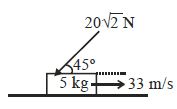
A block of mass $5\, kg$ is kept on a rough horizontal floor. It is given a velocity $33\, m/s$ towards right. A force of $20\sqrt {2\,} \,N$ continuously acts on the block as shown in the figure. If the coefficient of friction between block and floor is $0.5$ the velocity of block after $3\, seconds$ is ........ $m/s$  ($g = 10\, m/s^2$)
A gas is contained in a metallic cylinder fitted with a piston. The piston is suddenly moved in to compress the gas and is maintained at this position. As time passes the pressure of the gas in the cylinder:
  1. Increases.
  2. Decreases.
  3. Remains constant.
  4. Increases or decreases depending on the nature of the gas.
The horizontal range of a projectile is $4\sqrt 3 $ times its maximum height. Its angle of projection will be    ......... $^o$
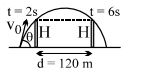
A projectile crosses two walls of equal height $H$ symmetrically as shown  The time of flight $T$ is given by  ........ $\sec$
______ of a two particle system depends only on the separation between the two particles. The most appropriate choice for the blank space in the above sentence is:
  1. Kinetic energy.
  2. Total mechanical energy.
  3. Potential energy.
  4. Total energy.
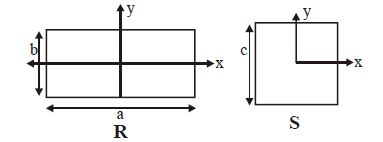
A uniform square plate $S$ (side $c$) and a uniform rectangular plate $R$ (sides $b$, $a$) ($a > b$) have identical areas and masses figure. Which of the following is correct

$(a)\ I_{xR}/I_{xS} <1;\  (b)\ I_{yR}/I_{yS}  >1; \  (c)\ I_{zR}/I_{zS} >1$
When a body is placed on a rough plane inclined at an angle $\theta $ to the horizontal, its acceleration is
$A$ block of mass $m$ slides down a plane inclined at an angle $\theta$ . Which of the following will $NOT$ increase the energy lost by the block due to friction?