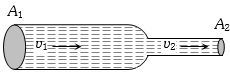
A liquid flows in a tube from left to right as shown in figure. ${A_1}$ and ${A_2}$ are the cross-sections of the portions of the tube as shown. Then the ratio of speeds ${v_1}/{v_2}$ will be
Medium
Download our app for free and get started
(b) $\overrightarrow {\frac{{\Delta v}}{{\Delta t}}} = \frac{{{A_1}{v_1}\Delta t}}{{\Delta t}} = \frac{{\overrightarrow {\Delta v} }}{{\Delta t}} = \frac{{{A_2}{v_2}\Delta t}}{{\Delta t}}$
${A_1}{v_1} = {A_2}{v_2}$
${A_1}{v_1} = {A_2}{v_2}$
${A_1}{v_1} \subset {A_2}{v_2}$
$A_2/A_1$

Download our appand get started for free
Experience the future of education. Simply download our apps or reach out to us for more information. Let's shape the future of learning together!No signup needed.*
Similar Questions
- 1A silver ingot weighing $2.1 kg$ is held by a string so as to be completely immersed in a liquid of relative density $0.8$. The relative density of silver is $10.5$ . The tension in the string in $kg-wt$ isView Solution
- 2A container of height $10\, cm$ is filled with water. There is a hole at bottom. Find the pressure difference between points at top and bottom.View Solution
- 3View SolutionThe property of a liquid by which it opposes the flow of itself is called ..........
- 4At what speed, the velocity head of water is equal to pressure head of $40 \,cm$ of mercury is ........ $m / s$View Solution
- 5Water is flowing with a velocity of $2\,m/s$ in a horizontal pipe where cross-sectional area is $2 \times 10^{-2}\, m^2$ at pressure $4 \times 10^4\, pascal$. The pressure at cross-section of area $0.01\, m^2$ in pascal will beView Solution
- 6A tiny spherical oil drop carrying a net charge $q$ is balanced in still air with a vertical uniform electric field of strength $\frac{81 \pi}{7} \times 10^5 \mathrm{Vm}^{-1}$. When the field is switched off, the drop is observed to fall with terminal velocity $2 \times 10^{-3} \mathrm{~ms}^{-1}$. Given $\mathrm{g}=9.8 \mathrm{~ms}^{-2}$, viscosity of the air $=1.8 \times 10^{-5} \mathrm{Ns} \mathrm{m}^{-2}$ and the density of oil $=$ $900 \mathrm{~kg} \mathrm{~m}^{-3}$, the magnitude of $\mathrm{q}$ isView Solution
- 7By sucking through a straw, a student can reduce the pressure in his lungs to $750\, mm\, of\, Hg$ (density $= 13.6\, gm/cm^3$). Using the straw, he can drink water from a glass upto a maximum depth of ....... $cm$View Solution
- 8A long cylindrical vessel is half filled with a liquid. When the vessel is rotated about its own vertical axis, the liquid rises up near the wall. If the radius of vessel is $5\,cm$ and its rotational speed is $2$ rotations per second, then the difference in the heights between the centre and the sides, in $cm,$ will beView Solution
- 9Water is flowing through a horizontal tube having cross-sectional areas of its two ends being $A$ and $A'$ such that the ratio $A/A'$ is $5$ છે.જો If the pressure difference of water between the two ends is $3 \times 10^5\, N\, m^{-2}$, the velocity of water with which it enters the tube will be ......... $m s^{-1}$ (neglect gravity effects)View Solution
- 10View SolutionWater coming out of the mouth of a tap and falling vertically in streamline flow forms a tapering column, i.e., the area of cross-section of the liquid column decreases as it moves down. Which of the following is the most accurate explanation for this