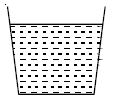
At what speed, the velocity head of water is equal to pressure head of $40 \,cm$ of mercury is ........ $m / s$
Medium


Download our appand get started for free
Experience the future of education. Simply download our apps or reach out to us for more information. Let's shape the future of learning together!No signup needed.*
Similar Questions
- 1A nurse measures the blood pressure of a seated patient to be $190 \,mm$ of $Hg$.View Solution
- 2A liquid flows through a horizontal tube. The velocities of the liquid in the two sections, which have areas of cross-section ${A_1}$ and ${A_2}$, are ${v_1}$ and ${v_2}$ respectively. The difference in the levels of the liquid in the two vertical tubes is $ h$View Solution
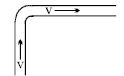
- 3A fire hydrant delivers water of density $\rho $ at a volume rate $L$. The water travels vertically upward through the hydrant and then does $90^o$ turn to emerge horizontally at speed $V$. The pipe and nozzle have uniform cross-section throughout. The force exerted by the water on the corner of the hydrant isView Solution
- 4A small ball of mass $M$ and density $\rho$ is dropped in a viscous liquid of density $\rho_0$. After some time, the ball falls with a constant velocity. What is the viscous force on the ball ?View Solution
- 5Different physical quantities are given in Column - $\mathrm{I}$ and their dimensional formula are given in Column - $\mathrm{II}$. Match them appropriately.View Solution
Column - $\mathrm{I}$ Column - $\mathrm{II}$ $(a)$ Viscous force $(i)$ $\left[ {{M^1}{L^1}{T^{ - 2}}} \right]$ $(b)$ Coefficient of viscosity $(ii)$ $\left[ {{M^1}{L^{ - 1}}{T^{ - 1}}} \right]$ $(iii)$ $\left[ {{M^1}{L^{ - 1}}{T^{ - 2}}} \right]$ - 6A load of mass $M\,kg$ is suspended from a steel wire of length $2\,m$ and radius $1.0\,mm$ in Searle’s apparatus experiment. The increase in length produced in the wire is $4.0\,mm.$ Now the load is fully immersed in a liquid of relative density $2$. The relative density of the material of load is $8$. The new value of increase in length of the steel wire is ........ $mm$View Solution
- 7Two cylindrical vessels of equal cross-sectional area $16\,cm ^{2}$ contain water upto herghts $100\,cm$ and $150\,cm$ respectively. The vessels are interconnected so that the water levels in them become equal. The work done by the force of gravity during the process, is $......J$ [Take density of water $=10^{3}\,kg / m ^{3}$ and $g =10\,ms ^{-2}$ ]View Solution
- 8A beaker containing water is placed on the platform of a spring balance. The balance reads $1.5$ $kg$. A stone of mass $0.5$ $kg$ and density $500$ $kg/m^3$ is immersed in water without touching the walls of beaker. What will be the balance reading now ? ..... $kg$View Solution
- 9An incompressible fluid flows steadily through a cylindrical pipe which has radius $2r$ at point $A $ and radius $r $ at $B $ further along the flow direction. If the velocity at point $A$ is $v, $ its velocity at point $B$ isView Solution
- 10A liquid of mass $1$ $kg$ is filled in a flask as shown in figure. The force exerted by the flask on the liquid is $(g = 10\ m/s^2)$[Neglect atmospheric pressure]:View Solution