A load of $2 \,kg$ produces an extension of $1 \,mm$ in a wire of $3 \,m$ in length and $1 \,mm$ in diameter. The Young's modulus of wire will be $.......... Nm ^{-2}$
Easy
Download our app for free and get started
We know
$\frac{\text { Force } \times \text { Length }}{\text { Area of cross-section } \times \text { elongation }}=$ Young's Modulus
$\frac{F \times L}{A \times \Delta L}=Y$ $\left\{\begin{array}{l}F=2 \times 10 N , A=\pi \times(1 / 2)^2 \times 10^{-6} \,m ^2 \\ L=3 \,m \quad, \Delta L=1 \times 10^{-3} \,m \end{array}\right\}$
Substituting values
$\frac{20 \times 3}{\pi \times \frac{1}{4} \times 10^{-6} \times 1 \times 10^{-3}}=Y$
$\frac{20 \times 3 \times 4}{3.14 \times 10^{-9}}=Y$
$7.48 \times 10^{10} \,Nm ^{-2}=Y$
$\frac{\text { Force } \times \text { Length }}{\text { Area of cross-section } \times \text { elongation }}=$ Young's Modulus
$\frac{F \times L}{A \times \Delta L}=Y$ $\left\{\begin{array}{l}F=2 \times 10 N , A=\pi \times(1 / 2)^2 \times 10^{-6} \,m ^2 \\ L=3 \,m \quad, \Delta L=1 \times 10^{-3} \,m \end{array}\right\}$
Substituting values
$\frac{20 \times 3}{\pi \times \frac{1}{4} \times 10^{-6} \times 1 \times 10^{-3}}=Y$
$\frac{20 \times 3 \times 4}{3.14 \times 10^{-9}}=Y$
$7.48 \times 10^{10} \,Nm ^{-2}=Y$

Download our appand get started for free
Experience the future of education. Simply download our apps or reach out to us for more information. Let's shape the future of learning together!No signup needed.*
Similar Questions
- 1View SolutionThe Bulk Modulus for an incompressible liquid is
- 2View SolutionIf Young's modulus for a material is zero, then the state of material should be
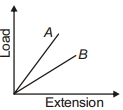
- 3In the given figure, if the dimensions of the two wires are same but materials are different, then Young's modulus is $ ........$View Solution
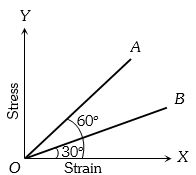
- 4The stress versus strain graphs for wires of two materials $A$ and $B$ are as shown in the figure. If ${Y_A}$ and ${Y_B}$ are the Young ‘s modulii of the materials, thenView Solution
- 5View SolutionThe material which practically does not show elastic after effect is
- 6The work done in increasing the length of a $1$ $metre$ long wire of cross-section area $1\, mm^2$ through $1\, mm$ will be ....... $J$ $(Y = 2\times10^{11}\, Nm^{-2})$View Solution
- 7A copper wire of length $1.0\, m$ and a steel wire of length $0.5\, m$ having equal cross-sectional areas are joined end to end. The composite wire is stretched by a certain load which stretches the copper wire by $1\, mm$. If the Young's modulii of copper and steel are respectively $1.0\times10^{11}\, Nm^{-2}$ and $2.0\times10^{11}\, Nm^{- 2}$, the total extension of the composite wire is ........ $mm$View Solution
- 8Let a wire be suspended from the ceiling (rigid support) and stretched by a weight $W$ attached at its free end. The longitudinal stress at any point of cross-sectional area $A$ of the wire is :View Solution
- 9A man grows into a giant such that his linear dimensions increase by a factor of $9$. Assuming that his density remains same, the stress in the leg will change by a factor ofView Solution
- 10The area of a cross-section of steel wire is $0.1\,\,cm^2$ and Young's modulus of steel is $2\,\times \,10^{11}\,\,N\,\,m^{-2}.$ The force required to stretch by $0.1\%$ of its length is ......... $N$.View Solution