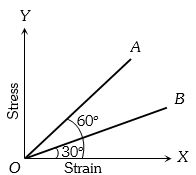
The stress versus strain graphs for wires of two materials $A$ and $B$ are as shown in the figure. If ${Y_A}$ and ${Y_B}$ are the Young ‘s modulii of the materials, then
Medium


Download our appand get started for free
Experience the future of education. Simply download our apps or reach out to us for more information. Let's shape the future of learning together!No signup needed.*
Similar Questions
- 1A thin $1 \,m$ long rod has a radius of $5\, mm$. A force of $50\,\pi kN$ is applied at one end to determine its Young's modulus. Assume that the force is exactly known. If the least count in the measurement of all lengths is $0.01\, mm$, which of the following statements is false ?View Solution
- 2How much force is required to produce an increase of $0.2\%$ in the length of a brass wire of diameter $0.6\, mm$ (Young’s modulus for brass = $0.9 \times {10^{11}}N/{m^2}$)View Solution
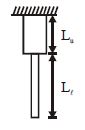
- 3A composite heavy rope of two materials is suspended vertically from a high ceiling. The ratios of different quantities for upper to lower rope are length $\frac{{{L_u}}}{{{L_l}}} = \frac{1}{2}$ , cross sectional area $\frac{{{A_u}}}{{{A_l}}} = \frac{2}{1}$ ,density $\frac{{{d_u}}}{{{d_l}}} = \frac{2}{3}$ .What is the ratio of maximum stress in the two ropesView Solution
- 4View SolutionIf the length of a wire is made double and radius is halved of its respective values. Then, the Young's modules of the material of the wire will :
- 5View SolutionThe following four wires are made of the same material. Which of these will have the largest extension when the same tension is applied?
- 6The elastic potential energy stored in a steel wire of length $20\,m$ stretched through $2 \,m$ is $80\,J$. The cross sectional area of the wire is $.........\,mm ^2$ (Given, $y =2.0 \times 10^{11}\,Nm ^{-2}$ )View Solution
- 7View SolutionIf the tension on a wire is removed at once, then
- 8If the temperature of a wire of length $2 \,m$ and area of cross-section $1 \,cm ^2$ is increased from $0^{\circ} C$ to $80^{\circ} C$ and is not allowed to increase in length, then force required for it is ............$N$ $\left\{Y=10^{10} \,N / m ^2, \alpha=10^{\left.-6 /{ }^{\circ} C \right\}}\right.$View Solution
- 9View SolutionThe compressibility of a material is
- 10If the volume of the given mass of a gas is increased four times, the temperature is raised from $27°C$ to $127°C.$ The elasticity will becomeView Solution