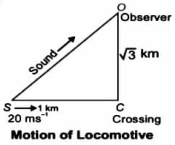
A locomotive approaching a crossing at a speed of $20 \,ms ^{-1}$ sounds a whistle of frequency $640 \,Hz$ when $1 \,km$ from the crossing. There is no wind and the speed of sound in air is $330 \,ms ^{-1}$. What frequency is heard by an observer $\sqrt{3} \,km$ on the straight road from the crossing at right angle ......... $Hz$
Medium
Download our app for free and get started
(c)
$\tan \theta=\frac{\sqrt{3}}{1}$
$0=60^{\circ}$
If at any instant the line joining moving source and stationary observer makes an angle $\theta$ with the direction of motion of source,
$f^{\prime}=f\left(\frac{c}{c-v \cos \theta}\right)$
Where $c$ is speed of sound and $v$ is speed of source
$f^{\prime}=640\left(\frac{330}{330-20 \cos 60^{\circ}}\right)=640\left(\frac{330}{320}\right)$
$f=660\,Hz$

Download our appand get started for free
Experience the future of education. Simply download our apps or reach out to us for more information. Let's shape the future of learning together!No signup needed.*
Similar Questions
- 1A wave equation which gives the displacement along $y-$direction is given by $y = 0.001\sin (100t + x)$ where $x$ and $y$ are in meterand t is time in second. This represented a waveView Solution
- 2Two sound waves having a phase difference of $60°$ have path difference ofView Solution
- 3View SolutionWhich of the following equations represents a travelling wave ?
- 4A body sends waves $100\, mm$ long through medium $A$ and $0.25\, m$ long in medium $B$. If the velocity of waves in medium $A$ is $80\, cms^{-1}$. The velocity fo waves in medium $B$ is .... $ms^{-1}$View Solution
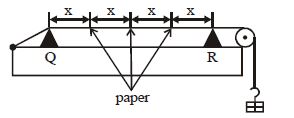
- 5The given diagram shows three light pieces of paper placed on a wire that is stretched over two supports, $Q$ and $R$ , a distance $4x$ apart. When the wire is made to vibrate at a particular frequency, all the pieces of paper, except the middle one, fall off the wire. Which of the following could be the wavelength of the vibration?View Solution
- 6A car $P$ travelling at $20\,ms ^{-1}$ sounds its horn at a frequency of $400\,Hz$. Another car $Q$ is travelling behind the first car in the same direction with a velocity $40\,ms ^{-1}$. The frequency heard by the passenger of the car $Q$ is approximately $.......\,Hz$ [Take, velocity of sound $=360\,ms ^{-1}$ ]View Solution
- 7The difference between the apparent frequency of a source of sound as perceived by an observer during its approach and recession is $2\%$ of the natural frequency of the source. If the velocity of sound in air is $300 \,m/sec,$ the velocity of the source is ... $m/sec$ (It is given that velocity of source $<<$ velocity of sound)View Solution
- 8A simple harmonic progressive wave is represented by the equation : $y = 8\sin 2\pi (0.1x - 2t)$ where $x$ and $y$ are in $cm$ and $t$ is in seconds. At any instant the phase difference between two particles separated by $2.0 \,cm$ in the $x-$direction is ..... $^o$View Solution
- 9In a wave motion $y = a\sin (kx - \omega t)$, $y$ can representView Solution
- 10View SolutionTwo waves having sinusoidal waveforms have different wavelengths and different amplitude. They will be having