MCQ
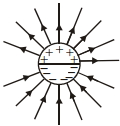
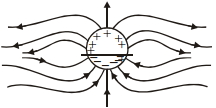
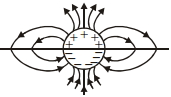
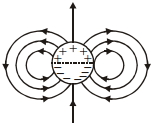
A long cylindrical shell carries positive surface charge $\sigma$ in the upper half and negative surface charge $-\sigma$ in the lower half. The electric field lines around the cylinder will look like figure given in : (figures are schematic and not drawn to scale)
  • A

  • B

  • C


Answer

Correct option: D.

d
Field lines originate perpendicualr from positive charge and terminate perpendicular at negative charge. Further this system can be treated as an electric dipole.

Need a full question paper?

Generate a complete, print-ready paper with questions like this in minutes — across 16+ boards, with answer keys.

Start Generating Free

Similar questions

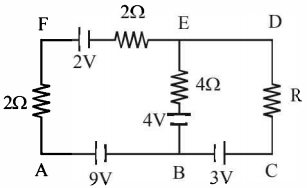
In the electric network shown, when no current flows through the $4 \Omega$ resistor in the arm EB, the potential difference between the points $A$ and $D$ will be $.............\,V$
Two lines of force due to a bar magnet
The decay constant of a radioactive element is $1.5 \times 10^{-9}$ per second. Its mean life in seconds will be
If the current is doubled, the deflection is also doubled in
The potential difference applied to an $X-$ ray tube is $5kV$ and the current through it is $3.2 mA$. Then the number of electrons striking the target per second is
A $10\,m$ long horizontal wire extends from North East to South West. It is falling with a speed of $5.0\,ms^{-1},$ at right angles to the horizontal component of the earth’s magnetic field, of $0.3\times 10^{-4}\,Wb/m^2$. The value of the induced $emf$ in wire is 
The number density of free electrons in copper is nearly $8 \times 10^{28}\,m ^{-3} . A$ copper wire has its area of cross section $=2 \times 10^{-6}\,m ^2$ and is carrying a current of $3.2\,A$. The drift speed of the electrons is $.....\times 10^{-6}\,ms ^{-1}$.
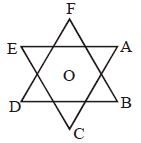
The magnitude of electric force on $2\, \mu \,C$ charge placed at the centre $O$ of two  equilateral triangles each of side $10 \,cm$, as shown in figure is $P$. If charge $A, B, C, D, E$ and $F$ are $2\, \mu \,C, 2\, \mu \,C, 2\, \mu \,C,-2\, \mu \,C, -2\, \mu \,C, -2\, \mu \,C$   respectively, then $P$ is :.....$N$
A plane electromagnetic wave is incident on a material surface. If the wave delivers momentum $p$ and energy $E$, then
In a nuclear reaction, which of the following is conserved