A long solenoid has $n$ turns per meter and current $I\, A$ is flowing through it. The magnetic field at the ends of the solenoid is
Easy


Download our appand get started for free
Experience the future of education. Simply download our apps or reach out to us for more information. Let's shape the future of learning together!No signup needed.*
Similar Questions
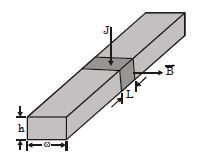
- 1Heart-lung machines and artifical kidney machines employ blood pumps. A mechanical pump can mangle blood cells.Figure represents an electromagnetic pump. The blood is confined to an electrically insulating tube, represented as a rectangle of width $\omega$ and height $h.$ Two electrodes fit into the top and the bottom of the tube. The potential difference between them establishes an electric current through the blood, with current density $J$ over a section of length $L.$ A perpendicular magnetic field exists in the same region. The section of liquid in the magnetic field experiences a pressure increase given by :-View Solution
- 2The coil in a moving coil Galvanometer experiences torque proportional to current passed through it. If a steady current $i$ is passed through it the deflection of the coil is found to be $90^o$ . Now the steady current is switched off and a charge $Q$ is suddenly passed through the coil. If the coil has $N$ turns of area $A$ each and its moment of inertia is $I$ about the axis it is going to rotate then the maximum angle through which it deflects upon passing $Q$ isView Solution
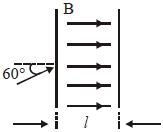
- 3The figure shows a region of length $'l'$ with a uniform magnetic field of $0.3\, T$ in it and a proton entering the region with velocity $4 \times 10^{5}\, ms ^{-1}$ making an angle $60^{\circ}$ with the field. If the proton completes $10$ revolution by the time it cross the region shown, $l$ is close to....... $m$View Solution
(mass of proton $=1.67 \times 10^{-27} \,kg ,$ charge of the proton $\left.=1.6 \times 10^{-19}\, C \right)$
- 4Two coaxial solenoids of different radii carry current $I$ in the same direction. Let $\;{\overrightarrow {\;F} _1}$ be the magnetic force on the inner solenoid due to the outer one and $\;{\overrightarrow {\;F} _2}$ be the magnetic force on the outer solenoid due to the inner one. ThenView Solution
- 5View SolutionAn electron is travelling in east direction and a magnetic field is applied in upward direction then electron will deflect in
- 6A beam of protons with speed $4 \times 10^{5}\, ms ^{-1}$ enters a uniform magnetic field of $0.3\, T$ at an angle of $60^{\circ}$ to the magnetic field. The pitch of the resulting helical path of protons is close to....$cm$View Solution
(Mass of the proton $=1.67 \times 10^{-27}\, kg$, charge of the proton $=1.69 \times 10^{-19}\,C$)
- 7Two particles $A$ and $B$ having equal charges $+6\,C$, after being accelerated through the same potential difference, enter in a region of uniform magnetic field and describe circular paths of radii $2\,cm$ and $3\,cm$ respectively. The ratio of mass of $A$ to that of $B$ isView Solution
- 8If the angular momentum of an electron is $\vec J$ then the magnitude of the magnetic moment will beView Solution
- 9Two parallel long wires carry currents $i_1$ and $i_2$ with ${i_1} > {i_2}$. When the currents are in the same direction, the magnetic field midway between the wires is $10\, \mu T$. When the direction of $i_2$ is reversed, it becomes $40 \,\mu T$. the ratio ${i_1}/{i_2}$ isView Solution
- 10View SolutionThe pole pieces of the magnet used in a pivoted coil galvanometer are