Question
A long, straight wire carries a current. Is Ampere's law valid for a loop that does not enclose the wire? That encloses the wire but is not circular?

Answer

Ampere's law is valid for a loop that is not circular. However, it should have some charge distribution in the area enclosed so as to have a constant electric field in the region and a non-zero magnetic field. Even if the loop defined does not have its own charge distribution but has electric influence of some other charge distribution, it can have some constant magnetic field $\big(\oint\overrightarrow{\text{B}}.\text{d}\overrightarrow{\text{l}}=\mu_0\text{i}\ \text{enclosed}\big).$

Need a full question paper?

Generate a complete, print-ready paper with questions like this in minutes — across 16+ boards, with answer keys.
Start Generating Free

Similar questions

Answer the following question:
Why must both the objective and the eyepiece of a compound microscope have short focal lengths?
In a Young's double experiment, the slits are 1.5 mm apart. When the slits are illuminated by a monochromatic light source and the screen is kept 1 m apart from the slits, width of 10 fringes is measured as 3.93 mm.
Calculate the wavelength of light used. What will be the width of 10 fringes when the distance between the slits and the screen is increased by 0.5 m. The source of light used remains the same.
Can we have magnetic hysteresis in paramagnetic or diamagnetic substances?
Suppose the frequency of the source in the previous example can be varied. (a) What is the frequency of the source at which resonance occurs? (b) Calculate the impedance, the current, and the power dissipated at the resonant condition.
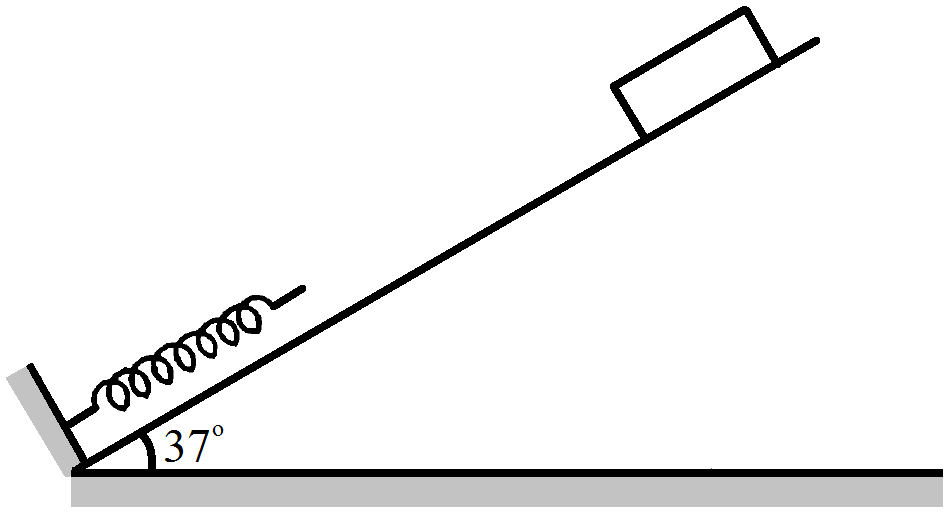
Figure shows a spring fixed at the bottom end of an incline of inclination 37°. A small block of mass 2kg starts slipping down the incline from a point 4.8m away from the spring. The block compresses the spring by 20cm, stops momentarily and then rebounds through a distance of 1m up the incline. Find.
  1. The friction coefficient between the plane and the block.
  2. The spring constant of the spring. Take g = 10m/s2.

A straight wire of length l can slide on two parallel plastic rails kept in a horizontal plane with a separation d. The coefficient of friction between the wire and the rails is $\mu.$ If the wire carries a current i, what minimum magnetic field should exist in the space in order to slide the wire on the rails?
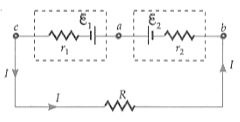
In Figure, $\varepsilon_1$ and $\varepsilon_2$ are respectively 2.0 V and 4.0 V and the resistances $r _1, r _2$ and R are respectively $1.0 \Omega$ $2.0 \Omega$ and $5.0 \Omega$. Calculate the current in the circuit. Also, calculate:
i. potential difference between the points b and a,
ii. potential difference between a and c.
Image
How many time constants will elapse before the current in a charging RC circuit drops to half of its initial value? Answer the same question for a discharging RC circuit.
Find the moment of inertia of a uniform square plate of mass m and edge a about one of its diagonals.
In a plot of photoelectric current versus anode potential, how does?

  1. The saturation current vary with anode potential for incident radiations of different frequencies but same intensity?
  2. The stopping potential vary for incident radiations of different intensities but same frequency?
  3. Photoelectric current vary for different intensities but same frequency of incident radiations?

Justify your answer in each case.